We went back through everything we published in this newsletter since the start of the year. Here are the five big ideas you should keep in mind, for a read before your holidays or to help you find new ideas as you come back from the summer break.
1 – The innovation ecosystem has moved from hype to rationalisation
Our trends report identified 36 trends shaping the future of food and agriculture. The conclusion was clear: innovation has not stopped, but many trends have moved beyond the excitement phase and entered a period of reality checks. Companies must now prove they have a path to profitability and can scale, all to gain combined regulatory and corporate support.
Contrary to many expectations, this shift is happening faster than anticipated. Faced with cash constraints, companies working in areas such as precision fermentation and cellular agriculture are adapting, often by targeting narrower, higher-value applications.
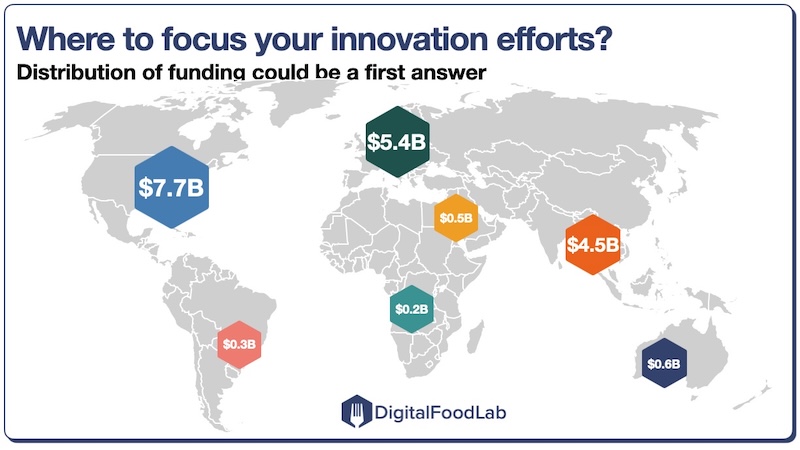
Funding continued to decline during the first half of 2026. Yet the ecosystem may be becoming healthier: more startups are working with large corporations, and acquisitions are creating credible exit paths. In the meantime, some technologies are moving closer to market readiness, and capital is concentrating on companies with the best chances of reaching the market.

For leading agrifood companies, this shift means that awareness is no longer enough. The challenge is to decide which trends deserve attention, which should be prioritised given their assets and ambitions, and how to turn them into a competitive advantage. The rise in corporate partnerships and investments since the start of the year suggests that many leading companies have understood this.
Read our insights on the topic:
- Download DigitalFoodLab’s trend report or watch our webinar covering the key takeaways.
- The end of excess: AgriFoodTech enters a new phase
- AgriFoodTech update in Q2 2026: cooling funding, warming signals
2 – Health is becoming the food industry’s new battleground
When asked what we are focusing on this year, the answer is straightforward: the intersection of food and health. Accelerated by the rapid adoption of GLP-1 drugs, healthy ageing has moved from an emerging consumer narrative to a strategic issue for food and ingredient companies. Earlier this year, we started defining this concept more precisely by mapping the categories it covers, the underlying innovation trends, and how large companies are responding.

As explained in past insights, corporate strategies remain highly uneven. Many companies are still without a clear vision of where they stand in a world of decreased consumption and with consumers seeking differentiation through healthy products.
The key question for every agrifood company remains: what role should food play in helping consumers live longer, healthier lives?
In the short term, there are many opportunities to seize, such as brands that address consumer needs with innovative ingredients and sugar alternatives to meet regulatory and consumer concerns.
Read our insights on the topic:
- The sugar-alternative landscape: what’s real, what’s hype and what to do about it
- Healthy ageing: is health the future of food?
- Longevity: from science to real-world strategy
3 – Emerging brands remain one of the clearest growth and exit opportunities
Danone’s €1 billion acquisition of Huel, Unilever’s $1.2 billion acquisition of Grüns, and the growing number of smaller deals illustrate a pattern we expect to see more often: large food companies using acquisitions to gain exposure to faster-growing consumer categories, notably those that provide health benefits.
Huel succeeded where many direct-to-consumer brands fail. It combined profitable online growth, retail expansion, internationalisation and product diversification without diluting its positioning.
For established food companies, emerging brands are not only competitors or sources of inspiration. They are becoming strategic growth platforms. Competition to identify, partner with or acquire the most promising ones will intensify.

Read our insights on the topic:
- Why do so many DTC brands’ M&A fail? DigitalFoodLab’s acquisition framework
- From DTC to a €1 billion exit: what Huel tells us about food innovation
4 – China may become the industrial engine of future food technologies
China has now formally identified synthetic biology, biomanufacturing and new protein sources as strategic priorities. The comparison with electric vehicles and solar panels is imperfect, but useful. Many of these technologies no longer require a scientific breakthrough as much as industrial optimisation, infrastructure and scale, areas where China has demonstrated its strength.
The future “BYD of food” may not be a consumer brand, but an industrial platform providing fermentation capacity, bioreactors, enzymes, functional proteins, biosolutions or agricultural robots.
For Western companies, the strategic question is uncomfortable but increasingly urgent: are they prepared to pay for a resilient, non-Chinese supply chain?
Read our insight on the topic: Is China building the BYD for food?
What matters for the second half of 2026?
The common thread across these insights is that FoodTech is becoming less noisy but more strategic. There is less funding and fewer startups, but more partnerships and more tangible results. This makes it more urgent for companies to set clear priorities and secure the right partners. Too many still run broad, unfocused open-innovation programmes designed to accommodate every possible opportunity.
The priority is therefore shifting from watching innovation to making choices:
- Which topics actually matter to us?
- Which capabilities should we build, buy or access through partnerships?
- Which companies should we engage with before the ecosystem consolidates further?
- And how do we turn these insights into decisions today?