We are glad to share with you the seventh edition of DigitalFoodLab’s report on trends shaping the future of Food. After more than a decade of hypes, disappointments and overall progress, the AgriFood innovation ecosystem is entering a new phase: less noise, fewer bold promises, but more results. This is a new phase for large companies, too. Ecosystem consolidation alone around key innovators is making the cost of ignoring innovation, or of being wrong, no longer marginal; it is becoming strategic.
The report identifies and analyses five megatrends and 36 trends. Collectively, they show that we are going through an inflexion point: from hype to rationalisation.

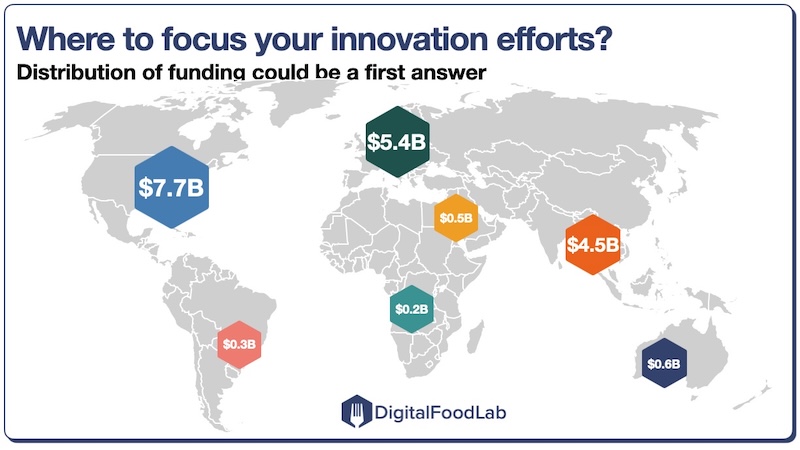
Even if funding for startups has declined, and as many large agrifood companies are struggling to find their way in the current context of economic uncertainties and heightened environmental shocks, innovation has not stopped, far from it. It may have become more selective and more constrained by reality, but fundamentals are strengthening: many trends are moving forward, driven by companies with a real path to scale and profitability. Large corporations are more engaged through commercialisation and scale-up deals, and valuations are more reasonable.
In a word, what we observe today is not the end of innovation, but its rationalisation and, in many ways, its implementation. In this new phase, the main risk for agrifood leaders is no longer missing innovation; it is misjudging when and where it becomes unavoidable.
Compared to the previous edition, there are some key evolutions:
- Healthy ageing is emerging: most ecosystems are still nascent, with few concrete applications, even though the industry’s appetite is strong.
- Sustainable ingredients: most of the underlying technologies (e.g., precision fermentation) are not yet ready to scale profitably and hence are undergoing a phase of disillusionment. Supposedly greater scalability is the main argument behind the rising trends (e.g. molecular farming).
- Ecosystems supporting the Resilient Farm megatrend are mostly doing well and moving forward, even if they face similar scalability challenges.
- A return to reason on artificial intelligence across all trends: it can reduce some costs, increase the speed of some processes, but it is mostly about finding incremental applications rather than a revolution.
This year, we have added an extra layer of analysis by introducing the Innovation Radar, which reveals the current industry’s level of engagement with each trend and its evolution. Indeed, in this new phase, scaling up and commercialisation will be supported in great part by incumbent leaders. We wanted to reflect how much they were invested (or not) in the different trends. As mentioned above, incumbents can’t remain spectators, and, as seen across the different category radars in the report, some companies are already taking the lead to sustain their market position or become tomorrow’s leaders in new markets.

Each trend’s success will be determined by its ability to find answers to the following three themes:
- Profitable scalability by finding short-term high-value applications (e.g. functional ingredients), support for industrialisation efforts, and then ramping up production to reach the mass market.
- Political support through incentives and forward-looking regulation. Political leaders must now act depending on where they want their country to stand on the future of food: a leader, a follower, or a laggard?
- Corporate engagement through partnerships, investments and eventually acquisitions: for companies, the core issue is no longer awareness; it is now about prioritising areas in which they want to be tomorrow’s leaders, by aligning strategy with their own assets and constraints. The same trend can represent an immediate opportunity for one player, and a distant signal for a third, depending on geography, portfolio, capabilities and time horizon.
This report reflects how DigitalFoodLab works with agrifood leaders: connecting high-level ecosystem insights to concrete strategic decisions. The future of food will not be shaped by those who follow hype cycles, but by those who understand where their innovation can become a lever of success and act before these choices become constrained.
We hope you’ll enjoy this report (available here). Also, we organise bespoke workshops to present the trends and discuss their implication on your businesses. If this is relevant to you, please reach out!