From DTC to €1B exit: what Huel tells us about food innovation

Published on March 24, 2026

Danone is acquiring Huel, the British meal replacement brand, in a €1B deal. The DTC (direct-to-consumer) is now joining the long list of successful startup food and beverage brands that have succeeded on their journey to stand out as an emerging venture, catching the eye of investors and early adopters alike, then (much harder) generating strong revenue growth, and finally getting the attention of a large CPG company.

Beyond this, the deal underscores the importance of emerging brands as a driver of growth for both CPG companies and the broader AgriFoodTech innovation ecosystem. And more specifically, this is also a story about the journey of a concept and how European companies can win.

1 – What is Huel?

Huel is a meal-replacement startup founded in 2014 in the UK. It offers a range of products marketed as “complete nutrition” that serve as substitutes for whole meals or snacks, from ready-to-drink (RTD) beverages to protein bars
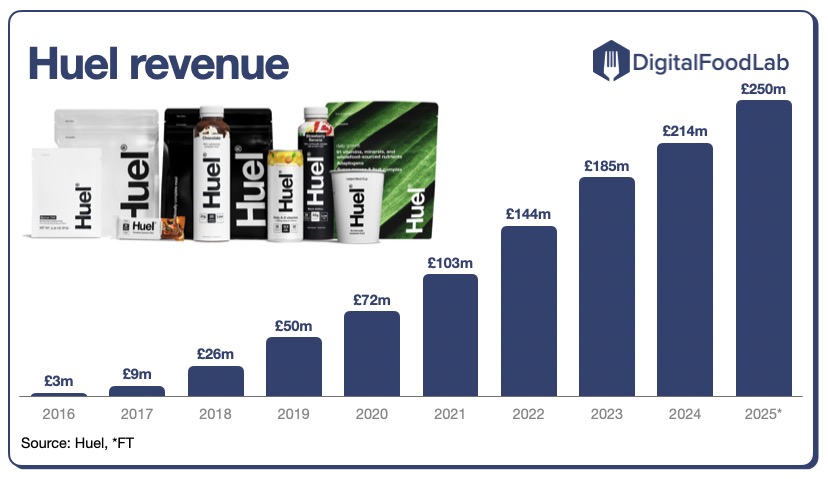
Huel-revenue-growth-DigitalFoodLab-chart

As displayed in the graph, revenue growth has been impressive over the past decade. It raised about £40m between its foundation in 2014 and 2022. In 2023, it raised £82.5M in a private equity deal, rumoured to be a step toward an IPO (a listing on public markets).

Compared to most brands, it has avoided what we call the “four horsemen of the F&B apocalypse” for a young brand, and which individually can kill an emerging brand:

  • Profitable online growth: most brands hit a glass ceiling when growing online and never reach profitability.
  • Brand expansion without dilution: while initially offering only a single product (RTD), the brand has expanded its product range and customer base. It successfully addressed the needs of busy people and markets, including sport/performance nutrition and weight loss. With its low-calorie solutions and promise of complete nutrition, it has become an ideal solution for GLP-1 drug users.
  • Channel growth: Huel is now available at multiple retailers across a selected range (RTD, bars), which is supporting its online sales and growth.
  • Internationalisation: it has successfully entered many markets beyond the UK, notably in continental Europe and in the US, where it is now a significant player.

2 – Is it a good deal for Danone, and what does it say about the broader brand/DTC market?

As recently highlighted in our latest insight on DTC brands and M&A, FMCG companies must evolve quickly, and internal growth alone won’t be enough. Looking at the examples of failures and the more limited set of successes, we shared DigitalFoodLab’s DTC acquisition framework. Let’s see how this deal fares against its six points:

DigitalFoodLab-Why-so-many-DTC-brands-MA-fail

1️⃣ Legitimacy: high, but not perfect. Huel has indeed evolved towards supplements recently (with an alternative to AG1) and fits well with Danone’s vision of health through nutrition. This also fits well with Danone’s recent acquisitions, including Kate Farms in medical nutrition, and the potential for Huel to benefit from this to improve its own scientific legitimacy. However, the deal runs counter to the current “anti-processing” trend, as meal replacement solutions are, by definition, highly

2️⃣ Integration: we don’t yet know the details of the plans or the speed of integration, but Danone has shown an ability to slowly integrate players in the past.

3️⃣ International validation: yes, and Huel is at a stage where more capital and the resources of a global FMCG player could help it.

4️⃣ Retail validation: yes, and similarly, it could be boosted.

5️⃣ Right timing: yes, as it was considering an IPO and potential other buyers.

6️⃣ Clear support, growth and exit plan: that we don’t know yet, and that will be the key to the years ahead.

3 – Other companies to follow and a great win for Europe

Huel is following another of our frameworks: the DTC copycat. Actually, it did better than all of the past examples:

  • Meal replacement, as a category, was “invented (if we forget about weight-loss products) by US players such as Solyent (founded in 2013).
  • Huel “imported” the concept into the UK and launched its first products in 2015. Then, others across Europe, notably Yfood (founded in Germany in 2017 and recently bought by Nestlé), copied the concept again.

What we can learn from this example, and many others like it, including gummies and coffee alternatives, is that there is a pattern where concepts emerge in the US and are heavily funded there. When they succeed, 2 to 4 years later, they are “ready” to expand in the UK and then across the rest of Europe. What is unique about Huel is that the copy has become much bigger than the original.

In a word, this is good news, especially for the European ecosystem, showing that the old continent can be good at creating food brands.

DigitalFoodLab-Emerging-brands-to-put-on-your-radar

As explained in our predictions for the year, we expect more acquisitions of brands, as food and beverage leaders are reinventing themselves. This is an example of a much larger trend. For companies to follow, you can look at DigitalFoodLab’s list of the most inspiring European AgriFoodTech startups, which includes Huel and a dozen other brands. Also, the chart above shows some of the Global DTC brands we consider the most exciting right now.

In practice, this means that beyond this (short) list, you have to screen these brands as a lever of insights and as potential targets. Spotting, analysing, and sorting them is one thing, but then deciding when to engage (and for what) is another. The question is then: will you spot them early enough, and know what to do with them?

You're in a good company

Join the 60+ clients of Digital FoodLab: leading agrifood companies, retailers, banks, investors, startups, and public organisations.

Use case: project for a global F&B company looking to map its AgTech innovation ecosystem and the best startups to partner with

What we did:

  • Mapping of the AgTech ecosystem: startups, research regulators, and other leading companies.
  • Discussion to select areas to focus on.
  • Analysis of the information to reveal the trends and a model to analyse eventual partners.
  • A workshop to validate the opportunities based on our recommendations.
  • Scouting of relevant partners followed by introductions.

Results:

  • Mapping the different categories of innovations in AgTech that should be considered now to create long-term benefits for the business.
  • Identification of key partners (an incubator and a couple of startups).

Use case: project for a CPG company on the healthy ageing ecosystem

What we did:

  • Education of the board through a couple of workshops to define the perimeter
  • Identification of key opportunities and threats created by long-term evolutions (technologies, business models, behavioural changes).
  • Deep dives on each of the priority categories.
  • Co-construction of a vision on how the company should address these challenges.
  • Identification of partners (startups, incubators, funds) to move forward.

Results:

  • Creating a consensus on which categories to prioritise and how to address them.
  • Implementation of an open innovation strategy through the development of partnerships.

Use case: project for a global CPG company to develop a strategy on the healthy ageing ecosystem

What we do (ongoing mission on a subscription model):

  • Kick-off where we present an overview of the AgriFoodTech ecosystem to select with the client the categories to cover and for each, the level of information required.
  • Monthly newsletter: each month we send a newsletter with the articles that we have gathered ranked by relevance, their summaries, and a layer of analysis.
  • Database: we set up a personalised database that will be filled month after month with the information gathered on the companies identified for the watch.
  • Workshops: twice a year with the client’s innovation team and other “innovation curious” team members, we present an overview of the evolutions, key trends and a dashboard of the topics followed by the watch.

Results:

  • A clear, regular and evolutive tool to follow what is happening in terms of innovation on key topics.
  • A forum (through the workshops) to discuss innovation trends and new opportunities.

Use case: opportunity screening for an ingredient company

What we did:

  • Kick-off to define the perimeter of the ecosystem studied.
  • Mapping of the different trends shaping the innovation ecosystem of the client.
  • Analysis of the trends on DigitalFoodLab’s trend curve and other relevant frameworks.
  • Workshop to discuss DigitalFoodLab’s recommendations on key trends to prioritise

Results:

  • Shared view of the innovation ecosystem for the client with a view of the trends to prioritize.
  • Clear document (personalised trend curve) that can be easily shared internaly to explain the company’s innovation choices and which can be then updated each year.

Use case: scouting for an agriculture coop

What we did:

  • Kick-off to define the perimeter of the client, the goals of the scouting (partnerships) and the criteria on which startups should be evaluated.
  • Set-up scouting: we selected the first batch of 20+ key startups following the criteria of the client.
  • On-going scouting: then we set up a quarterly scouting of about ten startups.
  • For each scouted startup, we created an ID card with key information such as the business and technological maturity, funding, and corporate partnerships. We also added an explanation of why we selected this startup.

Results:

  • An ongoing and evolutive scouting are matching the client's criteria and its capabilities in terms of deal flow.

Use case: working on an acquisition process for a CPG company

What we did:

  • Kick-off to define what the client is seeking, notably in terms of maturity.
  • Workshop with the client based on a mapping of the different innovation ecosystems adjacent to its activities to select some priorities and discuss inspiring examples of startup acquisition stories.
  • Identification of 20+ targets.
  • Workshop to select the most relevant to engage with.
  • DigitalFoodLab worked as a sparing partner during the acquisition process, notably to help design how the acquired startup could be integrated into the overall company’s strategy.

Results:

  • Different results from traditional M&A processes with a focus on the client’s innovation strategy.
  • Identification of a good match for an acquisition.

Use case: market due diligence on sugar alternatives

What we did:

  • Kick-off with the client to discuss its interest on this category, its expectations and existing level of information (notably on the target company).
  • Mapping of the ecosystem to analyse the different existing alternatives and technologies to compare them.
  • Interview (calls) with relevant startups made by our internal biotechnology expert.
  • Recommendation on whether to invest or not.

Results:

  • Clear view of the ecosystem and of the reasons to believe (or not) in each sub-category.
  • Enforceable recommendations based on facts and expertise.