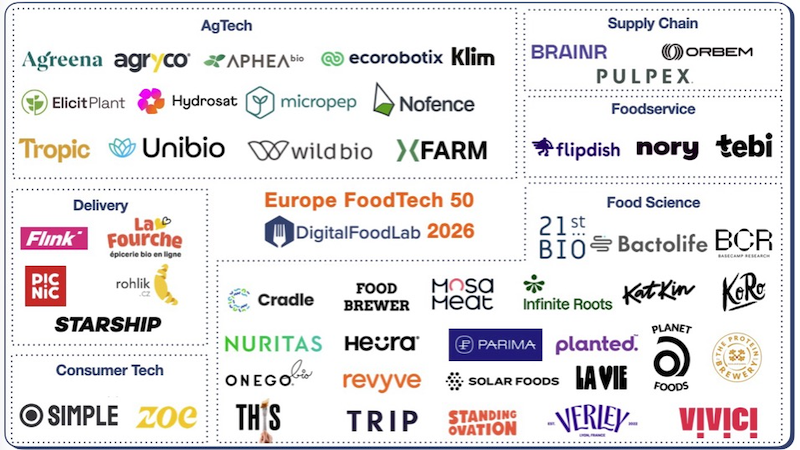
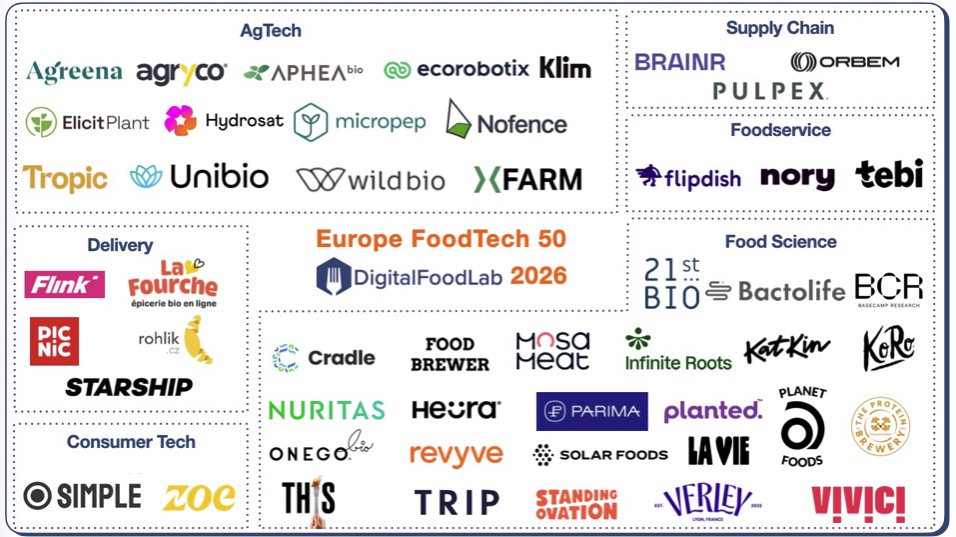
We’ve just updated DigitalFoodLab’s FoodTech Europe Top 50 for 2026, our annual snapshot of the 50 European startups with the strongest growth potential, exit prospects, or capacity to disrupt the agrifood value chain. This follows the release of our report on the state of the European AgriFoodTech ecosystem, which you can read here.
How did we build this list?
This year, we wanted to add the focus on two criteria: path to profitability and growth potential. As funding is decreasing both in the amounts raised by startups and in relevance, we notably looked at the number and quality of the commercialisation partnerships announced.
Beyond these, we looked at all the startups and evaluated them on four dimensions:
- Trend — alignment with key trends identified by DigitalFoodLab
- Funding or profitability — enough runway to reach the next stage
- Hype — ability to communicate and attract interest
- Exit potential — realistic path to IPO or acquisition at an attractive valuation
What changed in a year?
1 – More startups born from research
as recently underlined in a dedicated insight, Europe is now leading in funding and partnerships in alternative proteins and new ingredients, and this didn’t happen by accident. The “research to startup” pathway (transforming the high-quality research generated in universities into entrepreneurial ventures) has matured significantly, driven by institutes like VTT (Finland) and VIB (Belgium). In the 2026 Top 50, Aphea.bio and Solar Foods are strong examples of this.
2 – One major exit, zero failures
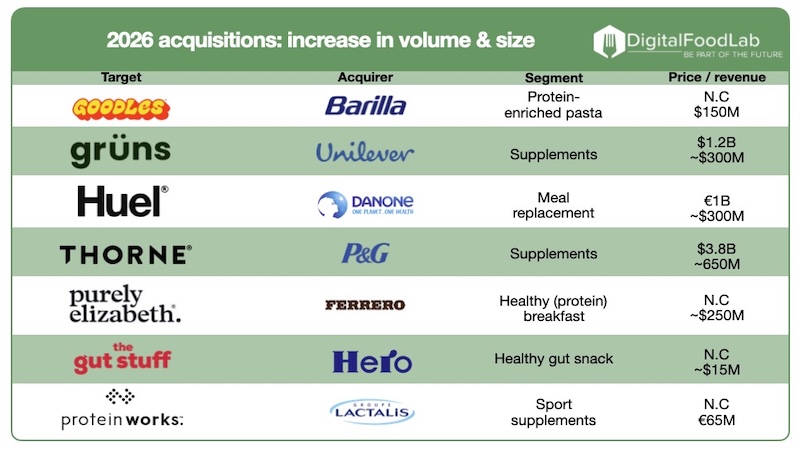
The only exit from the 2025 list is Huel, acquired by Danone for €1B. While impressive, the acquisition of this meal replacement brand, which follows the similar acquisition of YFood by Nestlé, also confirms a structural pattern: meaningful exits in European FoodTech still come almost exclusively from consumer brands. We don’t see (yet) such large-sized deals for agriculture technologies or innovative ingredients.
The good news: not a single company from last year’s list has gone under, which stands out in a startup landscape marked by weekly bankruptcies.
3 – More brands, far less delivery and foodservice
One of the benefits of doing this kind of exercise regularly is having a point of comparison and seeing how things evolve. Compared to previous years, we observe three clear shifts:
- More DTC (direct-to-consumer) brands: Huel and Yfood (meal replacement, Germany, acquired by Nestlé) are the template, which is now followed by companies such as KatKin (pet food), Trip (beverage), and plant-based companies. From an outsider’s perspective, it is interesting to note that most of the “exciting” brands emerge and grow in the UK.
- Less delivery and foodservice: these capital-intensive, hard-to-scale topics are increasingly avoided by investors. Few players still emerge with integrated platforms for restaurants, for instance (such as Teby and Nory).
- More sustainable farming: bioinputs, in particular, are drawing serious attention
4 – The persistent gap: scale
If we look beyond the mapping and wonder what could hinder the growth of these companies, the answer is clear: scale. In Food Science, for instance, 15 of 24 startups are primarily targeting the US as their first market. Industrialisation plans, when they exist, point to the Gulf or the US, not Europe. Brands still struggle to cross national borders.
This is not (only) a regulatory problem, but mostly a question of how innovation can access such a fragmented market, and of limited access to industrialisation capital. We’re cautiously optimistic on the capital side: EU-backed grants and investments are growing, Solar Foods’ €77.8M facility funding being the most recent example. But market fragmentation remains Europe’s structural disadvantage.
5 – When startups forget how to be startups
Lastly, a quick note of concern about a trend we observe: startups becoming “too narrowly focused”. As often mentioned, having corporate partners has become a cornerstone for most startups, notably tech-heavy ones. This aligns with the “venture clienting” strategy that many agrifood companies are implementing.
However, during a recent pitch session, I felt that many things were maybe going too far. Many entrepreneurs are dropping too much of what made them “startupers” to sound more suitable to corporations. This is a game startups can’t win: by trying to look more serious and to appear like a traditional company, they mostly remove the disruptiveness and the edge that made them interesting in the first place.
Use this list (with all the details and links available below) as a working map of what’s being built in Europe for the future of food and agriculture. For a deeper dive, watch the webinar where we walked through 6 selections (KatKin, Starship, Zoé, NoFence, Planted, and Bactolife) and explained our reasoning. And if you have any questions or suggestions, please reach out!
AgTech
- Agreena: Soil-carbon platform paying farmers for regenerative practices (insets/credits) — Denmark 🇩🇰
- Agryco: e-commerce platform for farmers — France 🇫🇷
- Aphea.Bio: Microbial biostimulants & biocontrol for major crops — Belgium 🇧🇪
- ecoRobotix: Precision weeding/spraying robots reducing herbicide use — Switzerland 🇨🇭
- ElicitPlant: Plant-based biostimulants improving crops’ drought tolerance — France 🇫🇷
- Hydrosat: Thermal satellite imagery for crop water stress monitoring — Luxembourg 🇱🇺
- Klim: Platform helping farmers adopt regenerative practices (advice + credits) — Germany 🇩🇪
- Micropep Technologies: Micropeptide-based bioherbicides/biostimulants as pesticide alternatives — France 🇫🇷
- Nofence: Virtual fencing collars for livestock with GPS & audio cues — Norway 🇳🇴
- Tropic Biosciences: Gene-edited tropical crops (banana, coffee) for resilience & yield — UK 🇬🇧
- Unibio: Methane-fed single-cell protein (UniProtein) for animal feed — Denmark 🇩🇰
- WildBio: Microbiome-based biocontrol solutions for crop protection — UK 🇬🇧
- xFarm: Digital farm management platform to collect data, manage operations, and improve sustainability and traceability — Italy 🇮🇹
Supply Chain
- BRAINR: Factory operations software for food manufacturing — Portugal 🇵🇹
- Orbem: MRI-based AI scanning for quality control of eggs and seeds — Germany 🇩🇪
- Pulpex: Pulp-based paper packaging technology to replace plastic — UK 🇬🇧
Foodservice
- Flipdish: White-label ordering, loyalty & marketing for restaurants — Ireland 🇮🇪
- Nory: AI operating system for restaurants (labour, inventory, forecasting) — Ireland 🇮🇪
- Tebi: Back-of-house management platform for hospitality/foodservice — Netherlands 🇳🇱
Delivery
- Flink: On-demand quick-commerce grocery delivery — Germany 🇩🇪
- La Fourche: Membership-based online organic grocery at wholesale prices — France 🇫🇷
- Picnic: Online grocery with proprietary electric-van logistics — Netherlands 🇳🇱
- Rohlik: Online grocer with fast delivery in CEE & Germany — Czech Republic 🇨🇿
- Starship Technologies: Autonomous sidewalk delivery robots for last-mile food — Estonia 🇪🇪
Consumer Tech
- Simple: AI-based fasting & nutrition tracking app — UK 🇬🇧
- ZOE: Data-driven personal nutrition insights via microbiome & blood sugar testing — UK 🇬🇧
Food Science
- 21st.BIO: Scale-up platform for precision fermentation & industrial biotech — Denmark 🇩🇰
- Bactolife: Precision fermentation-derived probiotic & microbiome ingredients — Denmark 🇩🇰
- Basecamp Research: Protein/enzyme discovery from global biodiversity datasets — UK 🇬🇧
- Cradle: AI protein design for novel enzymes & ingredients — Switzerland 🇨🇭
- Food Brewer: Plant-cell culture applied to coffee and cocoa production — Switzerland 🇨🇭
- Heura Foods: Plant-based meat brand — Spain 🇪🇸
- Infinite Roots: Mycelium fermentation for sustainable protein & ingredients — Germany 🇩🇪
- KatKin: Premium fresh cat food subscription — UK 🇬🇧
- KoRo: D2C pantry & healthy foods brand with bulk formats — Germany 🇩🇪
- Mosa Meat: Cultivated beef grown from cells — Netherlands 🇳🇱
- Nuritas: AI-discovered bioactive peptides for health & nutrition — Ireland 🇮🇪
- Onego Bio: Precision-fermented egg proteins (ovalbumin) for food — Finland 🇫🇮
- Parima: merger of two cultivated meat startups (Gourmey and Vital Meat) — France 🇫🇷
- Planted Foods: Plant-based meat via wet extrusion & fermentation — Switzerland 🇨🇭
- Planet A Foods: Cocoa-free chocolate alternatives from fermented ingredients — Germany 🇩🇪
- The Protein Brewery: Proteins and fibers by fermenting fungi (Fermotein) — Netherlands 🇳🇱
- Revyve: Upcycled brewer’s yeast proteins used to replace eggs, egg whites and additives — Netherlands 🇳🇱
- Solar Foods: Protein (Solein) made by microbes using CO₂, electricity & air — Finland 🇫🇮
- Standing Ovation: Precision fermentation for casein proteins — France 🇫🇷
- THIS: Plant-based chicken & pork alternatives focused on taste parity — UK 🇬🇧
- TRIP: Functional CBD & adaptogen drinks for relaxation — UK 🇬🇧
- La Vie: Plant-based bacon and pork alternatives using innovative fat technology — France 🇫🇷
- Verley: Precision fermentation used to create functionalised whey proteins — France 🇫🇷
- Vivici: Precision fermentation used to create dairy proteins, notably lactoferrin — Denmark 🇩🇰