Food automation is coming, just slower than expected

Published on May 12, 2026

Following the release of DigitalFoodLab’s FoodTech Trends 2026 report, we continue our deep dives into megatrends shaping the future of food. After alternative proteins, resilient farming, and healthy ageing, we turn to the automation of the food system.

What’s behind automation?

When we talk about automation, it’s not only to mention robots, or at least not for the sake of robots. It’s rather to solve some of the most pressing issues facing the food industry:

  • A greater need to substitute workers: historically, the food industry is probably the least automated industry. This is visible from farm to fork, from the reliance on immigrant labourers in the fields to low-paid foodservice workers. As the population ages and shrinks globally, automation is increasingly making sense.
  • Consumers’ desire for instant access to groceries and cooked meals, combined with a very low willingness to pay for the extra convenience.
  • The need to reduce waste alongside the value chain, notably downstream and midstream, with better tools to predict what will be sold and hence what should be ordered.

Three innovation ecosystems
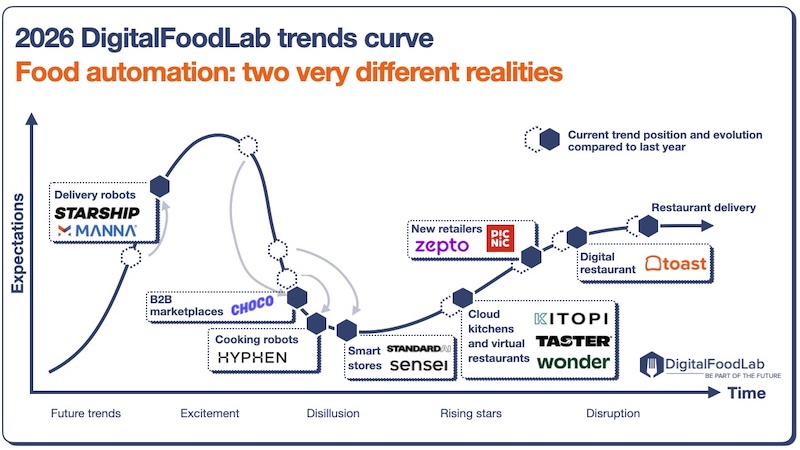
DigitalFoodLab-trends-curve-for-food-automation

As shown in DigitalFoodLab’s trends curve, 8 trends make up the food automation megatrend. These can be split into three groups:

1 – Delivery trends which are doing well: from restaurant delivery to new retailers and cloud kitchens, these trends are already mature or on the verge of being so.

  • Innovation is getting scarcer in this category, with regional leaders now quite established.
  • As a testimonial to the relevance of FoodTech, even if these companies are often not perceived as disruptive, they are the first to go “all the way” from inception to disruption. Many of the delivery startups are now publicly traded and profitable companies. This journey took the better part of a decade and shows that changing things is possible in food, but that it also requires time and huge continuous investments.
  • Source of the largest deals, with, for example, Picnic, €500M recent funding.
  • Big regional differences: while quick-commerce is not a topic anymore in most developed countries, it is still very active in South America or Asia (notably India).

2 – Digitisation efforts enabling automation for the foodservice industry are still moving forward, but slowly:

  • Digital restaurant startups are still popping up everywhere, even if nowadays the focus is increasingly on using artificial intelligence (AI) to create centralised “restaurant operating systems”.
  • B2B marketplaces are not doing well at all: startups have failed to replace leading incumbents (which are doing better and are more consolidated than ever).

3 – Cooking robots, delivery robots, and smart stores are still emerging technologies not ready for disruption:

  • Most cooking robots have gone bankrupt as they have failed to attract enough capital to keep experimenting. However, with the progress in physical AI, a renewal could happen, but probably not until a couple of years.
  • Delivery robot players have gotten a bit of attention recently, but mass deployment still seems quite far away.
  • Smart stores are almost forgotten for now: as for delivery robots, the problem is less with the technology than with behavioural issues.
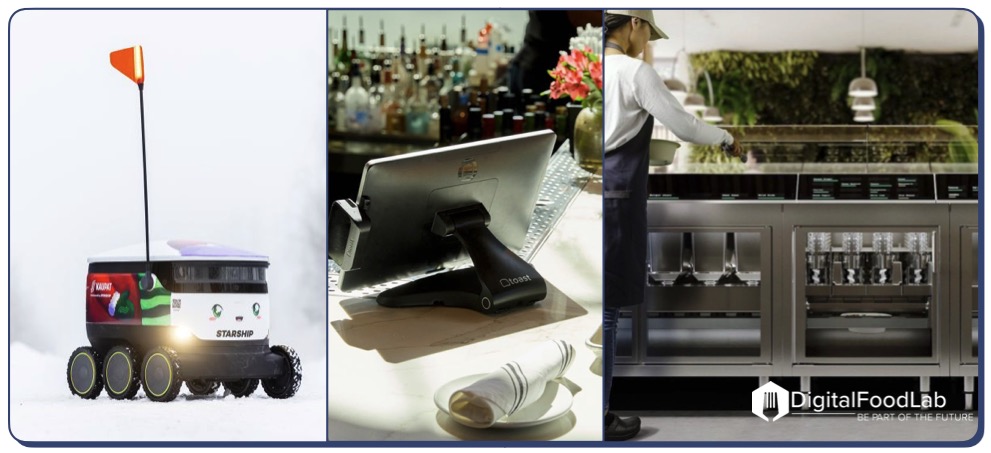
DigitalFoodLab-food-automation-illustrations-starship-hyphen-epos

How to manage these topics within an innovation strategy?

For now, food automation relies even more on cheap labour for cooking meals and delivering them alongside groceries. What should have been a transitory model has now become dominant, as progress in robotics has been much slower than anticipated ten years ago.

It is then important to shift expectations and be realistic about timelines. Even with advances in physical AI and recent progress in humanoid robots, it will take at least 5 to 10 years to glimpse the food automation initially imagined (with cooking and delivery robots).

So, what does that mean for an innovation strategy? First, that’s not such a long timeline, and planning ahead for this new robotic paradigm should start now. Indeed, it opens many new opportunities for companies, notably to directly transform ingredients and food products into cooked meals that are readily available to consumers. Secondly, in the short term, many areas are open to experimentation, starting with increasingly efficient and smart vending machines. These are not “ideal” robots, but they can do the job of creating new and interesting consumer experiences.

In a word, while food automation is often overlooked and considered only relevant to grocers and foodservice players, it is a space all players should consider, notably brands and ingredient companies.


You're in a good company

Join the 60+ clients of Digital FoodLab: leading agrifood companies, retailers, banks, investors, startups, and public organisations.

Use case: project for a global F&B company looking to map its AgTech innovation ecosystem and the best startups to partner with

What we did:

  • Mapping of the AgTech ecosystem: startups, research regulators, and other leading companies.
  • Discussion to select areas to focus on.
  • Analysis of the information to reveal the trends and a model to analyse eventual partners.
  • A workshop to validate the opportunities based on our recommendations.
  • Scouting of relevant partners followed by introductions.

Results:

  • Mapping the different categories of innovations in AgTech that should be considered now to create long-term benefits for the business.
  • Identification of key partners (an incubator and a couple of startups).

Use case: project for a CPG company on the healthy ageing ecosystem

What we did:

  • Education of the board through a couple of workshops to define the perimeter
  • Identification of key opportunities and threats created by long-term evolutions (technologies, business models, behavioural changes).
  • Deep dives on each of the priority categories.
  • Co-construction of a vision on how the company should address these challenges.
  • Identification of partners (startups, incubators, funds) to move forward.

Results:

  • Creating a consensus on which categories to prioritise and how to address them.
  • Implementation of an open innovation strategy through the development of partnerships.

Use case: project for a global CPG company to develop a strategy on the healthy ageing ecosystem

What we do (ongoing mission on a subscription model):

  • Kick-off where we present an overview of the AgriFoodTech ecosystem to select with the client the categories to cover and for each, the level of information required.
  • Monthly newsletter: each month we send a newsletter with the articles that we have gathered ranked by relevance, their summaries, and a layer of analysis.
  • Database: we set up a personalised database that will be filled month after month with the information gathered on the companies identified for the watch.
  • Workshops: twice a year with the client’s innovation team and other “innovation curious” team members, we present an overview of the evolutions, key trends and a dashboard of the topics followed by the watch.

Results:

  • A clear, regular and evolutive tool to follow what is happening in terms of innovation on key topics.
  • A forum (through the workshops) to discuss innovation trends and new opportunities.

Use case: opportunity screening for an ingredient company

What we did:

  • Kick-off to define the perimeter of the ecosystem studied.
  • Mapping of the different trends shaping the innovation ecosystem of the client.
  • Analysis of the trends on DigitalFoodLab’s trend curve and other relevant frameworks.
  • Workshop to discuss DigitalFoodLab’s recommendations on key trends to prioritise

Results:

  • Shared view of the innovation ecosystem for the client with a view of the trends to prioritize.
  • Clear document (personalised trend curve) that can be easily shared internaly to explain the company’s innovation choices and which can be then updated each year.

Use case: scouting for an agriculture coop

What we did:

  • Kick-off to define the perimeter of the client, the goals of the scouting (partnerships) and the criteria on which startups should be evaluated.
  • Set-up scouting: we selected the first batch of 20+ key startups following the criteria of the client.
  • On-going scouting: then we set up a quarterly scouting of about ten startups.
  • For each scouted startup, we created an ID card with key information such as the business and technological maturity, funding, and corporate partnerships. We also added an explanation of why we selected this startup.

Results:

  • An ongoing and evolutive scouting are matching the client's criteria and its capabilities in terms of deal flow.

Use case: working on an acquisition process for a CPG company

What we did:

  • Kick-off to define what the client is seeking, notably in terms of maturity.
  • Workshop with the client based on a mapping of the different innovation ecosystems adjacent to its activities to select some priorities and discuss inspiring examples of startup acquisition stories.
  • Identification of 20+ targets.
  • Workshop to select the most relevant to engage with.
  • DigitalFoodLab worked as a sparing partner during the acquisition process, notably to help design how the acquired startup could be integrated into the overall company’s strategy.

Results:

  • Different results from traditional M&A processes with a focus on the client’s innovation strategy.
  • Identification of a good match for an acquisition.

Use case: market due diligence on sugar alternatives

What we did:

  • Kick-off with the client to discuss its interest on this category, its expectations and existing level of information (notably on the target company).
  • Mapping of the ecosystem to analyse the different existing alternatives and technologies to compare them.
  • Interview (calls) with relevant startups made by our internal biotechnology expert.
  • Recommendation on whether to invest or not.

Results:

  • Clear view of the ecosystem and of the reasons to believe (or not) in each sub-category.
  • Enforceable recommendations based on facts and expertise.