It is hard to miss the noise around SpaceX’s upcoming IPO (the company’s stock market debut) at a whopping $1.75 trillion valuation. The goal of moving a million people to Mars in the next few decades comes alongside the renaissance of the space race, with multiple countries seeking to build permanently inhabited bases on the moon. But this newsletter is not about rockets and not whether or how we will grow food on Mars. It is about how increasing space funding will accelerate the food technologies needed for a more constrained planet.
Space has already shaped agriculture and food in more ways than we can imagine
As explained above, the link between space and food innovation is not new, and investments in space exploration have already had very significant results. Here are three of the most striking examples of technologies now massively used:
- Preservation: obviously, some funding of the first wave of space exploration went to… feeding astronauts, and tackling the challenge of food preservation. This led to key developments around lyophilisation, freeze-drying, and packaging.
- Food safety: one of the most famous food standards, HACCP, the food safety methodology, was developed for NASA to prevent contamination in astronauts’ food. It has now become one of the cornerstones of the modern food industry’s safety.
- Nutrition: beyond preservation and safety, NASA also sponsored a lot of research on nutrition, notably on algae, which contributed to the development of DHA-rich ingredients, now used in infant nutrition, animal feed and aquaculture.
And this is without mentioning more “obvious” space-related developments, such as satellite imagery, which is now increasingly getting used for precision farming, with applications ranging from measuring the impact of regenerative agriculture to yield prediction. This latest example is important because it underscores a key point: our point here is not to say that space research or NASA “invented” all of these technologies. Rather, it was a catalyst. When funding is allocated with the goal of finding solutions for extreme conditions, there are often ripple effects on our daily lives.
The next wave of technologies is different
While the first wave of space-related innovation was mostly about safety and food preservation for short space journeys, the new wave is focused on autonomous production. Indeed, either on the moon or on Mars (or on the journey there), food cannot be transported from Earth. It has to be produced locally, and as much as possible in an efficient closed-loop system (with minimal inputs). This is where things start to collide directly with the AgriFoodTech ecosystem, and where some of the trends that we regularly discuss here could benefit. This is notably the case of two groups of technologies:
1 – Fermentation-related alternative protein production: This is especially the case for biomass fermentation, with some startups having already benefited from funding from space agencies, notably:
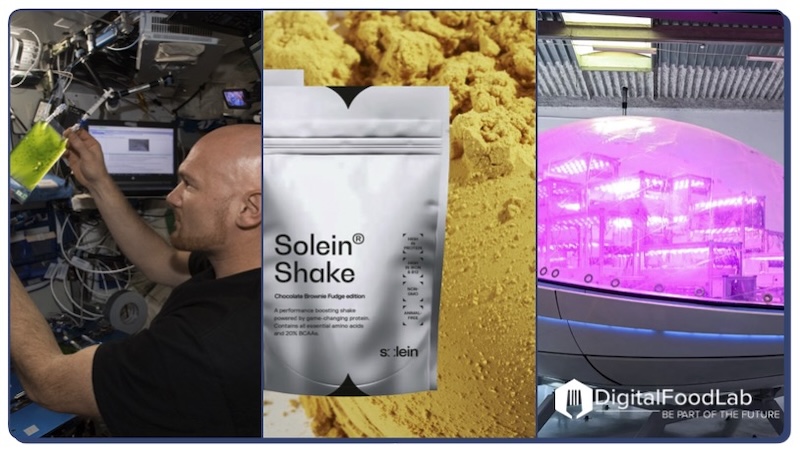
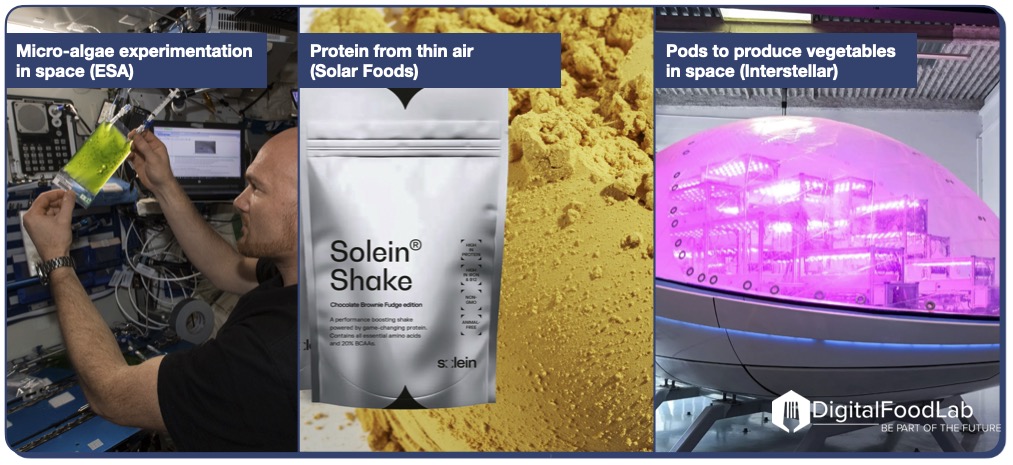
- Solar Foods, the Finnish startup, which uses captured carbon dioxide as an input to produce a source of protein through fermentation, has received funding from both NASA and ESA (European Space Agency), and it will test its technology aboard the International Space Station.
- Nature’s Fynd, a US-based startup, which produces protein through a fermentation process using a microorganism living in extreme conditions in Yellowstone Park. The initial research that led to the discovery was NASA-funded.
More broadly, biomass fermentation is a really exciting technology for space, notably gas fermentation, which can use carbon dioxide as an input. To a lesser extent, we can expect an increased appetite for precision fermentation, cellular agriculture and plant-cell culture.
Producing enough high-quality protein will be a key element of the success of any long-term mission, and we already know that it won’t be with animals, and probably not with crops such as soybeans, which require too much space. Hence, if we believe that funding for space exploration will increase, even if just for geopolitical reasons, just as it did during the Cold War, we can then expect a boost to these technologies.
2 – Vertical farming: beyond proteins, how to have access to food in space? Controlled-environment agriculture, and especially vertical farming, has already benefited a lot from past space research (LED lighting, aeroponics…). Even if most of the companies that have recently tried to scale these approaches have failed, some thrive, and, more generally, scaling the technology to enable in-space production of fruits and vegetables will be key. An interesting company to look at in this space is Interstellar Lab, a French startup with ambitions both on Earth and in space for its autonomous systems.
Space will not revive the idea that vertical farms can replace agriculture on Earth. But it may help fund technologies useful for very specific cases, notably high-value crops, climate-stressed geographies and closed-loop cultivation systems.
And beyond these two categories, immediately related to the goal of feeding a number of “travellers” or people based on space bases, other areas will be impacted, notably packaging. We expect an uptick in funding and grants for smart packaging and shelf-life extension technologies.
The real market is not astronauts
For AgriFoodTech entrepreneurs, investors, and agrifood companies interested in the future of food, the renewed enthusiasm for space is an opportunity that shouldn’t be missed.
But not because Mars will become a meaningful food market anytime soon. The real question is not really how we will grow food on Mars. It is how accelerating space funding will benefit food technologies needed for a more constrained planet.
For entrepreneurs, this means more grants, research contracts and potential early customers for technologies that are still too early, or too uncertain for mainstream food markets.
And most importantly, the biggest opportunity is that all these technologies will be developed for extreme environments. As with the technologies funded during the 1960s space race, many of them may later find applications in our daily lives. Increased space funding could help some technologies, notably biomass fermentation, mature faster than expected.
For large companies, tracking space-related funding in agriculture and food-adjacent technologies should become part of their “future of food” intelligence platform. Not because space is the market, but because it can act as an early signal of which technologies may become relevant on Earth.