We just looked at how the regulatory race in alternative proteins was largely the wrong race for startups. Being the first company to receive approval created headlines, but not a scalable market.
The same lesson applies to countries. Approving a product first can attract attention and a few startups. It does not create an industrial ecosystem. As regulatory approvals multiply and more companies develop credible routes to scale, the strategic question for governments is shifting: who will finance the production assets, and where will they be built?
Being first was not a strategy, neither for startups nor countries
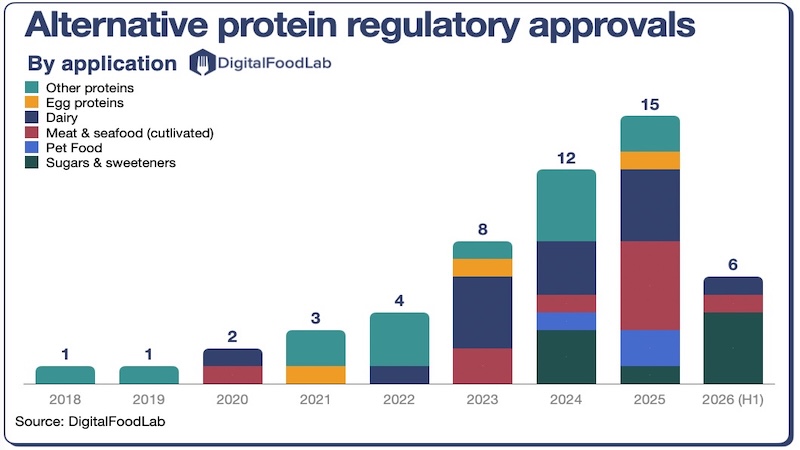
As well as startups, there was a race between countries to be the first to authorise new ingredients. This race was won by Singapore, which in 2020 was the first country to approve cultivated meat, with Eat Just’s chicken. It was presented as the beginning of a new industry and as a demonstration of how regulation could support national food sovereignty.
Six years later, cultivated meat and other products that received a “world’s first” approval in Singapore are still hard to find beyond select restaurants and limited retail experiments. More striking, after efforts to become more resilient, Singapore has now replaced its “30 by 30” food self-sufficiency target with narrower objectives. The government recognised that alternative proteins remain too expensive and that consumer acceptance is lower than expected. Also, it has drastically reduced its sovereign-fund investments in early-stage companies, including AgriFoodTech.
Europe’s regulatory environment may have reinforced its ecosystem
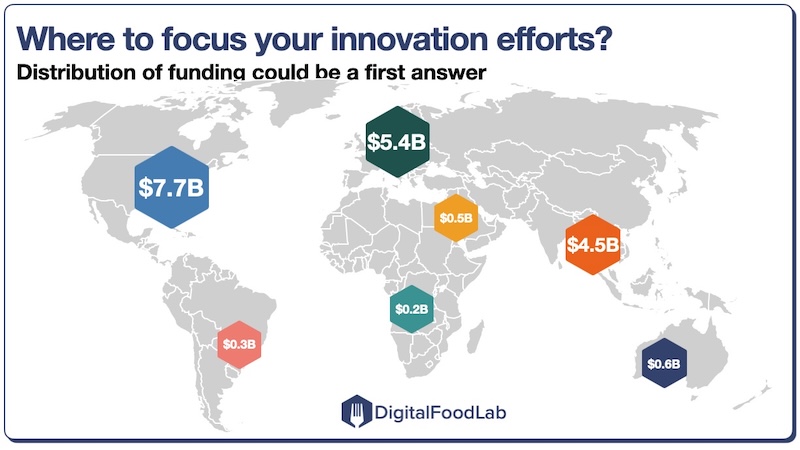
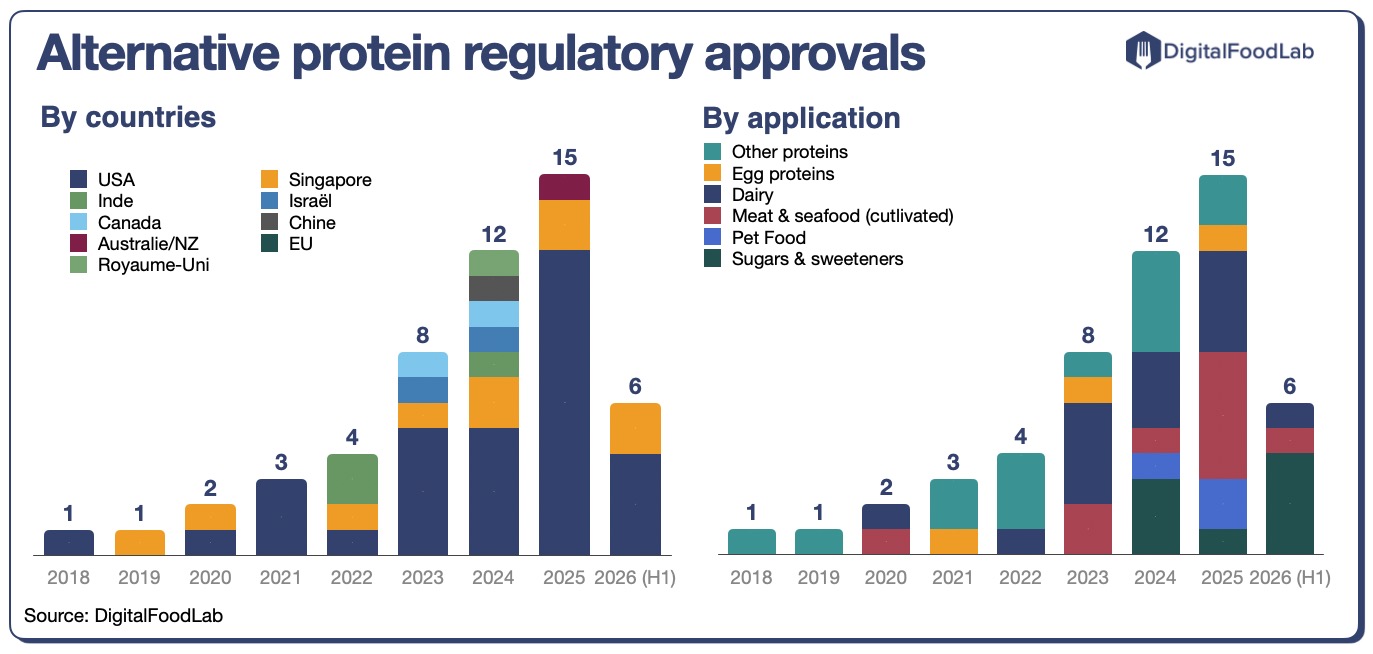
The graph above suggests that innovation is concentrated in countries with the fastest regulatory pathways, such as the US and Singapore. This is true to an extent, but more than half of the funding is now going to startups from Europe, the “regulatory laggard” continent.
Europe’s regulatory lag has not prevented companies such as Parima, Mosa Meat, Standing Ovation, or Vivici from developing technologies, raising capital, and building partnerships. Europe has not suffered significantly from being late on regulation because the industry was still mostly in its research and experimentation phase. There was simply no market to miss. Its slower approach may even have protected part of the ecosystem from some of the excessive expectations and destruction of capital observed elsewhere.
However, being late is not a viable strategy. At some point, there will be a price. The region that will become the first real consumer market will be the first to have large-scale facilities, but that will also be the case for all future markets, as food production tends to be localised. What the “first market” will win is probably the underlying infrastructure: all the players who will build the facilities, the bioreactors, and the supplies required to make it work. This supply chain, with all its jobs and value creation, is the real prize to win to be first.
The new strategy: a clear regulation framework combined with scale-up support
Alternative protein companies raised a record $7 billion in 2021, but funding has since declined to $900M in 2025, just as companies are entering their most capital-intensive phase of development.
The landscape is moving much faster than we might think just by looking at funding headlines. While there is still a wave of consolidation and most companies struggle to raise funds, real progress is being made almost weekly. These successes include regulatory approvals, increasingly credible pathways towards industrial scale, and commercial traction.
These two points are proven by the rising number of corporate and startup partnerships focused on scaling up production, with recent examples including:
- Standing Ovation (France, precision fermentation, caseins) signing a manufacturing deal with Ajinomoto
- TurtleTree (Singapore, precision fermentation, lactoferrin) partnering with Novonesis on scale and commercialisation.
- The Every Co (USA, precision fermentation, egg whites) partnering with ADM on production.
The latter deal is quite interesting, as it involves ADM investing $55M to convert an underused facility and receiving $2.23M in tax credits from the state of Iowa. While marginal, the public contribution acts as an additional motivation and improves the investment attractiveness.
Through these kinds of direct incentives or through the backing of sovereign funds, there is a new angle for governments to support the development of the new ingredient industry.
Regulatory clarity remains necessary, not necessarily through the fastest process, but through clear frameworks that enable a company to know what it needs to deliver and when it will get an answer (and many regulatory agencies, notably Europe’s, could learn a great deal from each other). However, now regulation is not that central, and much less relevant than other tools that can be created, financed, or supported by governments, including: sandboxes to test and pilot, shared pilot and demonstration facilities, support for converting or building existing industrial assets, research and development in the supply chain (notably feedstocks).
The lesson for governments is not to stop competing, but to think a bit more about the long-term development of this ecosystem and how it can help create factories, capabilities, suppliers and jobs.
Governments should stop measuring success through approvals, startup counts, and even pure funding. This was good enough, but now a much more relevant metric is how much private capital they can help companies mobilise to develop commercial assets that will help future ingredients find their market.