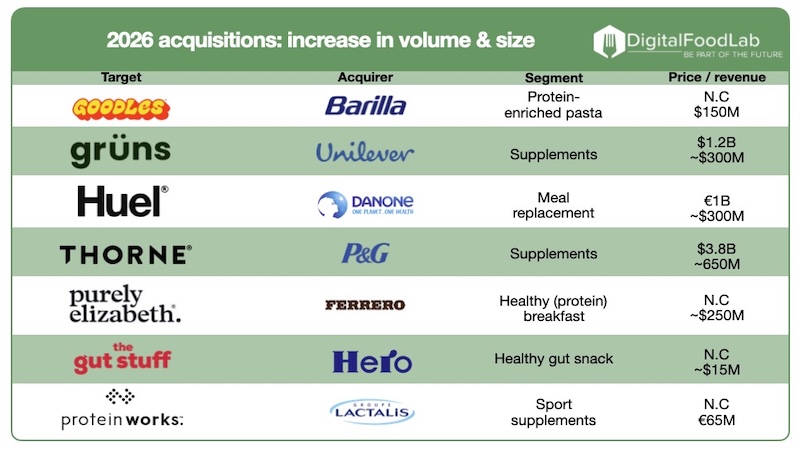
Since the start of the year, emerging food, beverage and supplement brands have been in the spotlight. There is a very unusual alignment of large investments at striking valuations, impressive revenue growth, and acquisitions by leading companies. In past weeks, Barilla acquired US pasta brand Goodles for a price rumoured to be between $300 and $600M. The same week, the company behind David Protein, the fast-rising protein bar, raised $250M to sustain its growth and its portfolio expansion.
So, what is happening? Is it sustainable, and what are the lessons we can learn from this disruption of the CPG landscape?
1 – An acquisition spree across emerging food, beverage and supplement brands
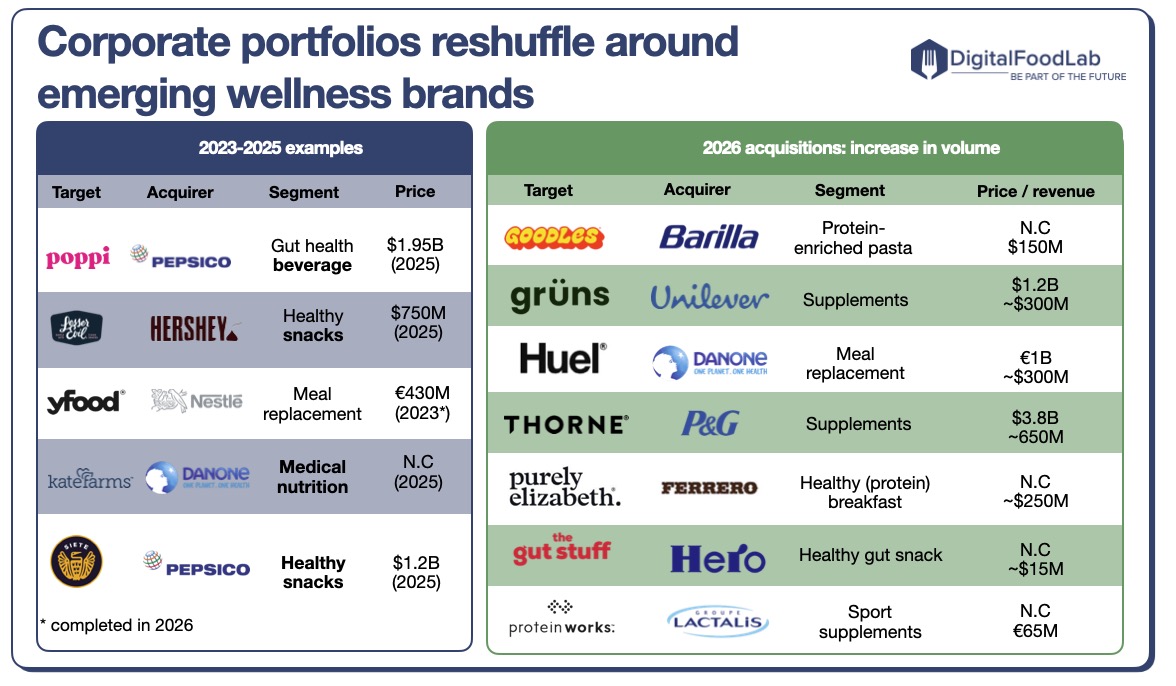
Massive deals were already appearing in 2025, but the pace has accelerated since the start of the year. We can group them in three overlapping spaces:
- Everyday food with a nutritional positioning (i.e. an increased protein ratio): Goodles and Purely Elizabeth (acquired by Ferrero).
- Complete and active nutrition: Huel joining Danone and Protein Works joining Lactalis.
- Supplements: Grüns joining Unilever and P&G agreeing to acquire Thorne for $3.8B.
What’s interesting is that the boundaries between these categories are getting increasingly blurry. Looking at the products and marketing of these brands, you can easily get confused, as they are all selling a similar promise: mixing a healthy ageing promise with indulgence.
Beyond the categories, timing is key:
- Targets are mostly emerging brands: these have grown extremely fast over the past couple of years. They have combined the tools of digitally native brands (extensive use of social networks), often relying on strong brand ambassadors) with astute retail strategies.
- Wellness requires selectivity: this acquisition spree is happening at a time when leading companies are rethinking their portfolios to better align with current health trends (and the threat of declining consumption due to ageing and GLP-1 adoption). Recent examples include Nestlé selling some of its supplements portfolio or Unilever divesting from its food activities.
- Later-stage acquisition in terms of scale: compared to brand acquisitions, they also come at a later stage in terms of scale (with revenues already above $100M), but just at the moment when internationalisation makes sense for these brands (and hence, the backing of a global commercial machine that only the largest food companies have).
2 – Capital is accelerating the next generation
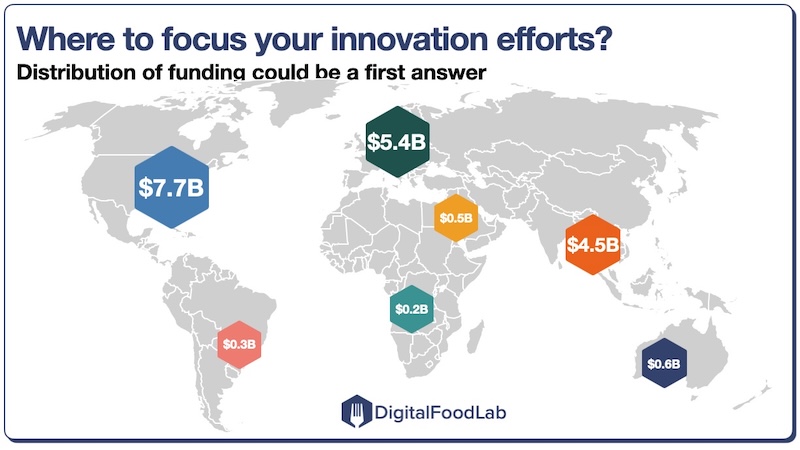
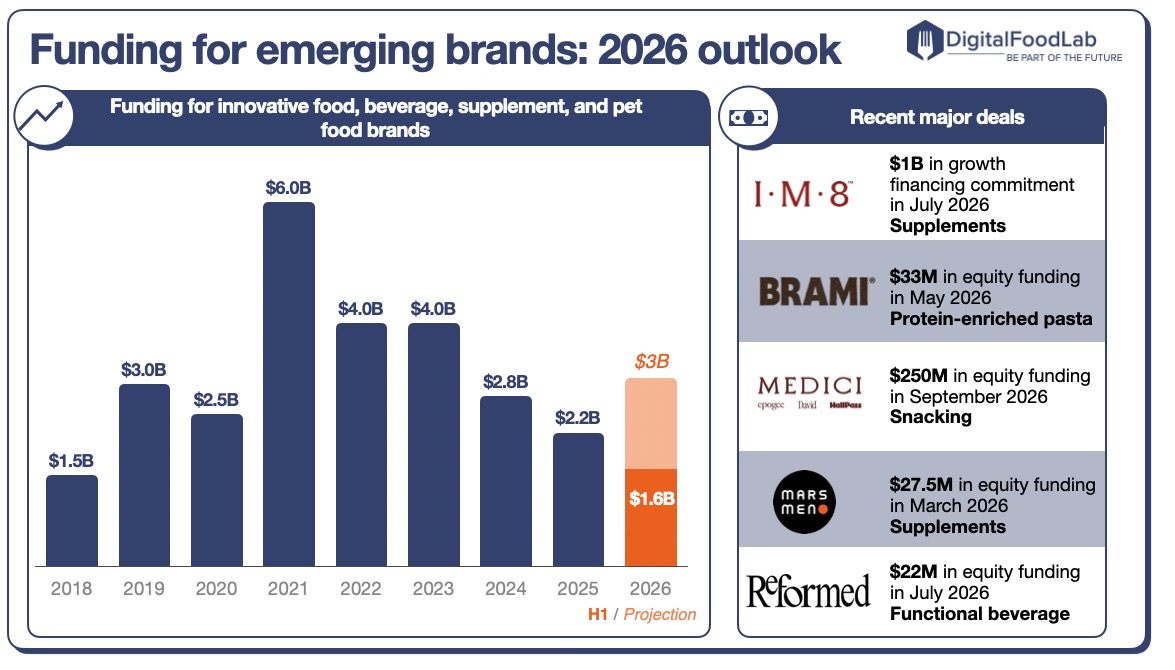
The story also doesn’t stop there. Beyond the acquisitions, there is a whole set of brands that are rising behind. And investors have noticed it, and are ready to bend the rules for these companies. In July, IM8 secured a $1B growth financing commitment. The facility finances customer acquisition without issuing equity, with repayment linked to the customers financed. It shows how capital can be deployed specifically to accelerate a business built around repeat purchases.
Corporates are also participating earlier. Brami’s $33M funding round included pasta producer La Molisana.
This suggests that a positive feedback loop is being created: successful brands attract buyers, visible exits encourage investment, and new capital accelerates the next generation.
3 – Extremely fast growth for “ultraprocessed healthy” products
Many emerging brands make their proposition easy to understand: more protein, more fibre, better hydration, or a simpler supplement routine. They put that promise into products consumers already know how to use, and which require relatively little change in everyday behaviour.
This also relies on increasingly indulgent products, at least in terms of taste. A very noticeable point is that many of these brands are heavily processed. Here, Medici Brands’ example is striking. The company has just raised $250M and should surpass $300M in revenue in 2026, just two years after its first product was sold. The story behind the product is telling:
- Its founder was behind RxBar, the brand which was sold to Kellogg’s in 2017, and which was the embodiment of the search for more natural food products, with its four ingredients and “no B.S” signature.
- Today, he is surfing on a “high protein, low calories” signature, with a product (David Protein, a snack bar) having about 15 ingredients.
The signal is quite clear: as shown by data (and the revenue these brands generate), it seems that processing is much less of a concern for consumers when the products are being brought by emerging players, combined with the right marketing. For established companies, this raises a strategic question: which definition of “healthy” can their brands credibly stand for?
4 – What will last, and where should corporates act?
We expect this trend to continue, notably as evidenced by the strong pipeline of emerging brands.
First, we should note that tension around ultra-processed foods remains, but it may not be shared similarly by all consumers. The success of brands built around health-claims targets suggests that some consumers judge products first by what they promise to deliver rather than by their ingredient lists. In the short and medium term, we see competing definitions of “healthy”, leaving room for different approaches. A key metric for evaluating the long-term potential of these brands should, however, be the feasibility of evolving their recipes towards something cleaner.
For companies looking at this space, we would start with three questions:
- Which consumer do you want to serve first? Protein, digestive health or healthy ageing lead to different opportunities, both in terms of products and services.
- Where can the company build credibility? Are you building on your existing credibility on this field or acquiring credibility through an addition to your portfolio?
- What is the right way to enter? Beyond acquisitions and their associated risks and costs, internal developments, commercial partnerships with an innovative ingredient company, minority investments are also relevant.
At DigitalFoodLab, we help food and ingredient companies translate these questions into innovation priorities and identify the startups that can help them build a position. If you are reviewing or exploring your health and wellness priorities, let’s discuss which opportunities and startups are most relevant to you.