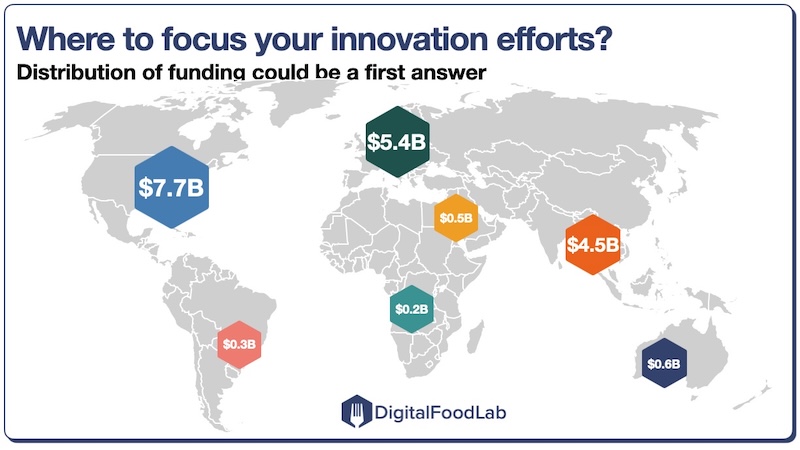
Today, I’d like to share a couple of graphs and a mapping that underline the importance of the FoodTech ecosystem, both in its current position and its potential for the future.
1 – Food is medicine – Americans largely agree
The New Consumer published a very good special report on Food & Wellness. Based on a survey of American consumers, we learn that US consumers across all generations agree with the idea that food is medicine.
That’s a theme dear to us, as we spend quite some time talking in this newsletter and in our work about the growing importance of food as medicine and, more specifically, about healthy ageing.

Beyond, we also learn how the US consumer intends to act on this belief:
- by cutting on sugar (almost half of the respondents)
- by seeking new products, notably mushroom coffee, healthy beverages (like Poppi, which as acquired last week by PepsiCo), green powders, and plant-based milk
2 – A new wave of “insurgent brands”
Bain released its yearly mapping of what it calls insurgent brands, with a large share of them being food & beverage products. These brands are defined by their size ($25M + in revenues) and their growth (x10 the category average)
In the current inflationary context, it is striking to see that many new brands finding their niche.

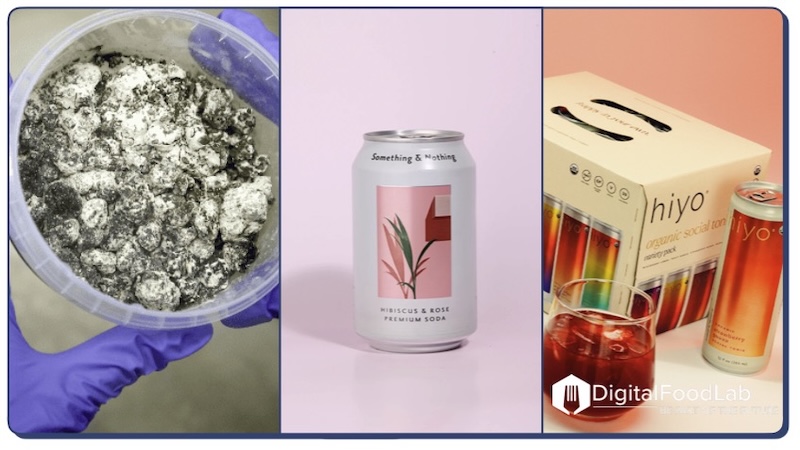
It is also possible to connect this mapping with the above report on health and wellness. First, most of these insurgent brands have a health claim attached to them. Second, beyond their health benefit claim, they have, for the most part, a focus on “indulgence” and pleasure. To succeed, being healthy is far from enough; that can only be a baseline; you first need to have a brand whose products are tasty and “beautiful” and “different” enough to be shared online. A perfect example of the above would be Goodles, a brand of pasta (notably mac & cheese), made “good” by being enriched in proteins and fibres while having a low GI.
3 – New projections on the potential size of the alternative protein market
McKinsey released a note on the size of the global protein market, focusing on alternative proteins. It is expected to grow to about $300 billion by 2050. While this is big, it is far less than previous predictions, which saw alternatives dominate the overall protein market.

Also, the report estimates the cost of reaching cost parity with traditional proteins. It would require over $250B in investment by 2050, mainly to scale fermentation capacity and improve bioreactor efficiency.
On the same note, Morgan Stanley released a podcast on the same topic. For them, fermented proteins (notably from biomass and precision fermentation) could reach $30 billion by 2030. It sees two phases:
1 – from 2025 to 2027 with a focus on whey protein and animal nutrition.
2 – a second phase from 2028 to 2030 with competitive alternatives to egg, meat and dairy products.