DigitalFoodLab, en partenariat avec Sopexa et Vitagora, publie la première étude sur la FoodTech française

Published on December 7, 2017

DigitalFoodLab, en partenariat avec Sopexa et Vitagora, publie la première étude portant sur la FoodTech en France. Cette étude a pour objectif de mesurer et de décrypter cette tendance, pour mieux l’accompagner.


Pourquoi étudier les chiffres de la FoodTech en France ?

Avec DigitalFoodLab, nous cherchons à développer la FoodTech en France. Pour cela nous travaillons avec les acteurs de l’agro-alimentaire, les investisseurs, les institutionnels et bien sur les entrepreneurs. La première chose que nous avons faite est de créer des événements, les DigitalFoodClubs, il y a 3 ans. Si ces réunions entre acteurs et curieux de la FoodTech fonctionnent, ils n’étaient pas suffisants pour accélérer le développement d’un écosystème. Nous avons donc commencé à travailler avec les différents acteurs pour leur fournir du conseil et des données sur ce que représente la FoodTech. Un des points récurrents auxquels nous étions confrontés était le manque de données fiables sur cet écosystème en France. Les chiffres sont présents au niveau mondial, rien n’existait à l’échelle nationale.

C’est autour de cette problématique que nous nous sommes réunis avec nos deux partenaires et sponsors : Sopexa et Vitagora. Sopexa est l’agence de communication dédiée à l’agro-alimentaire et Vitagora est le pôle de compétitivité agro-alimentaire des régions Bourgogne-Franche-Comté et Île-de-France.


Que représente la FoodTech en France en 2017 ?

Il ressort de notre étude que le nombre de créations de start-ups a été multiplié par 3 entre 2014 et 2016 ; on en compte 472 en 2017.

317 millions d’euros ont été investi dans ces startups entre 2013 et le premier semestre 2017. La croissance des investissements dans le domaine a fortement augmenté d’année en année. Cette hausse s’explique de plusieurs façons, en particulier par l’augmentation du nombre d’investissements par année, pour un total de 219 investissements sur la période couverte.


nbr_invest

nbr_levees

Cependant le nombre d’investissement n’explique pas tout. Si le montant médian investi est quasiment stable, le nombre de deals de plus d’un million d’euros connaît une forte croissance. On voit même apparaître en 2016 les premiers deals de plus de 20 millions d’euros (Alkemics, Wynd, Frichti). Ces levées de fonds importantes suivent la tendance générale de l’écosystème startup français mais témoignent également d’une FoodTech de plus en plus mature avec des sociétés justifiant ces niveaux d’investissements.

Les domaines et les régions les plus actifs

DigitalFoodLab a réalisé une cartographie de la FoodTech (accessible ici) avec 6 domaines et 31 sous-domaines de la FoodTech. Globalement, les startups du Delivery & Retail (startups qui répondent aux défis du e-commerce alimentaire) sont celles qui captent le plus d’investissements.

carte_fr

L’étude se penche également sur la répartition géographique des startups et des investissements en France. Nous observons alors une très large concentration autour de Paris avec 60% des startups actives, 66% des investissements en nombre et 80% en montants. Cependant, plusieurs régions se développent : Lyon étant le seul écosystème, hors Paris, comprenant l’ensemble des domaines de la FoodTech, les autres étant plus spécialisés.

Encore beaucoup de potentiel

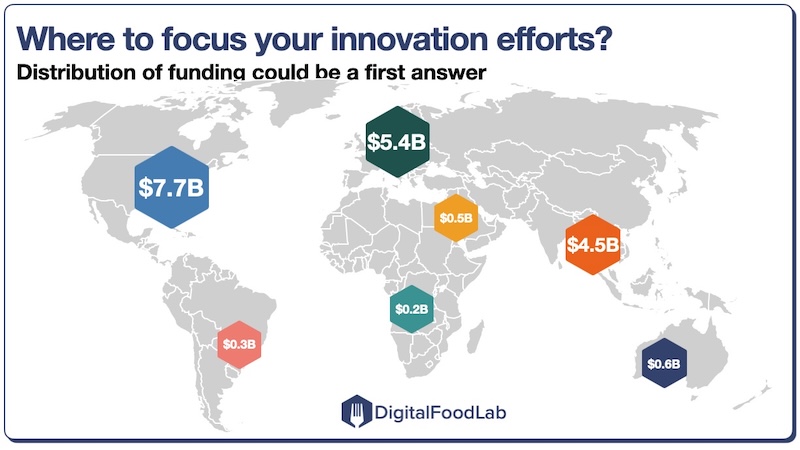
Selon les études internationales sur les investissements mondiaux dans la FoodTech, nous en déduisons que la France pèse seulement 1 à 2%. Avec tous les atouts dont les startups françaises disposent de manière générale et dans ce domaine en particulier avec la culture gastronomique, les grandes entreprises de l’agro-alimentaire et de la distribution, cela représente un gigantesque potentiel. C’est en tout cas le message que nous souhaitons faire passer à tous les entrepreneurs, industriels et investisseurs : il existe une opportunité considérable à saisir en France pour la FoodTech. Si des leaders internationaux sont déjà en train de se dessiner, la France peut en faire partie.


L’étude complète est consultable ici : https://www.digitalfoodlab.com/rapport-foodtech-13-17/

You're in a good company

Join the 60+ clients of Digital FoodLab: leading agrifood companies, retailers, banks, investors, startups, and public organisations.

Use case: project for a global F&B company looking to map its AgTech innovation ecosystem and the best startups to partner with

What we did:

  • Mapping of the AgTech ecosystem: startups, research regulators, and other leading companies.
  • Discussion to select areas to focus on.
  • Analysis of the information to reveal the trends and a model to analyse eventual partners.
  • A workshop to validate the opportunities based on our recommendations.
  • Scouting of relevant partners followed by introductions.

Results:

  • Mapping the different categories of innovations in AgTech that should be considered now to create long-term benefits for the business.
  • Identification of key partners (an incubator and a couple of startups).

Use case: project for a CPG company on the healthy ageing ecosystem

What we did:

  • Education of the board through a couple of workshops to define the perimeter
  • Identification of key opportunities and threats created by long-term evolutions (technologies, business models, behavioural changes).
  • Deep dives on each of the priority categories.
  • Co-construction of a vision on how the company should address these challenges.
  • Identification of partners (startups, incubators, funds) to move forward.

Results:

  • Creating a consensus on which categories to prioritise and how to address them.
  • Implementation of an open innovation strategy through the development of partnerships.

Use case: project for a global CPG company to develop a strategy on the healthy ageing ecosystem

What we do (ongoing mission on a subscription model):

  • Kick-off where we present an overview of the AgriFoodTech ecosystem to select with the client the categories to cover and for each, the level of information required.
  • Monthly newsletter: each month we send a newsletter with the articles that we have gathered ranked by relevance, their summaries, and a layer of analysis.
  • Database: we set up a personalised database that will be filled month after month with the information gathered on the companies identified for the watch.
  • Workshops: twice a year with the client’s innovation team and other “innovation curious” team members, we present an overview of the evolutions, key trends and a dashboard of the topics followed by the watch.

Results:

  • A clear, regular and evolutive tool to follow what is happening in terms of innovation on key topics.
  • A forum (through the workshops) to discuss innovation trends and new opportunities.

Use case: opportunity screening for an ingredient company

What we did:

  • Kick-off to define the perimeter of the ecosystem studied.
  • Mapping of the different trends shaping the innovation ecosystem of the client.
  • Analysis of the trends on DigitalFoodLab’s trend curve and other relevant frameworks.
  • Workshop to discuss DigitalFoodLab’s recommendations on key trends to prioritise

Results:

  • Shared view of the innovation ecosystem for the client with a view of the trends to prioritize.
  • Clear document (personalised trend curve) that can be easily shared internaly to explain the company’s innovation choices and which can be then updated each year.

Use case: scouting for an agriculture coop

What we did:

  • Kick-off to define the perimeter of the client, the goals of the scouting (partnerships) and the criteria on which startups should be evaluated.
  • Set-up scouting: we selected the first batch of 20+ key startups following the criteria of the client.
  • On-going scouting: then we set up a quarterly scouting of about ten startups.
  • For each scouted startup, we created an ID card with key information such as the business and technological maturity, funding, and corporate partnerships. We also added an explanation of why we selected this startup.

Results:

  • An ongoing and evolutive scouting are matching the client's criteria and its capabilities in terms of deal flow.

Use case: working on an acquisition process for a CPG company

What we did:

  • Kick-off to define what the client is seeking, notably in terms of maturity.
  • Workshop with the client based on a mapping of the different innovation ecosystems adjacent to its activities to select some priorities and discuss inspiring examples of startup acquisition stories.
  • Identification of 20+ targets.
  • Workshop to select the most relevant to engage with.
  • DigitalFoodLab worked as a sparing partner during the acquisition process, notably to help design how the acquired startup could be integrated into the overall company’s strategy.

Results:

  • Different results from traditional M&A processes with a focus on the client’s innovation strategy.
  • Identification of a good match for an acquisition.

Use case: market due diligence on sugar alternatives

What we did:

  • Kick-off with the client to discuss its interest on this category, its expectations and existing level of information (notably on the target company).
  • Mapping of the ecosystem to analyse the different existing alternatives and technologies to compare them.
  • Interview (calls) with relevant startups made by our internal biotechnology expert.
  • Recommendation on whether to invest or not.

Results:

  • Clear view of the ecosystem and of the reasons to believe (or not) in each sub-category.
  • Enforceable recommendations based on facts and expertise.