Etat des investissements dans la FoodTech française en 2025

Published on November 6, 2025

Je suis heureux de partager avec vous notre rapport annuel sur l’écosystème French FoodTech. Vous pouvez télécharger le rapport complet ici. Nous prévoyons également un webinaire le 27 novembre à 11h30, en français – vous pouvez vous y inscrire dès maintenant ici.

1 – Les startups French FoodTech auront levé environ 290 M€ en 2025

Jusqu’à présent, 225 M€ ont été levés sur les trois premiers trimestres. Cela représente une baisse de 35 % par rapport à 2024 et de 74 % par rapport au pic de 2022. Le déclin semble toutefois ralentir, ce qui laisse penser que la situation pourrait se stabiliser avant un éventuel rebond en 2026‑2027.

investments-french-foodtech-startups-DigitalFoodLab-2025

On ne peut guère se rassurer en se comparant. Cette chute est certainement similaire à celle observée dans le reste du monde, mais l’écosystème français avait pris son envol plus tard. Il retourne donc à une position marginale, en n’étant que le 9e plus important à l’échelle mondiale.

Cette baisse des investissements s’explique par :

  • Une diminution du nombre de startups émergentes : le nombre de startups créées diminue rapidement, ainsi qu’en parallèle le nombre de tours de tables pre-seed, seed et series A.
  • Un retour de la difficulté à financer le passage à l’échelle : ce point, qui avait longtemps constitué la plus grande limite de l’écosystème “tech” français s’était réduit par la double intervention de fonds étrangers et de la BPI. Le retrait des premiers face aux incertitudes politiques et économiques, ainsi que la plus grande modération des acteurs publics créent un cercle vicieux dont l’issue est incertaine.

À ce rythme, et si rien n’est fait pour restaurer la confiance dans la capacité de l’écosystème d’innovation à produire des résultats, celui‑ci pourrait disparaître d’ici quelques années.

distribution-funding-french-foodtech-startups-2025

Alors qu’au niveau mondial l’AgTech est l’une des catégories FoodTech les plus dynamiques, ce n’est pas le cas en France. Les investissements dans l’AgTech française, principalement liés à l’élevage d’insectes, s’effondrent, et ce qui subsiste en 2025 est essentiellement lié à des tours de table pour éviter la faillite de certains acteurs (comme Ÿnsect ou Agronutris).

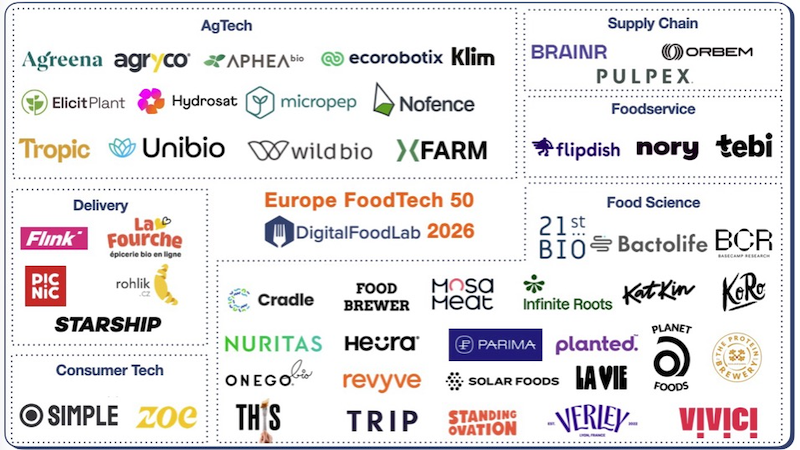
Pour dépasser l’analyse purement financière, nous avons mis à jour le mapping de DigitalFoodLab des 25 startups françaises AgriFoodTech les plus prometteuses. Parmi toutes les startups actives, nous avons sélectionné celles qui présentent le plus fort potentiel de croissance, de sortie significative ou de transformation de la chaîne de valeur agro‑alimentaire dans l’année à venir. Nous évaluons notamment leur alignement avec les tendances clés ; leur financement (disposent‑elles de ressources suffisantes pour passer à l’étape suivante ?) ; la dynamique (hype) ; et l’implication d’acteurs industriels.

Vous trouverez dans le rapport la liste de 25 startups, avec leurs noms, leurs liens et leurs descriptions d’activité.

Le contexte global reste compliqué : l’instabilité politique renforce la prudence des investisseurs. Pourtant, tout n’est pas sombre : la France conserve une forte expertise en AgTech et sur les ingrédients innovants. L’émergence de marques grand public visibles, telles qu’Accro et La Fourche, montre que l’écosystème peut encore se réinventer.

You're in a good company

Join the 60+ clients of Digital FoodLab: leading agrifood companies, retailers, banks, investors, startups, and public organisations.

Use case: project for a global F&B company looking to map its AgTech innovation ecosystem and the best startups to partner with

What we did:

  • Mapping of the AgTech ecosystem: startups, research regulators, and other leading companies.
  • Discussion to select areas to focus on.
  • Analysis of the information to reveal the trends and a model to analyse eventual partners.
  • A workshop to validate the opportunities based on our recommendations.
  • Scouting of relevant partners followed by introductions.

Results:

  • Mapping the different categories of innovations in AgTech that should be considered now to create long-term benefits for the business.
  • Identification of key partners (an incubator and a couple of startups).

Use case: project for a CPG company on the healthy ageing ecosystem

What we did:

  • Education of the board through a couple of workshops to define the perimeter
  • Identification of key opportunities and threats created by long-term evolutions (technologies, business models, behavioural changes).
  • Deep dives on each of the priority categories.
  • Co-construction of a vision on how the company should address these challenges.
  • Identification of partners (startups, incubators, funds) to move forward.

Results:

  • Creating a consensus on which categories to prioritise and how to address them.
  • Implementation of an open innovation strategy through the development of partnerships.

Use case: project for a global CPG company to develop a strategy on the healthy ageing ecosystem

What we do (ongoing mission on a subscription model):

  • Kick-off where we present an overview of the AgriFoodTech ecosystem to select with the client the categories to cover and for each, the level of information required.
  • Monthly newsletter: each month we send a newsletter with the articles that we have gathered ranked by relevance, their summaries, and a layer of analysis.
  • Database: we set up a personalised database that will be filled month after month with the information gathered on the companies identified for the watch.
  • Workshops: twice a year with the client’s innovation team and other “innovation curious” team members, we present an overview of the evolutions, key trends and a dashboard of the topics followed by the watch.

Results:

  • A clear, regular and evolutive tool to follow what is happening in terms of innovation on key topics.
  • A forum (through the workshops) to discuss innovation trends and new opportunities.

Use case: opportunity screening for an ingredient company

What we did:

  • Kick-off to define the perimeter of the ecosystem studied.
  • Mapping of the different trends shaping the innovation ecosystem of the client.
  • Analysis of the trends on DigitalFoodLab’s trend curve and other relevant frameworks.
  • Workshop to discuss DigitalFoodLab’s recommendations on key trends to prioritise

Results:

  • Shared view of the innovation ecosystem for the client with a view of the trends to prioritize.
  • Clear document (personalised trend curve) that can be easily shared internaly to explain the company’s innovation choices and which can be then updated each year.

Use case: scouting for an agriculture coop

What we did:

  • Kick-off to define the perimeter of the client, the goals of the scouting (partnerships) and the criteria on which startups should be evaluated.
  • Set-up scouting: we selected the first batch of 20+ key startups following the criteria of the client.
  • On-going scouting: then we set up a quarterly scouting of about ten startups.
  • For each scouted startup, we created an ID card with key information such as the business and technological maturity, funding, and corporate partnerships. We also added an explanation of why we selected this startup.

Results:

  • An ongoing and evolutive scouting are matching the client's criteria and its capabilities in terms of deal flow.

Use case: working on an acquisition process for a CPG company

What we did:

  • Kick-off to define what the client is seeking, notably in terms of maturity.
  • Workshop with the client based on a mapping of the different innovation ecosystems adjacent to its activities to select some priorities and discuss inspiring examples of startup acquisition stories.
  • Identification of 20+ targets.
  • Workshop to select the most relevant to engage with.
  • DigitalFoodLab worked as a sparing partner during the acquisition process, notably to help design how the acquired startup could be integrated into the overall company’s strategy.

Results:

  • Different results from traditional M&A processes with a focus on the client’s innovation strategy.
  • Identification of a good match for an acquisition.

Use case: market due diligence on sugar alternatives

What we did:

  • Kick-off with the client to discuss its interest on this category, its expectations and existing level of information (notably on the target company).
  • Mapping of the ecosystem to analyse the different existing alternatives and technologies to compare them.
  • Interview (calls) with relevant startups made by our internal biotechnology expert.
  • Recommendation on whether to invest or not.

Results:

  • Clear view of the ecosystem and of the reasons to believe (or not) in each sub-category.
  • Enforceable recommendations based on facts and expertise.