We are collectively living longer: by 2030, more than one billion people will be aged 65 and older. Longevity (extending lifespan) is only one part of the puzzle to make ageing a better experience, but it is a fundamental one. It is also a huge market opportunity for the agrifood industry, from ingredients to food and beverage products.
This topic came up repeatedly during our recent webinar on healthy ageing (here is the replay and here is the link to the insight note), enough that it deserves its own deep dive. Below is our take on the science, the innovation ecosystem, and its strategic implications.
1 – Longevity is a part of healthy ageing
Longevity is, quite simply, about extending the duration of life. The difference in goals with healthy ageing is quite simple:
- Longevity: extending life
- Healthy ageing: extending health span, or the duration of life in good health
In a word, achieving longevity is good and well, but not sufficient if it is just about adding years of frailty, which makes life unfulfilling. That’s why in our proposed definition of healthy ageing, we say that it is about achieving six goals, with longevity being just one of them.
2 – How can food support longevity
Longevity is a relatively new field of study, and there are still many unknowns. However, there is a growing understanding of the different mechanisms behind it, which are illustrated by the 12 hallmarks of ageing.
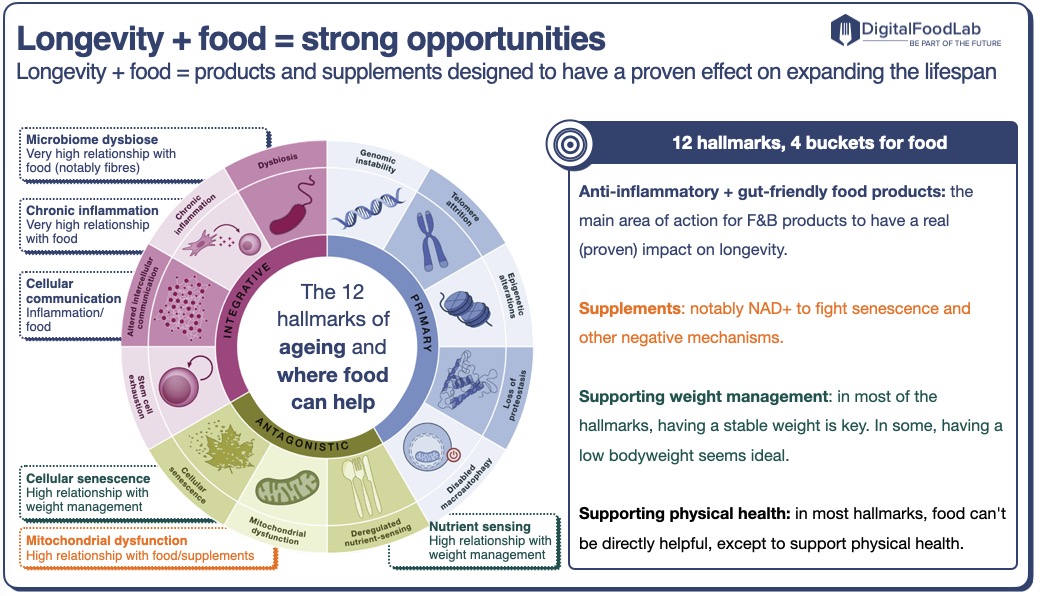
Of the 12 hallmarks of ageing, food can directly impact half of them. We can identify 4 “buckets” of ageing mechanisms on which food can have an impact:
- Anti-inflammatory + gut-friendly food products: it is the main way for food and beverage products to have a real and proven impact on longevity. The hallmarks targeted include chronic inflammation, microbiome dysbiosis and cellular communication.
- Supplements to act on mitochondrial dysfunction: NAD+ supplements are here especially interesting, with potential benefits on many other hallmarks.
- Supporting weight management: in most of the hallmarks, having a stable weight is key. In some, having a low bodyweight seems ideal.
- Supporting physical health: in most hallmarks, food in itself can’t be really helpful, while physical activity is widely proven to be beneficial.
3 – An innovation ecosystem in its early days
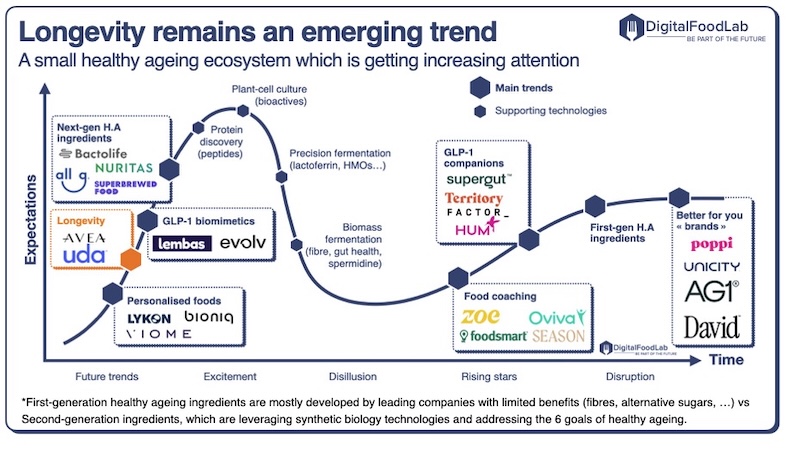
As shown on DigitalFoodLab’s trends curve, longevity remains an emerging topic in the agrifood context. We don’t yet fully understand the mechanisms of ageing, and activating them would require solutions more related to health and physical activity than food.
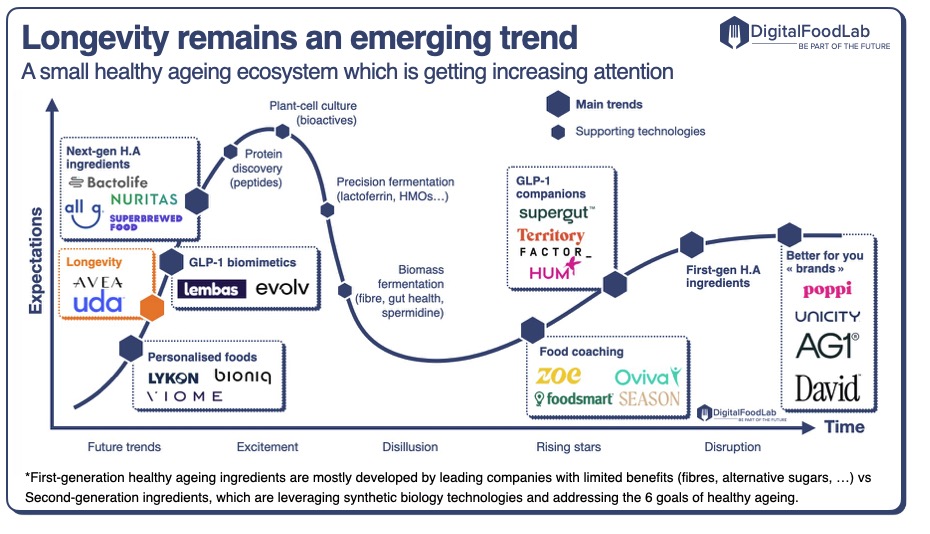
However, as we have seen, food and beverage products can have a positive effect on many levels, without even mentioning weight control. Key categories include:
- Promoting physical activity: that’s where we observe the most marketing innovation through protein enrichment of existing products, new DTC brands, coaching, and the development of new ingredients (such as Nuritas’ Peptistrong).
- Supporting gut health: that’s where we see the biggest potential. Innovation is happening all across the value chain, and at all stages of maturity, from new beverages (Poppi) to next-generation ingredients (Bactolife, Superbrewed).
- Immunity with ingredients such as lactoferrin.
- Longevity supplements, including NAD+
4 – Rising corporate involvement
The topic of longevity has long remained niche. However, the rise of GLP-1 drugs, followed by the current wave of biohacking (showing the growing will of a range of consumers to experiment on themselves) and the general population ageing, makes longevity much more appealing for large FMCG companies.
In the past few months alone, we have observed a rise in corporate communication on this topic, including:
- The investment from Unilever in the startup Novos (supplements targeting hallmarks of ageing)
- Danone’s acquisition of a Belgian company developing biotics for gut health benefits (including longevity)
- Nestlé recent release of its science results on the effects of NAD+ on longevity
We are still in the early days of a potential larger corporate involvement, as most players are still wondering how they want to play in the broader healthy ageing space. Many questions remain unanswered, notably the positioning of potential products: should they fall under their medical nutrition or CPG categories?
5 – How to move beyond awareness?
The potential market for longevity products and solutions is huge. Western populations are ageing, and wealth concentration makes it even more attractive. Also, as shown above, while most innovations are far from market-ready, those with underlying longevity benefits are already being launched.
There is no “one size fits all” path to longevity (or to healthy ageing as a whole). There are actually as many paths as there are companies. The key question isn’t “should we do something on longevity?” (the answer is almost certainly yes), but rather it’s “where is our entry point on this new market, and how do we approach it?”