FoodTech in 2026: A Year of Strategic Decisions

Published on February 16, 2026

Hi,

Following last week’s webinar on the trends shaping the future of food (you can watch the replay here) and the report’s release, we wanted to share some key learnings that point to structural shifts in the relationship between large agrifood companies and innovation.

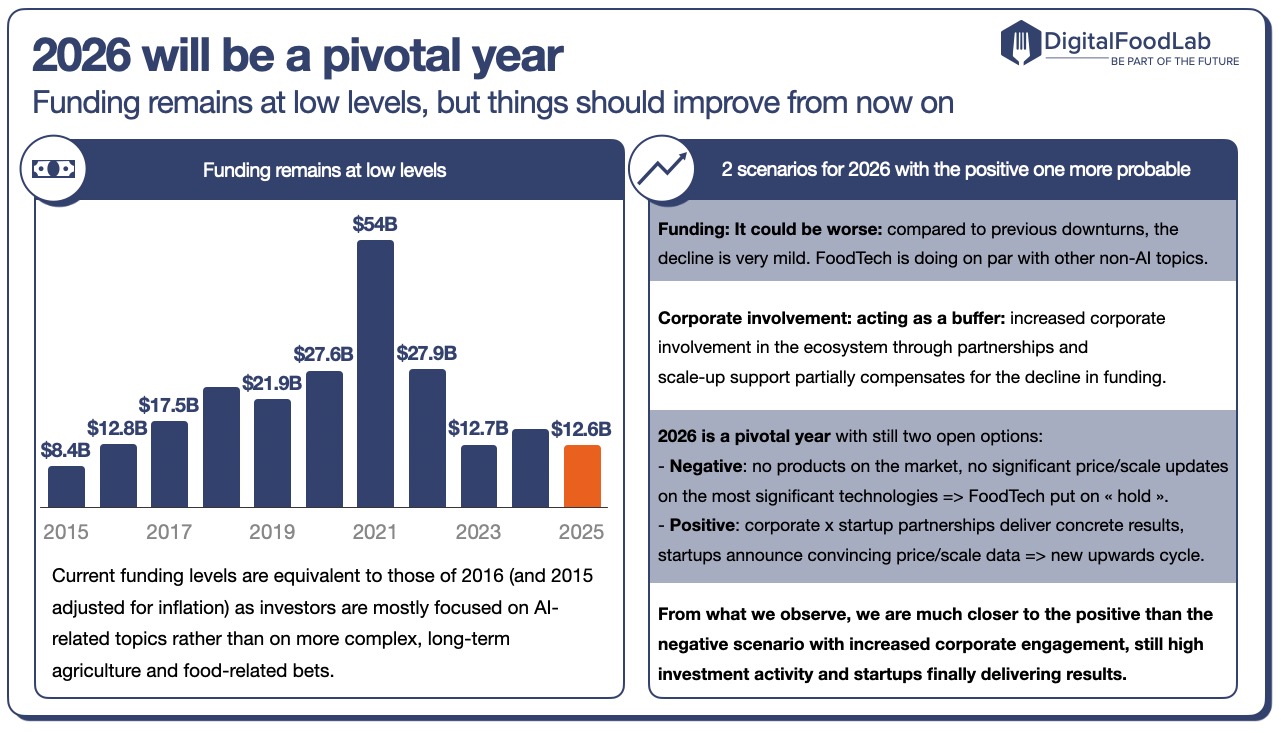
1 – 2026 will be a pivotal year

After almost four years of consolidation, and a current preference of investors for artificial intelligence, the ecosystem is doing much better than we could have anticipated:

  • It could be much worse: companies are still raising funds and are moving forward, and now that the AI hype is somewhat fading, a return to the companies trying to solve real-world issues could give a boost to the AgriFoodTech ecosystem.
  • Corporate involvement has acted as a buffer through a rise of commercialisation and scale-up partnerships.

Even if we don’t expect a bounce back in terms of funding (you can view the full list of our predictions for the year here), 2026 will be decisive in many ways, with two broad scenarios:

  • Negative: no products on the market, no significant price/scale updates on the most significant technologies => FoodTech put on « hold ».

  • Positive: corporate x startup partnerships deliver concrete results, startups announce convincing price/scale data => new upwards cycle.

Implications:

  • For startups: without surprise, the key theme of the year will be the ability to demonstrate industrial validation and consumer traction through corporate partnerships, small-scale product launches, clinical studies, field trials…
  • For corporations: this year should mark a shift from exploration to execution. The window to secure strong partners at rational valuations will not stay open forever.
DigitalFoodLab-trends-learnings-1-pivotal-year


2. The hype cycle is resetting and that’s healthy

Several segments that experienced peak excitement (notably alternative proteins, vertical farming, automation) are now deep into the disillusionment phase of the innovation cycle. At the same time, other themes such as healthy ageing are boosted by the current GLP-1 hype and gaining visibility, but without yet translating into structured industrial engagement.
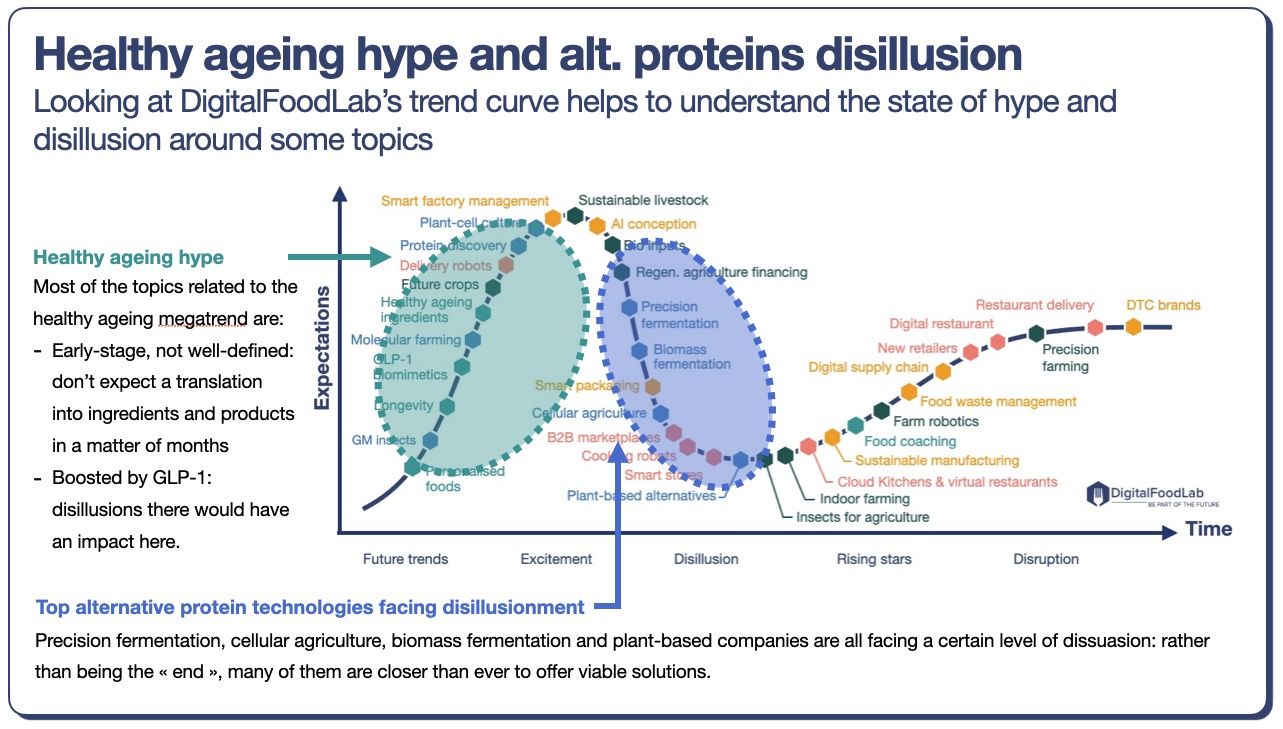
DigitalFoodLab-trends-learnings-2-trend-curve-disilusion-and-healthy-ageing

3 – Resilient farming: doing really well on almost all fronts

As shown in the trend curve, the components of the resilient farming megatrend  can be divided into two blocks:

  • Post-disillusion trends moving forward and getting increasingly adopted by the industry, such as precision farming and farm robotics
  • Hype trends such as sustainable livestock (reducing methane emissions) and bio-inputs, which have not yet validated from a business and technical point of view.

Both compartments are attracting increasing attention from large corporations, with the risk of some disappointment in the latter category, especially in regenerative agriculture, where companies are moving forward, but without the help of startups.
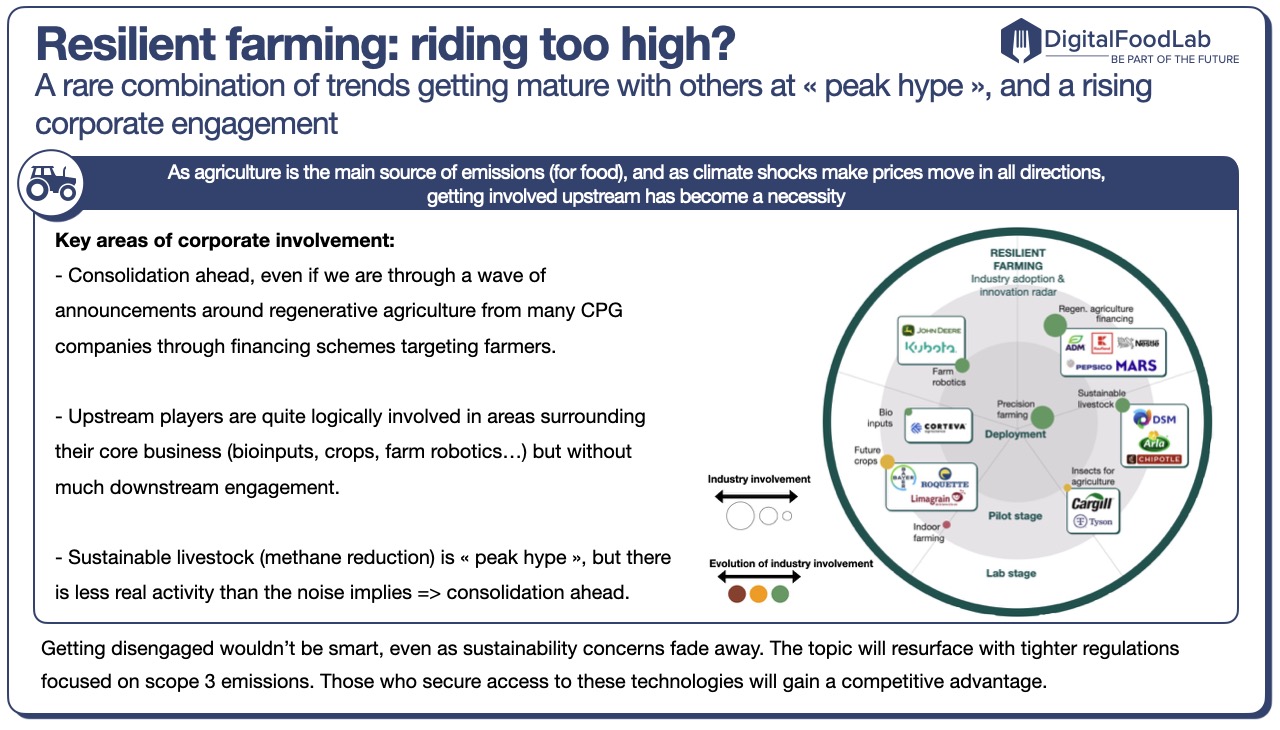
DigitalFoodLab-trends-learnings-3-resilient-farming-innovation-radar

4 – Sustainable ingredients: a really decisive year ahead

Sustainable ingredients, the category of players leveraging technologies such as precision fermentation and cellular agriculture, are entering a critical phase. The core question is no longer technological feasibility but rather about profitable scalability. More precisely:

  • From the point of view of both startups and corporates, it’s about which technology is best suited for which application.
  • Who will finance the scale-up, and what will be the business model?
  • Beyond niche functional ingredient applications, what would be the consequences of these technologies becoming economically viable at scale?

The coming 18 months will be decisive for:

  • Startups: many are running out of money or just raising barely enough to sustain their commercial activity (with no funding for industrialisation efforts). They will need to prove commercial traction to regain the confidence of investors.
  • Corporations: as the ecosystem consolidates, the number of players with whom to sign partnership deals decreases. It is now time to choose with whom to engage and to be clear on the goals.
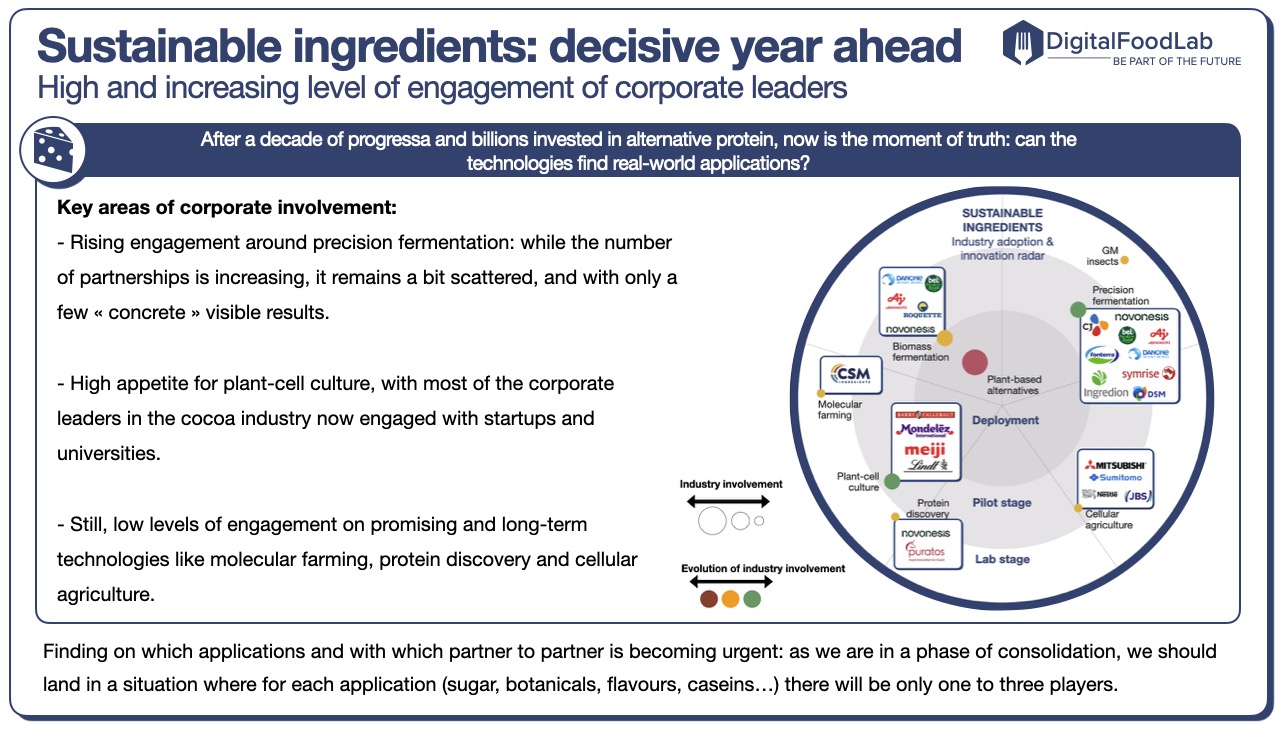
DigitalFoodLab-trends-learnings-4-sustainable-ingredients-innovation-radar


5 – Healthy ageing: very limited engagement beyond the hype

Healthy ageing and longevity are increasingly important narratives in the era of GLP-1, rising health concerns, and global demographic changes. However, from an innovation perspective, the ecosystem is still in its early days; hence, corporate engagement remains limited.
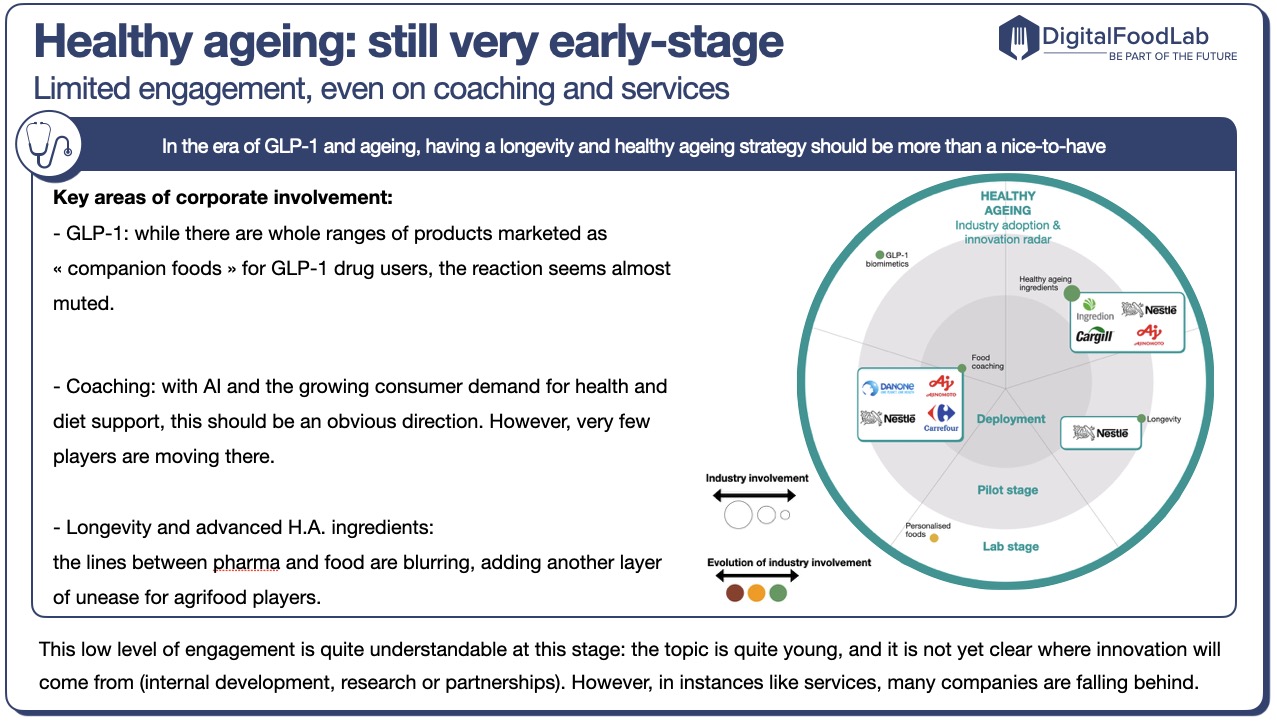
DigitalFoodLab-trends-learnings-5-healthy-ageing-innovation-radar


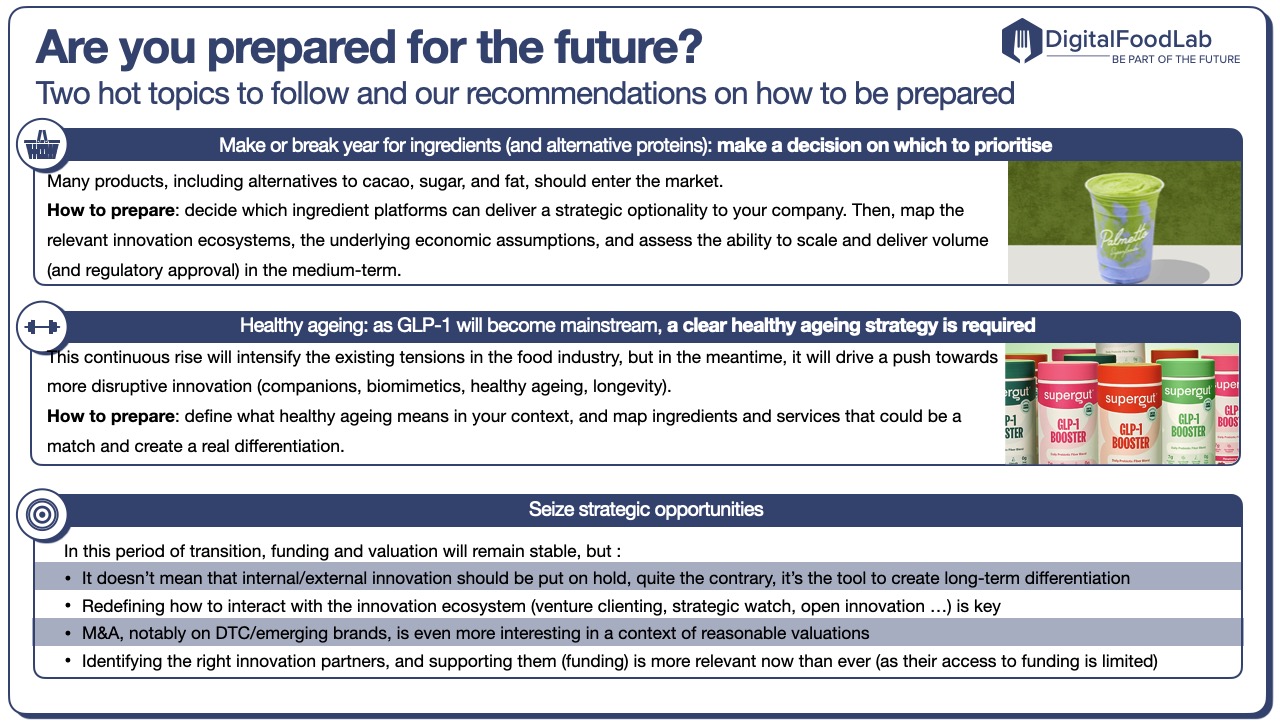
6 – Now, are you prepared for the future?
DigitalFoodLab trends learnings - 6 - conclusions and framework

Across all the themes covered in the report and in the webinar, the key takeaways and questions that need answers this year are:

  • Follow what’s happening around product launches this year (and ideally, test and taste the products) and develop answers to the questions:
    • Which combination of technology and application is relevant to you now, tomorrow and in the long-term?
    • What’s the plan to secure that on these key elements, you will gain a competitive advantage over your competitors?
  • GLP-1 and health: it’s now key to move beyond the hype and to define a clear healthy ageing strategy, both for startups and corporates, especially by answering the two following questions:
    • Are we aligned with the goal to promote health and longevity? If not, do we have sufficiently strong assets that will enable us to be increasingly against the tide?
    • Do we have a clear plan to accompany consumers increasingly seeking services and products promoting their health at different stages of their lives?
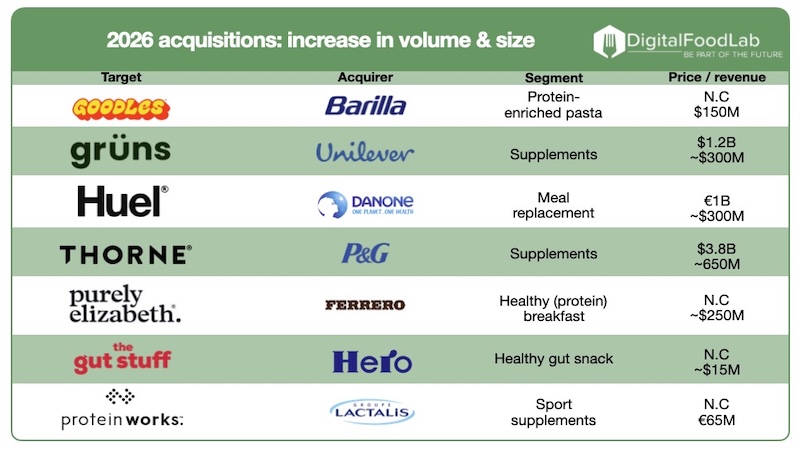
  • M&A: as funding and valuation remain low, what are the opportunities to seize upon before an eventual bounce back?

Meanwhile, you can still download and share the trends report, and let us know if you have any questions or would like to have access to the slides used during the webinar.

Have a great week,
Matthieu

You're in a good company

Join the 60+ clients of Digital FoodLab: leading agrifood companies, retailers, banks, investors, startups, and public organisations.

Use case: project for a global F&B company looking to map its AgTech innovation ecosystem and the best startups to partner with

What we did:

  • Mapping of the AgTech ecosystem: startups, research regulators, and other leading companies.
  • Discussion to select areas to focus on.
  • Analysis of the information to reveal the trends and a model to analyse eventual partners.
  • A workshop to validate the opportunities based on our recommendations.
  • Scouting of relevant partners followed by introductions.

Results:

  • Mapping the different categories of innovations in AgTech that should be considered now to create long-term benefits for the business.
  • Identification of key partners (an incubator and a couple of startups).

Use case: project for a CPG company on the healthy ageing ecosystem

What we did:

  • Education of the board through a couple of workshops to define the perimeter
  • Identification of key opportunities and threats created by long-term evolutions (technologies, business models, behavioural changes).
  • Deep dives on each of the priority categories.
  • Co-construction of a vision on how the company should address these challenges.
  • Identification of partners (startups, incubators, funds) to move forward.

Results:

  • Creating a consensus on which categories to prioritise and how to address them.
  • Implementation of an open innovation strategy through the development of partnerships.

Use case: project for a global CPG company to develop a strategy on the healthy ageing ecosystem

What we do (ongoing mission on a subscription model):

  • Kick-off where we present an overview of the AgriFoodTech ecosystem to select with the client the categories to cover and for each, the level of information required.
  • Monthly newsletter: each month we send a newsletter with the articles that we have gathered ranked by relevance, their summaries, and a layer of analysis.
  • Database: we set up a personalised database that will be filled month after month with the information gathered on the companies identified for the watch.
  • Workshops: twice a year with the client’s innovation team and other “innovation curious” team members, we present an overview of the evolutions, key trends and a dashboard of the topics followed by the watch.

Results:

  • A clear, regular and evolutive tool to follow what is happening in terms of innovation on key topics.
  • A forum (through the workshops) to discuss innovation trends and new opportunities.

Use case: opportunity screening for an ingredient company

What we did:

  • Kick-off to define the perimeter of the ecosystem studied.
  • Mapping of the different trends shaping the innovation ecosystem of the client.
  • Analysis of the trends on DigitalFoodLab’s trend curve and other relevant frameworks.
  • Workshop to discuss DigitalFoodLab’s recommendations on key trends to prioritise

Results:

  • Shared view of the innovation ecosystem for the client with a view of the trends to prioritize.
  • Clear document (personalised trend curve) that can be easily shared internaly to explain the company’s innovation choices and which can be then updated each year.

Use case: scouting for an agriculture coop

What we did:

  • Kick-off to define the perimeter of the client, the goals of the scouting (partnerships) and the criteria on which startups should be evaluated.
  • Set-up scouting: we selected the first batch of 20+ key startups following the criteria of the client.
  • On-going scouting: then we set up a quarterly scouting of about ten startups.
  • For each scouted startup, we created an ID card with key information such as the business and technological maturity, funding, and corporate partnerships. We also added an explanation of why we selected this startup.

Results:

  • An ongoing and evolutive scouting are matching the client's criteria and its capabilities in terms of deal flow.

Use case: working on an acquisition process for a CPG company

What we did:

  • Kick-off to define what the client is seeking, notably in terms of maturity.
  • Workshop with the client based on a mapping of the different innovation ecosystems adjacent to its activities to select some priorities and discuss inspiring examples of startup acquisition stories.
  • Identification of 20+ targets.
  • Workshop to select the most relevant to engage with.
  • DigitalFoodLab worked as a sparing partner during the acquisition process, notably to help design how the acquired startup could be integrated into the overall company’s strategy.

Results:

  • Different results from traditional M&A processes with a focus on the client’s innovation strategy.
  • Identification of a good match for an acquisition.

Use case: market due diligence on sugar alternatives

What we did:

  • Kick-off with the client to discuss its interest on this category, its expectations and existing level of information (notably on the target company).
  • Mapping of the ecosystem to analyse the different existing alternatives and technologies to compare them.
  • Interview (calls) with relevant startups made by our internal biotechnology expert.
  • Recommendation on whether to invest or not.

Results:

  • Clear view of the ecosystem and of the reasons to believe (or not) in each sub-category.
  • Enforceable recommendations based on facts and expertise.