Following our last insight summarising what we learned from 2025 (and how our predictions fared), here is what we think will happen in what will be a crucial year.
1️⃣ 2026 will be a make-or-break year for ingredients: after years of pushback, many products, including alternatives to cacao, sugar, and fat, should enter the market, providing a much-needed boost to the innovation ecosystem.
- We are focusing our attention on three types of ingredients for which we expect to see regulatory approvals and product launches during the year (in the US, most probably):
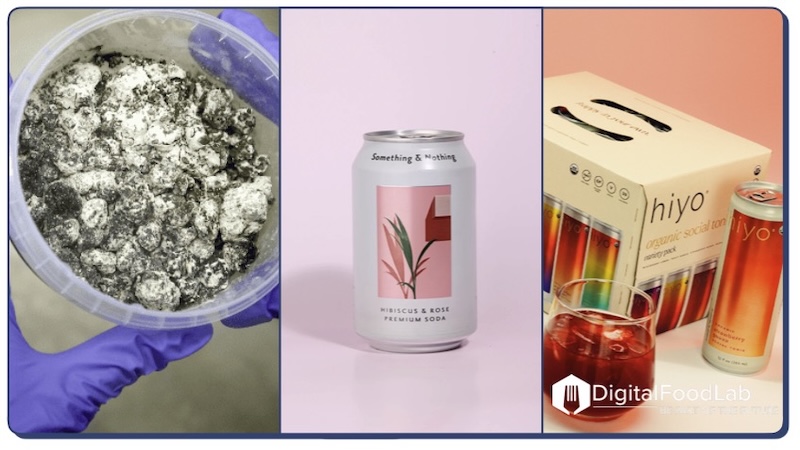
- cacao alternatives created through cellular agriculture
- sugar alternatives created through precision fermentation
- alternative protein created through biomass fermentation
- On the opposite, the year will remain complicated for other categories, including precision fermentation dairy.
- DigitalFoodLab’s conviction: don’t expect mass adoption yet, we are talking about limited editions by CPG companies, but this should help alleviate some of the doubts on these companies’ ability to reach relevant volumes.
2️⃣ GLP-1 will become mainstream in 2026, notably in emerging markets: it will intensify the existing tensions in the food industry (concentration, layoffs, restructuring), but in the meantime, it will drive a push towards more disruptive innovation.
- Inflection point in 2026: while GLP-1 drugs are widely used, they will become available and relevant to a huge share of the global population with more potent formulations (often referred as GLP-3, as they combine 3 molecules, to be more efficient), formats (pills instead of injections), studies eventually showing the benefits on the general population, and generics arriving in emerging markets (China, India).
- On the other side, we expect that the hype around GLP-1 boosters (both natural ones and bio-mimetics) to keep growing.
- DigitalFoodLab’s conviction: the agrifood industry will go beyond its playbook of consolidation/acquisition and will launch a second wave of innovations to support consumers in their journey through better ingredients, products, and services. We believe that the integration of these three points will be a game-changer.
3️⃣ Funding for the innovation ecosystem will remain flat
- The underlying reasons behind the current sluggish funding environment (funding for agrifood startup is not doing great as shown in our recent reports) are here to stay: relatively high inflation and interest rates, which make risky investments less rewarding, a preference for AI over anything else, global economic uncertainties accentuated by tariffs, and a lack of exits.
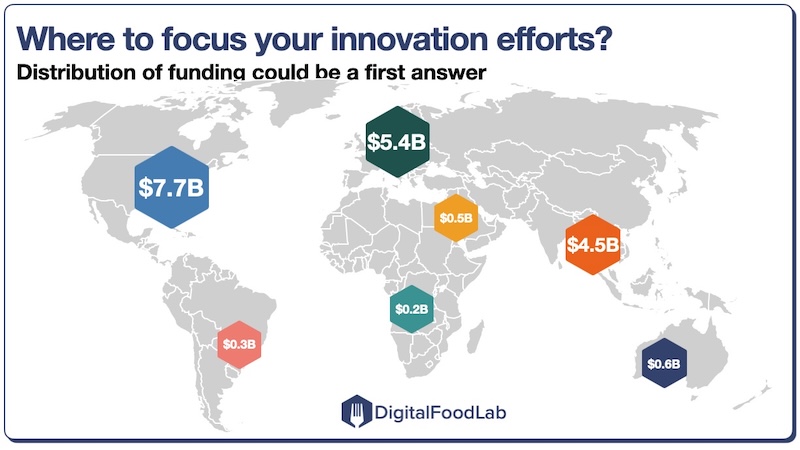
- In terms of geography, the US should be doing better with a third year of expansion, a stagnation in Europe, and maybe a small decline in Asia (as most of the funding was linked to a wave of funding in now mature delivery companies).
4️⃣ The ability to scale profitably will become the new metric as funding is becoming increasingly less relevant to evaluate the relevance of what’s happening. As a side effect, we will talk more and more about what is happening in China.
- From partnerships to scale: partnerships between large companies and startups have increased significantly in number and in scale in 2025, somehow compensating for the decrease in funding. Now, the question is whether these partnerships can deliver results, notably for new companies to scale their production.
- We expect this year to be about metrics of scale: instead of boasting how much money they have raised, startups will increasingly talk in bioreactor size, metric tons, and eventually in euros and dollars per kg.
- DigitalFoodLab’s conviction: China’s biotech capabilities will become a key part of the discussion, as it is already the case for artificial intelligence and pharma. Scaled-up production capabilities linked to the most advanced technologies opened or in construction in China will question the ability of “Western” players to win.

5️⃣ Robotics, longevity and sustainability are the three “other” topics to follow in 2026 beyond alternatives and GLP-1
- Consolidation around sustainability topics: after an impressive year, we expect a phase of reckoning and even of consolidation in some sub-categories, notably in:
- Regenerative agriculture financing (carbon credits notably): there are far too many players and it appears that large companies are creating financing incentives for farmers without using intermediaries.
- Sustainable livestock (methane blockers and vaccines) and bioinputs are in a better shape, and are two categories in which we see a strong potential for 2026. After raising so much money, they will now have to deliver concrete, measurable results (including on price), and for many, that will mean the end of the story.
- Robotics is the “new AI” topic, and will increase in relevance over the year with the launch of the first humanoid robots. Even if the first iterations of these robots seem quite limited, they will generate a lot of hype for foodservice applications.
- Longevity addressed through food is becoming an increasingly popular theme. Beyond food supplements and some high-end treatments, we expect it to become increasingly addressed by the “innovation ecosystem” in 2026, with products ready to be launched in the following years.
2026 will be a year of selection between winners and losers, between those who can scale innovation and those who cannot. This will be the case for both innovators and large companies, both facing strong headwinds:
- For disruptors, the main question will be whether they can scale while proving that their solution, ingredient, or service earns a profit down the line. This will apply at the company level, with still many bankruptcies ahead of us (a normal part of the innovation process), and also at the ecosystem level, with potentially whole sub-categories being wiped out.
- For their part, large companies will keep facing economic uncertainties and the cost of massive mergers, combined with growing consumer health concerns (GLP-1, UPF…). Some will retreat to their core business while others, the winners of tomorrow, will look out for new solutions to stand out.
In a word, for all, 2026 will be a challenging but exciting year, driven by the ability to scale innovation.
Also, as the year starts, I am sure you all know at least one person who would benefit from reading this newsletter to understand better what the future of food will be made of! You can forward the newsletter and add them to the list here.