🍔 Hybrid products are back – is it a good idea?

Published on June 5, 2024

Some topics have a funny habit of reappearing every few years in the food innovation ecosystem. Each time, a handful of startups raise money and often fail for the same reasons as their predecessors. However, that’s not always the case, and sometimes they can succeed either because the market conditions have changed or because they bring a new value proposition. One of these topics is hybrid products, which are currently making a comeback with some interesting arguments.

First, what do we mean by hybrids?  We can think about meat and dairy products where a significant part of animal proteins are substituted by other proteins (today, plants). However, as we’ll see, there are different applications, notably for alternative proteins.

1 – The traditional hybrids: animal products & plants

Many companies, from startups to leading brands, have tried to launch blends of meat and plants over the years. Let’s say they have not been rewarded with success. There are, however, some interesting exceptions, notably in the US with Perdue’s Chicken Plus nuggets, which are now blends of meat, vegetables, and mycoproteins.

This is the most active category in terms of innovation, with a range of innovators in the space:

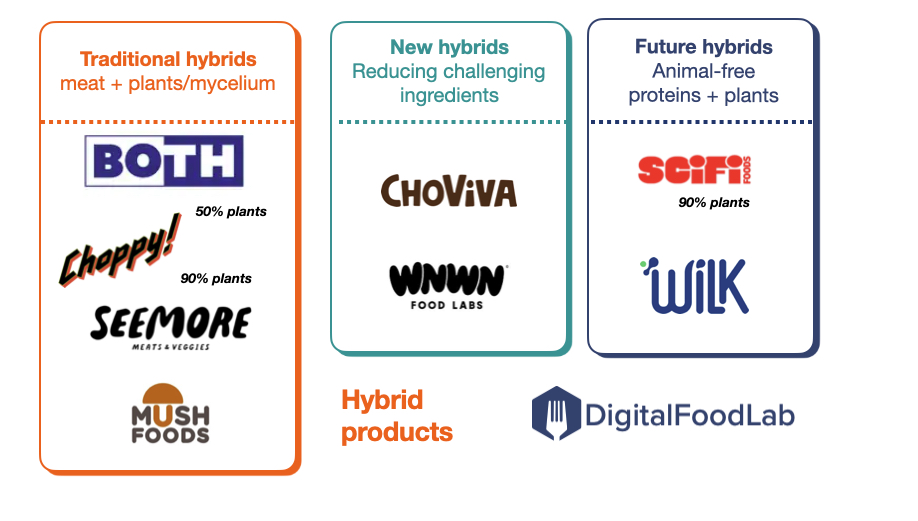
  • The most common types of players blend plants and meat with very different ratios and marketing: from the obvious 50% used by the well-named brand Both, or to 90% of plants Choppy.
  • Another emerging type of player is represented by Mush Foods with its blends of mycelium developed to be mixed with different kinds of meat or fish. It directly targets foodservice players with an argument on price.

A focus on the players who survived long enough to raise money and have actual clients point in an obvious direction: foodservice. For fast food restaurants and school canteens alike, having these products, which can reduce the price of meat and increase the amount of vegetables (for children) without removing anything to the taste, is a clear winner.

Consumers don’t know how to “read” these products and their complex messages. If you want to reduce your meat consumption for health and environmental concerns, it seems more straightforward to take one plant-based burger and one meat burger instead of two hybrids.

2 – The new hybrids: reducing “challenging” ingredients by plants

Hybrids go further than meat and plant blends. If the idea is to substitute a part of a key ingredient by plants, for reasons such as health, environment or cost, this can be applied to many things beyond meat. We can identify many companies which are developing alternatives to sugar, cocoa or coffee using plants. Some of them, notably for sugar and chocolate do not intend to be full substitutes but to enable brands to create hybrids. This is notably the case for sugar where replacing part of it with a compatible sweetener can help to receive a better “score” in countries with a mandatory nutritional display.

Another example is chocolate, with some startups such as Choviva developing a chocolate alternative which was used alongside “real” cocoa by Lindt in a limited edition.

We expect to see more and more of these “undisclosed” hybrid products created by brands with he help of B2B companies and startups. The simple use of 10 or 20% of their ingredient in a recipe will be able to improve a “score” and to create difference with the competition. This could be compounded by the emergence of nutritional scores (again, using a limited portion of plant substitues could reduce the impact of having “real” chocolate or coffee in your recipe).

3 – The future hybrids: animal-free products & plants

For startups using technologies such as cellular agriculture, hybrid products also make a lot of sense: their ingredients will be extremely expensive in the beginning and blending them with plants can help to make them affordable to the consumer.

That’s why many of them are already mentioning blends of animal-free meat or dairy ingredients and plants in their projects. This is notably the case of Wilk (cellular agriculture, breastmilk) which presented an hybrid yogurt with cultivated fat and plants or SciFi (cellular agriculture, meat) which says that its 90% plant-based hybrid beef will be soon on the market.

So, as I said at the beginning, some ideas come and go again and again. This time, it seems that hybrid products are here to stay. That’s an area where we are spending more and more time with clients discussing the best way to present them to the consumers and also which type of hybrid makes the most sense. As I often say when journalists ask me what the future of food will look like: “it will look exactly the same as what we know today, however, what’s inside the ingredients will be very different”. And in these ingredients, hybrids will become strategic. That’s why experimenting with them, and even taking the risk to fail, is also becoming strategically important for players seeking a place in the future of food.

You're in a good company

Join the 60+ clients of Digital FoodLab: leading agrifood companies, retailers, banks, investors, startups, and public organisations.

Use case: project for a global F&B company looking to map its AgTech innovation ecosystem and the best startups to partner with

What we did:

  • Mapping of the AgTech ecosystem: startups, research regulators, and other leading companies.
  • Discussion to select areas to focus on.
  • Analysis of the information to reveal the trends and a model to analyse eventual partners.
  • A workshop to validate the opportunities based on our recommendations.
  • Scouting of relevant partners followed by introductions.

Results:

  • Mapping the different categories of innovations in AgTech that should be considered now to create long-term benefits for the business.
  • Identification of key partners (an incubator and a couple of startups).

Use case: project for a CPG company on the healthy ageing ecosystem

What we did:

  • Education of the board through a couple of workshops to define the perimeter
  • Identification of key opportunities and threats created by long-term evolutions (technologies, business models, behavioural changes).
  • Deep dives on each of the priority categories.
  • Co-construction of a vision on how the company should address these challenges.
  • Identification of partners (startups, incubators, funds) to move forward.

Results:

  • Creating a consensus on which categories to prioritise and how to address them.
  • Implementation of an open innovation strategy through the development of partnerships.

Use case: project for a global CPG company to develop a strategy on the healthy ageing ecosystem

What we do (ongoing mission on a subscription model):

  • Kick-off where we present an overview of the AgriFoodTech ecosystem to select with the client the categories to cover and for each, the level of information required.
  • Monthly newsletter: each month we send a newsletter with the articles that we have gathered ranked by relevance, their summaries, and a layer of analysis.
  • Database: we set up a personalised database that will be filled month after month with the information gathered on the companies identified for the watch.
  • Workshops: twice a year with the client’s innovation team and other “innovation curious” team members, we present an overview of the evolutions, key trends and a dashboard of the topics followed by the watch.

Results:

  • A clear, regular and evolutive tool to follow what is happening in terms of innovation on key topics.
  • A forum (through the workshops) to discuss innovation trends and new opportunities.

Use case: opportunity screening for an ingredient company

What we did:

  • Kick-off to define the perimeter of the ecosystem studied.
  • Mapping of the different trends shaping the innovation ecosystem of the client.
  • Analysis of the trends on DigitalFoodLab’s trend curve and other relevant frameworks.
  • Workshop to discuss DigitalFoodLab’s recommendations on key trends to prioritise

Results:

  • Shared view of the innovation ecosystem for the client with a view of the trends to prioritize.
  • Clear document (personalised trend curve) that can be easily shared internaly to explain the company’s innovation choices and which can be then updated each year.

Use case: scouting for an agriculture coop

What we did:

  • Kick-off to define the perimeter of the client, the goals of the scouting (partnerships) and the criteria on which startups should be evaluated.
  • Set-up scouting: we selected the first batch of 20+ key startups following the criteria of the client.
  • On-going scouting: then we set up a quarterly scouting of about ten startups.
  • For each scouted startup, we created an ID card with key information such as the business and technological maturity, funding, and corporate partnerships. We also added an explanation of why we selected this startup.

Results:

  • An ongoing and evolutive scouting are matching the client's criteria and its capabilities in terms of deal flow.

Use case: working on an acquisition process for a CPG company

What we did:

  • Kick-off to define what the client is seeking, notably in terms of maturity.
  • Workshop with the client based on a mapping of the different innovation ecosystems adjacent to its activities to select some priorities and discuss inspiring examples of startup acquisition stories.
  • Identification of 20+ targets.
  • Workshop to select the most relevant to engage with.
  • DigitalFoodLab worked as a sparing partner during the acquisition process, notably to help design how the acquired startup could be integrated into the overall company’s strategy.

Results:

  • Different results from traditional M&A processes with a focus on the client’s innovation strategy.
  • Identification of a good match for an acquisition.

Use case: market due diligence on sugar alternatives

What we did:

  • Kick-off with the client to discuss its interest on this category, its expectations and existing level of information (notably on the target company).
  • Mapping of the ecosystem to analyse the different existing alternatives and technologies to compare them.
  • Interview (calls) with relevant startups made by our internal biotechnology expert.
  • Recommendation on whether to invest or not.

Results:

  • Clear view of the ecosystem and of the reasons to believe (or not) in each sub-category.
  • Enforceable recommendations based on facts and expertise.