🌱🚜 Bioinputs: making agriculture more sustainable

Published on July 3, 2024

Here, we often talk about the link between agriculture and climate change. It’s mostly then to focus on animal proteins. However, today, I’d like to go upstream and look at the inputs used for agriculture. Just consider that agriculture accounts for 70% of all freshwater withdrawals, and synthetic nitrogen fertilisers account for 2.1% of global greenhouse gas emissions. This last figure is about equivalent to what the aviation industry emits. So, in a word, there is an urgent need for alternatives to reduce the amount of inputs required in agriculture. For clarity, we call this broad category of solutions bioinputs.

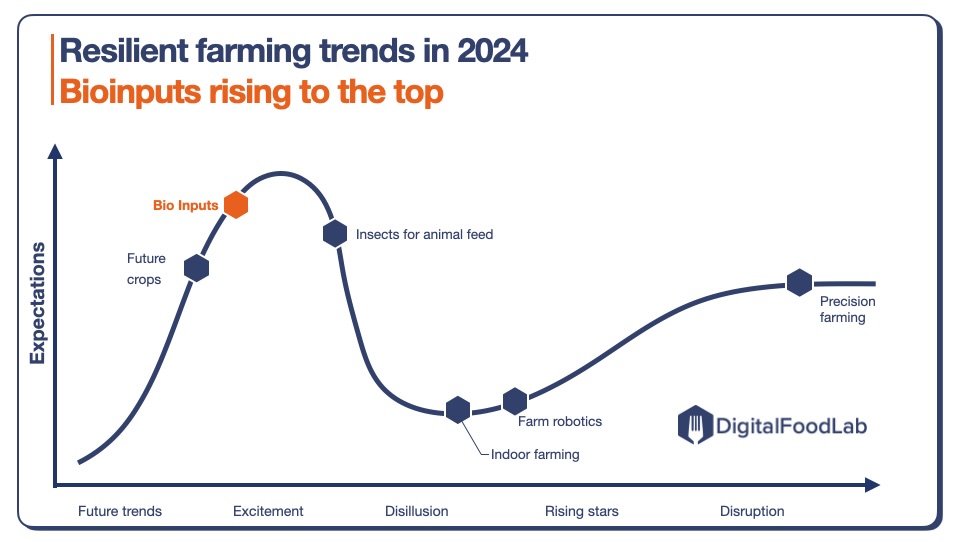
Entrepreneurs, investors, and large companies understand that well. In parallel with the global increase in energy costs, the “bioinputs” trend has risen. It is now at the top of the overall “resilient farm” megatrend (for more info on the other trends, here is the link to our 2024 trends report). Bioinputs match this trend really well as they make the farm more sustainable in the short term and also help it to be more resilient in the future (by being more adapted to the consequences of climate change).

Multiple categories of bioinputs

We can identify at two main categories of bioinputs:

1 – Alternatives to nitrogen-based fertilisers (itself produced from natural gas or coal), with again multiple categories of players, notably:

  • Biostimulants, such as Aphea.bio which uses bacteria to reduce the amount of nitrogen required.
  • Biofertilisers, such as Pivot Bio which uses microbes to naturally fix atmospheric nitrogen.

2 – Biopesticides are biological agents (notably microbes) used to used to control pest in order to repalce broad-spectrum chemical pesticides (example: BioConsortia which develops multiples products).

BioConsortia

They bring multiple benefits:

  • Reduced environmental impact, notably in comparison with chemical inputs which can lead to soil degradation, water pollution, and loss of biodiversity.
  • Improved soil health: biofertilizers and biostimulants enrich the soil with essential nutrients and beneficial microorganisms. This not only boosts crop yields but also enhances soil structure and fertility over the long term.

However, switching to bioinputs comes with its challenges:

  • Scale: most are still produced at small scale, or have not yet even been tested enough to be deployed. We observe increasing investments in startups and more engagement from agrifood leaders This should help help with this challenge.
  • Cost: linked to scale, most bioinputs are more expensive than existing solutions. Both rising energy cost and more demanding regulations help to create more interest for bioinputs.
  • Farmers awareness of the existence of bioinputs (and willingness to change their habits)
  • Efficiency limits: while chemical-based solutions can work on most types of conditions, bioinputs can have some limitations that will take time to be better understood.

While complex, the bioinputs ecosystem is one of the most active and exciting in AgriFoodTech, with relevant players all over the world. More interestingly even, it’s getting interest not only from upstream agrifood players, commodity traders, or seed manufacturers, but also from CPG and other downstream companies.

That’s something we are spending more and more time on with clients to help them understand the ecosystem of innovation, scout partners and identify the best path of action. Indeed, as they are getting more and more concerned by their scope 3 emissions (basically everything beyond manufacturing and transport, which in food mostly means agriculture inputs), they need to be able to present more sustainable solutions to the farmers they are partnering with.

You're in a good company

Join the 60+ clients of Digital FoodLab: leading agrifood companies, retailers, banks, investors, startups, and public organisations.

Use case: project for a global F&B company looking to map its AgTech innovation ecosystem and the best startups to partner with

What we did:

  • Mapping of the AgTech ecosystem: startups, research regulators, and other leading companies.
  • Discussion to select areas to focus on.
  • Analysis of the information to reveal the trends and a model to analyse eventual partners.
  • A workshop to validate the opportunities based on our recommendations.
  • Scouting of relevant partners followed by introductions.

Results:

  • Mapping the different categories of innovations in AgTech that should be considered now to create long-term benefits for the business.
  • Identification of key partners (an incubator and a couple of startups).

Use case: project for a CPG company on the healthy ageing ecosystem

What we did:

  • Education of the board through a couple of workshops to define the perimeter
  • Identification of key opportunities and threats created by long-term evolutions (technologies, business models, behavioural changes).
  • Deep dives on each of the priority categories.
  • Co-construction of a vision on how the company should address these challenges.
  • Identification of partners (startups, incubators, funds) to move forward.

Results:

  • Creating a consensus on which categories to prioritise and how to address them.
  • Implementation of an open innovation strategy through the development of partnerships.

Use case: project for a global CPG company to develop a strategy on the healthy ageing ecosystem

What we do (ongoing mission on a subscription model):

  • Kick-off where we present an overview of the AgriFoodTech ecosystem to select with the client the categories to cover and for each, the level of information required.
  • Monthly newsletter: each month we send a newsletter with the articles that we have gathered ranked by relevance, their summaries, and a layer of analysis.
  • Database: we set up a personalised database that will be filled month after month with the information gathered on the companies identified for the watch.
  • Workshops: twice a year with the client’s innovation team and other “innovation curious” team members, we present an overview of the evolutions, key trends and a dashboard of the topics followed by the watch.

Results:

  • A clear, regular and evolutive tool to follow what is happening in terms of innovation on key topics.
  • A forum (through the workshops) to discuss innovation trends and new opportunities.

Use case: opportunity screening for an ingredient company

What we did:

  • Kick-off to define the perimeter of the ecosystem studied.
  • Mapping of the different trends shaping the innovation ecosystem of the client.
  • Analysis of the trends on DigitalFoodLab’s trend curve and other relevant frameworks.
  • Workshop to discuss DigitalFoodLab’s recommendations on key trends to prioritise

Results:

  • Shared view of the innovation ecosystem for the client with a view of the trends to prioritize.
  • Clear document (personalised trend curve) that can be easily shared internaly to explain the company’s innovation choices and which can be then updated each year.

Use case: scouting for an agriculture coop

What we did:

  • Kick-off to define the perimeter of the client, the goals of the scouting (partnerships) and the criteria on which startups should be evaluated.
  • Set-up scouting: we selected the first batch of 20+ key startups following the criteria of the client.
  • On-going scouting: then we set up a quarterly scouting of about ten startups.
  • For each scouted startup, we created an ID card with key information such as the business and technological maturity, funding, and corporate partnerships. We also added an explanation of why we selected this startup.

Results:

  • An ongoing and evolutive scouting are matching the client's criteria and its capabilities in terms of deal flow.

Use case: working on an acquisition process for a CPG company

What we did:

  • Kick-off to define what the client is seeking, notably in terms of maturity.
  • Workshop with the client based on a mapping of the different innovation ecosystems adjacent to its activities to select some priorities and discuss inspiring examples of startup acquisition stories.
  • Identification of 20+ targets.
  • Workshop to select the most relevant to engage with.
  • DigitalFoodLab worked as a sparing partner during the acquisition process, notably to help design how the acquired startup could be integrated into the overall company’s strategy.

Results:

  • Different results from traditional M&A processes with a focus on the client’s innovation strategy.
  • Identification of a good match for an acquisition.

Use case: market due diligence on sugar alternatives

What we did:

  • Kick-off with the client to discuss its interest on this category, its expectations and existing level of information (notably on the target company).
  • Mapping of the ecosystem to analyse the different existing alternatives and technologies to compare them.
  • Interview (calls) with relevant startups made by our internal biotechnology expert.
  • Recommendation on whether to invest or not.

Results:

  • Clear view of the ecosystem and of the reasons to believe (or not) in each sub-category.
  • Enforceable recommendations based on facts and expertise.