When fertilisers become the food system’s weak point

Published on March 17, 2026

In history, rulers often tried to avoid going to war in the spring, for the sowing season, and in the autumn, as the harvest required most of the country’s workforce to be the fields. Messing with the agricultural calendar was a sure recipe for disaster. The war in Iran and its consequences on the availability of resources are reminding us of these historical lessons. Indeed, input prices are exploding, and the consequences could be dire.

1 – Urea prices are skyrocketing (again)

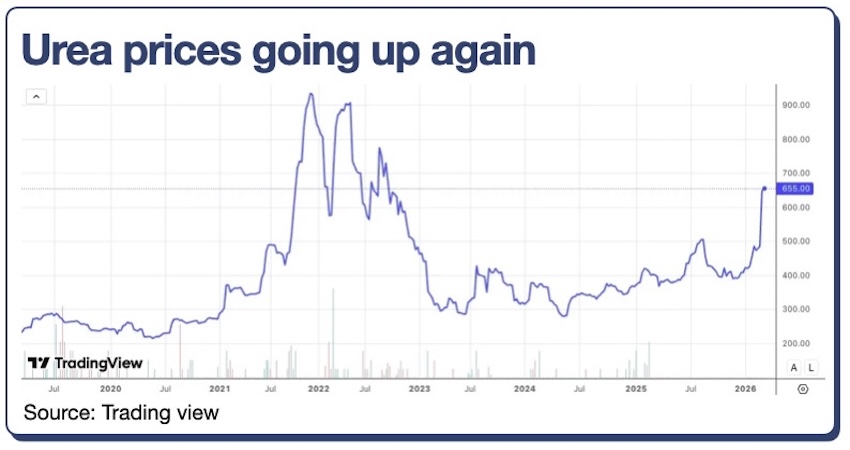
As you can see on the graph below, urea prices have increased significantly since the start of the war in Iran. For many, this is reminiscent of the peaks observed in 2022 when Russia’s invasion of Ukraine started.

As the world’s supply of natural gas is being strangled, we are also discovering a global dependency on the Middle East on Urea, a nitrogen fertiliser key for agriculture (and produced with natural gas). As urea granules are much more convenient to ship than gas, a large share is transformed directly where gas is extracted. And as it is considered a commodity, and not a strategic one like petrol, a tiny amount is being stocked.
Urea-prices-going-up-again

2 – Potentially dire consequences

As shown in the graph, fertilisers feed roughly half the world’s population. When sanctions on Russian exports took effect in 2022, fertiliser prices spiked, and those shocks were reflected in food commodity prices.
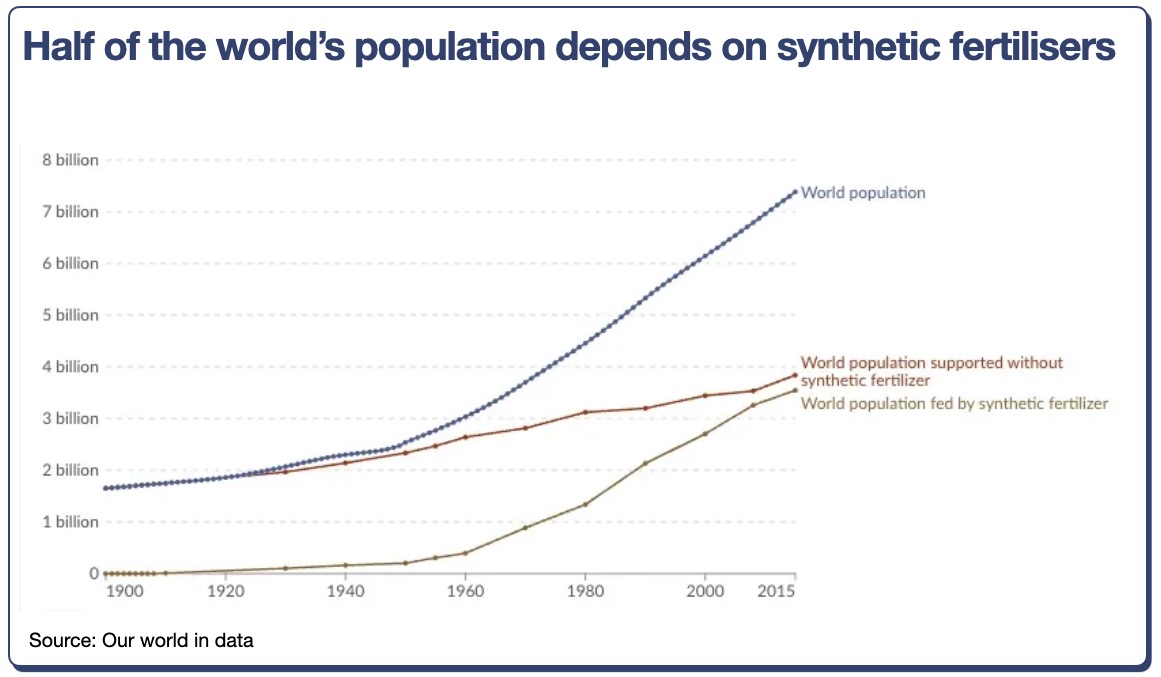
Half-of-the-worlds-population-depends-on-synthetic-fertilisers


If the supply is restored shortly, the consequences should be light. However, a long-term reduction in availability, leading many farmers in the Northern hemisphere to reduce their use of fertiliser, could have severe repercussions by the end of the year in the world’s poorest regions.

3 – How can innovation help us reduce our dependency on synthetic fertilisers?

It’s simply not feasible to do without synthetic fertiliser from one day to the next. Reducing their use progressively can be part of the solution, as can decreasing our meat consumption (a large share of crops is used to feed animals), but that’s not really realistic given current trends, which all point in the opposite direction.

Beyond conflicts, fertilisers are already responsible for about a quarter of cropland emissions, and their use is rising fast in developing economies. For any food company looking to decrease its scope 3 emissions, this is the bigger lever to play on alongside animal emissions.

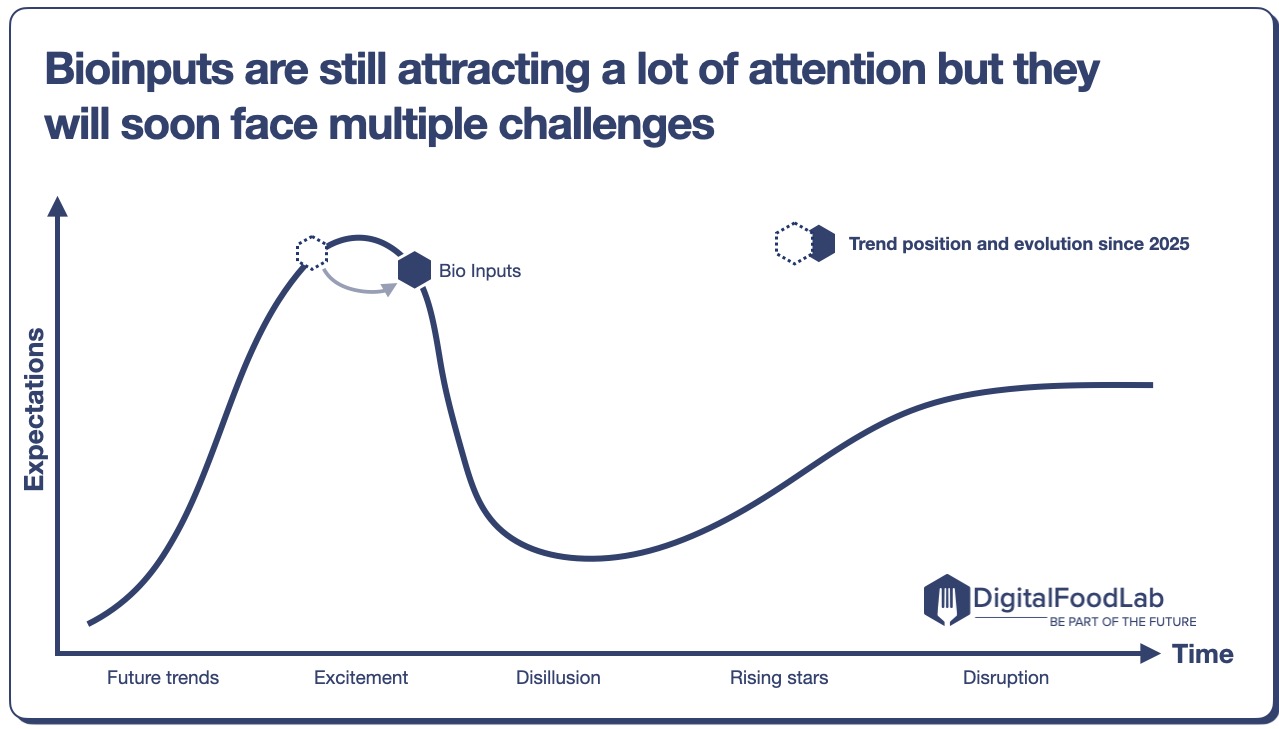
In 2022, as synthetic fertiliser prices skyrocketed, we observed a surge in investor appetite for alternatives as well as the resilient farming ecosystem. Four years later, many of the companies that emerged or got funded at that time have now matured and are ready to scale. The renewed urgency created by the current event could again boost this innovation ecosystem.
Bioinputs-are-still-attracting-a-lot-of-attention-but-they-will-soon-face-multiple-challenges

Bioinputs are not only about alternatives to synthetic-based fertilisers. The ecosystem has developed significantly and includes tens of startups across categories as diverse as bio-pesticides and soil microbiome solutions (such as Pivot Bio, Indigo, or Aphea Bio), which boost soil health while reducing the need for external sources of nitrogen.

But despite the growing interest, scaling these solutions remains difficult. Most bioinputs still face structural challenges:

  • Scale: production remains limited, and scaling microbial solutions is complex.
  • Localisation: unlike synthetic fertilisers, biological solutions often need to be adapted to specific crops and geographies (and to match local regulation).
  • Cost: fertilisers are still treated as commodities, and agricultural emissions are rarely prioritised in corporate decarbonisation strategies.

For most food companies, fertilisers are considered a distant upstream issue, even if they are a critical part of the supply chain and responsible for a significant share of agricultural emissions and production costs.

This second fertiliser shock in less than five years should be a reminder that inputs are not just a farming issue. Downstream food companies have spent the past decade focusing on ingredients and consumer trends. The next decade may require them to pay much closer attention to farm inputs. Developing an internal understanding of where things stand would be the first stage. Then, supporting localised experimentation would help to gain knowledge and increase their long-term resilience.

You're in a good company

Join the 60+ clients of Digital FoodLab: leading agrifood companies, retailers, banks, investors, startups, and public organisations.

Use case: project for a global F&B company looking to map its AgTech innovation ecosystem and the best startups to partner with

What we did:

  • Mapping of the AgTech ecosystem: startups, research regulators, and other leading companies.
  • Discussion to select areas to focus on.
  • Analysis of the information to reveal the trends and a model to analyse eventual partners.
  • A workshop to validate the opportunities based on our recommendations.
  • Scouting of relevant partners followed by introductions.

Results:

  • Mapping the different categories of innovations in AgTech that should be considered now to create long-term benefits for the business.
  • Identification of key partners (an incubator and a couple of startups).

Use case: project for a CPG company on the healthy ageing ecosystem

What we did:

  • Education of the board through a couple of workshops to define the perimeter
  • Identification of key opportunities and threats created by long-term evolutions (technologies, business models, behavioural changes).
  • Deep dives on each of the priority categories.
  • Co-construction of a vision on how the company should address these challenges.
  • Identification of partners (startups, incubators, funds) to move forward.

Results:

  • Creating a consensus on which categories to prioritise and how to address them.
  • Implementation of an open innovation strategy through the development of partnerships.

Use case: project for a global CPG company to develop a strategy on the healthy ageing ecosystem

What we do (ongoing mission on a subscription model):

  • Kick-off where we present an overview of the AgriFoodTech ecosystem to select with the client the categories to cover and for each, the level of information required.
  • Monthly newsletter: each month we send a newsletter with the articles that we have gathered ranked by relevance, their summaries, and a layer of analysis.
  • Database: we set up a personalised database that will be filled month after month with the information gathered on the companies identified for the watch.
  • Workshops: twice a year with the client’s innovation team and other “innovation curious” team members, we present an overview of the evolutions, key trends and a dashboard of the topics followed by the watch.

Results:

  • A clear, regular and evolutive tool to follow what is happening in terms of innovation on key topics.
  • A forum (through the workshops) to discuss innovation trends and new opportunities.

Use case: opportunity screening for an ingredient company

What we did:

  • Kick-off to define the perimeter of the ecosystem studied.
  • Mapping of the different trends shaping the innovation ecosystem of the client.
  • Analysis of the trends on DigitalFoodLab’s trend curve and other relevant frameworks.
  • Workshop to discuss DigitalFoodLab’s recommendations on key trends to prioritise

Results:

  • Shared view of the innovation ecosystem for the client with a view of the trends to prioritize.
  • Clear document (personalised trend curve) that can be easily shared internaly to explain the company’s innovation choices and which can be then updated each year.

Use case: scouting for an agriculture coop

What we did:

  • Kick-off to define the perimeter of the client, the goals of the scouting (partnerships) and the criteria on which startups should be evaluated.
  • Set-up scouting: we selected the first batch of 20+ key startups following the criteria of the client.
  • On-going scouting: then we set up a quarterly scouting of about ten startups.
  • For each scouted startup, we created an ID card with key information such as the business and technological maturity, funding, and corporate partnerships. We also added an explanation of why we selected this startup.

Results:

  • An ongoing and evolutive scouting are matching the client's criteria and its capabilities in terms of deal flow.

Use case: working on an acquisition process for a CPG company

What we did:

  • Kick-off to define what the client is seeking, notably in terms of maturity.
  • Workshop with the client based on a mapping of the different innovation ecosystems adjacent to its activities to select some priorities and discuss inspiring examples of startup acquisition stories.
  • Identification of 20+ targets.
  • Workshop to select the most relevant to engage with.
  • DigitalFoodLab worked as a sparing partner during the acquisition process, notably to help design how the acquired startup could be integrated into the overall company’s strategy.

Results:

  • Different results from traditional M&A processes with a focus on the client’s innovation strategy.
  • Identification of a good match for an acquisition.

Use case: market due diligence on sugar alternatives

What we did:

  • Kick-off with the client to discuss its interest on this category, its expectations and existing level of information (notably on the target company).
  • Mapping of the ecosystem to analyse the different existing alternatives and technologies to compare them.
  • Interview (calls) with relevant startups made by our internal biotechnology expert.
  • Recommendation on whether to invest or not.

Results:

  • Clear view of the ecosystem and of the reasons to believe (or not) in each sub-category.
  • Enforceable recommendations based on facts and expertise.