Q1 2026 funding: corporates take back control

Published on April 9, 2026

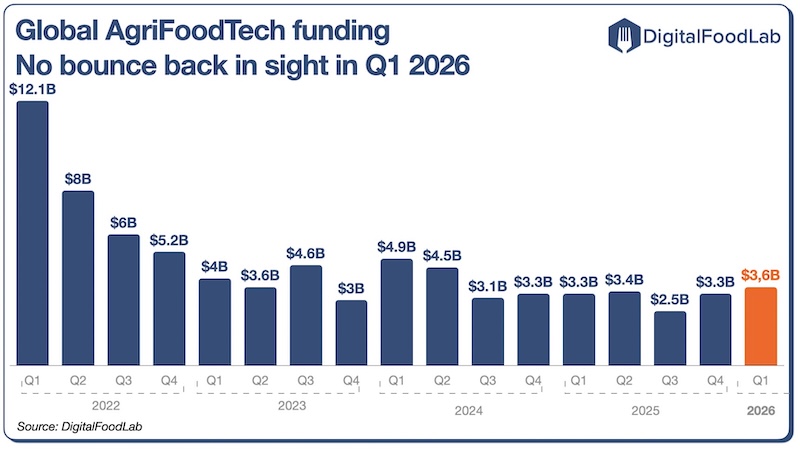
As indicated in our predictions at the start of the year, funding is not coming back to its hype levels, but that’s probably not the most important point anymore. Indeed, beyond the data and the deals, things are moving underground with a renewed appetite for AgriFoodTech topics.


Funding remains stable

Fact: funding remains stable with about $3.6B raised by AgriFoodTech startups in Q1 2026. As shown in the graph above, funding increased slightly in the first quarter of the year compared to the end of 2025.

Beyond funding, an accumulation of positive signals: as shown below, multiple signs indicate that the situation is improving. The main point is probably the uptick in corporate appetite, which is manifesting in partnerships and acquisitions. The ecosystem remains fragile, but if some of those partnerships start delivering results, we could observe a funding bounce back in the coming quarters.


Geography: a return to an equilibrium between the main innovation hubs

Funding-distribution-Q1-2026-DigitalFoodLab

After some movements last year around a couple of mega deals in US startups, we are going back to a more traditional distribution of funding. We observe:

  • A bump of funding in Oceania due to the $200M+ deal in Halter (see below)
  • An increase in South-East Asia and India around supply chain startups, with a focus on tools to better digitise farmers and help them connect with their clients.


Most interesting deals, acquisitions and partnerships of the quarter

Looking back at all the largest deals of the quarter, here are four key signals:

1️⃣ Corporations are taking back control, with high-value acquisitions (which come alongside the flurry of consolidation deals between large agrifood companies) and partnerships. Key acquisitions include:


2️⃣ The larger deals were focused on the hidden parts of the value chain, in agriculture and infrastructure:


3️⃣ Emerging brands are reshaping the CPG landscape and answering the consumer demand for innovation:

  • In the short-term, as analysed in this insight published earlier this year, and confirmed by the recent stream of acquisitions and investment deals, brands are starting to eat the lunch of major brands, at least in terms of value creation. This is even more visible in brands that are answering new consumers’ needs (performance, GLP-1 companions, processing concerns…).
  • For the long-term, with the surge of interest for healthy ageing, and especially, this quarter with a focus on women’s health (through supplements and companies like Biologica, which raised $7M) and longevity, with announcements from leading companies including Unilever’s investment in Novos, and the $100M invested in Loyal.

Top-deals-Q1-2026

So, what to expect for the near future?

As mentioned in our predictions, 2026 will be and is already all about scalability. Funding may remain stable in the coming quarters, but this is no longer the only metric to watch. A real shift is happening elsewhere: in the acceleration of acquisitions, in the growing role of corporates, and in the emergence of solutions that are no longer just promises but which are becoming deployable (or at least which will be so in the foreseeable future).

That’s why most investors, as well as large companies, are focused on execution. Every day, we see signs that the desire for innovation for its own sake is waning. Instead, the goal is to find new solutions that can have a concrete impact on tense supply chains, thin margins and wavering differentiation.

In this context, tomorrow’s winners won’t be those who invested or partnered first in startups or in new technologies, but those who are able to demonstrate an ability to leverage innovation now. And, for most companies, this shift is still not really well understood.

You're in a good company

Join the 60+ clients of Digital FoodLab: leading agrifood companies, retailers, banks, investors, startups, and public organisations.

Use case: project for a global F&B company looking to map its AgTech innovation ecosystem and the best startups to partner with

What we did:

  • Mapping of the AgTech ecosystem: startups, research regulators, and other leading companies.
  • Discussion to select areas to focus on.
  • Analysis of the information to reveal the trends and a model to analyse eventual partners.
  • A workshop to validate the opportunities based on our recommendations.
  • Scouting of relevant partners followed by introductions.

Results:

  • Mapping the different categories of innovations in AgTech that should be considered now to create long-term benefits for the business.
  • Identification of key partners (an incubator and a couple of startups).

Use case: project for a CPG company on the healthy ageing ecosystem

What we did:

  • Education of the board through a couple of workshops to define the perimeter
  • Identification of key opportunities and threats created by long-term evolutions (technologies, business models, behavioural changes).
  • Deep dives on each of the priority categories.
  • Co-construction of a vision on how the company should address these challenges.
  • Identification of partners (startups, incubators, funds) to move forward.

Results:

  • Creating a consensus on which categories to prioritise and how to address them.
  • Implementation of an open innovation strategy through the development of partnerships.

Use case: project for a global CPG company to develop a strategy on the healthy ageing ecosystem

What we do (ongoing mission on a subscription model):

  • Kick-off where we present an overview of the AgriFoodTech ecosystem to select with the client the categories to cover and for each, the level of information required.
  • Monthly newsletter: each month we send a newsletter with the articles that we have gathered ranked by relevance, their summaries, and a layer of analysis.
  • Database: we set up a personalised database that will be filled month after month with the information gathered on the companies identified for the watch.
  • Workshops: twice a year with the client’s innovation team and other “innovation curious” team members, we present an overview of the evolutions, key trends and a dashboard of the topics followed by the watch.

Results:

  • A clear, regular and evolutive tool to follow what is happening in terms of innovation on key topics.
  • A forum (through the workshops) to discuss innovation trends and new opportunities.

Use case: opportunity screening for an ingredient company

What we did:

  • Kick-off to define the perimeter of the ecosystem studied.
  • Mapping of the different trends shaping the innovation ecosystem of the client.
  • Analysis of the trends on DigitalFoodLab’s trend curve and other relevant frameworks.
  • Workshop to discuss DigitalFoodLab’s recommendations on key trends to prioritise

Results:

  • Shared view of the innovation ecosystem for the client with a view of the trends to prioritize.
  • Clear document (personalised trend curve) that can be easily shared internaly to explain the company’s innovation choices and which can be then updated each year.

Use case: scouting for an agriculture coop

What we did:

  • Kick-off to define the perimeter of the client, the goals of the scouting (partnerships) and the criteria on which startups should be evaluated.
  • Set-up scouting: we selected the first batch of 20+ key startups following the criteria of the client.
  • On-going scouting: then we set up a quarterly scouting of about ten startups.
  • For each scouted startup, we created an ID card with key information such as the business and technological maturity, funding, and corporate partnerships. We also added an explanation of why we selected this startup.

Results:

  • An ongoing and evolutive scouting are matching the client's criteria and its capabilities in terms of deal flow.

Use case: working on an acquisition process for a CPG company

What we did:

  • Kick-off to define what the client is seeking, notably in terms of maturity.
  • Workshop with the client based on a mapping of the different innovation ecosystems adjacent to its activities to select some priorities and discuss inspiring examples of startup acquisition stories.
  • Identification of 20+ targets.
  • Workshop to select the most relevant to engage with.
  • DigitalFoodLab worked as a sparing partner during the acquisition process, notably to help design how the acquired startup could be integrated into the overall company’s strategy.

Results:

  • Different results from traditional M&A processes with a focus on the client’s innovation strategy.
  • Identification of a good match for an acquisition.

Use case: market due diligence on sugar alternatives

What we did:

  • Kick-off with the client to discuss its interest on this category, its expectations and existing level of information (notably on the target company).
  • Mapping of the ecosystem to analyse the different existing alternatives and technologies to compare them.
  • Interview (calls) with relevant startups made by our internal biotechnology expert.
  • Recommendation on whether to invest or not.

Results:

  • Clear view of the ecosystem and of the reasons to believe (or not) in each sub-category.
  • Enforceable recommendations based on facts and expertise.