Is food a bigger threat than AI? What the Lancet tells the food industry

Published on October 12, 2026

Ahead of our upcoming webinar on global FoodTech investment and trends next week (October 20 at 11 am CET; you can register here), I want to put these trends into perspective and offer hints on how much more we need agrifood innovation.

A new Lancet Commission examines the major threats to global health through 2100. Its findings are a reminder of how much is at stake in food and nutrition. For food companies and investors, they also offer a starting point for understanding how pressure to improve health could reshape products, portfolios and innovation priorities.

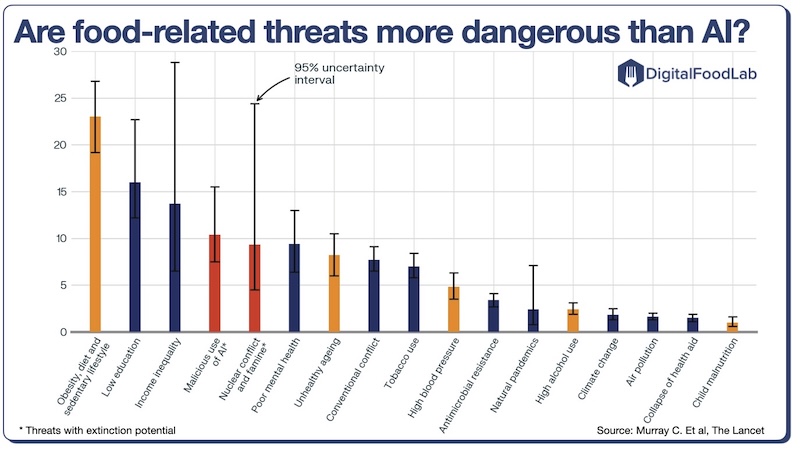
Are food-related threats more dangerous than AI?

While this is maybe a catchy question, it is also one of the conclusions we can draw from the 17 threats examined by the Lancet commission, from climate change and pandemics to nuclear conflict and the malicious use of artificial intelligence.

While most of the attention is being put on AI threats, which are separately classified, not very reassuringly, as existential threats. However, beyond these, two areas related to food and lifestyle stand out, and how much progress can be made:

  • Obesity, diet and sedentary lifestyles: addressing these risks could prevent the loss of around 23 billion years of healthy life, the largest threat identified in the study.
  • Unhealthy ageing, high blood pressure and high alcohol use, with 8, 5 and 2.5 billion years of healthy life potentially recoverable by 2100 respectively. Each points to areas where food and beverage innovation could, and should, contribute to improve the situation, from nutrition for older adults to sodium reduction and appealing alcohol-free alternatives.

Child malnutrition also features in the study, reminding us that the challenge includes both excess in food and beverage intakes and deficiencies.
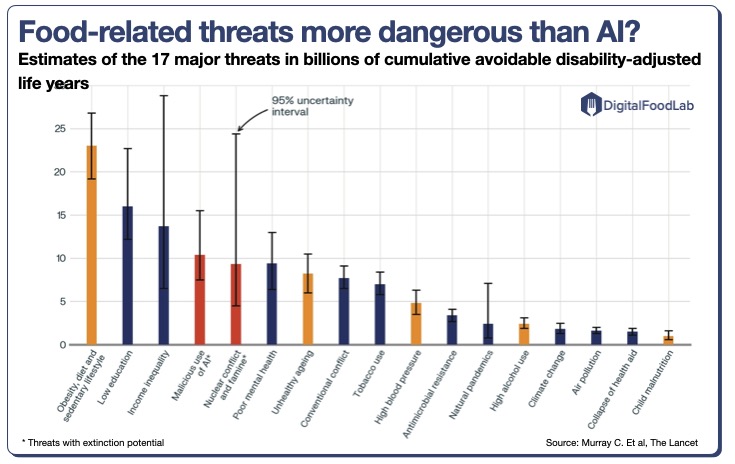
Food-related-threats-more-dangerous-than-AI-DigitalFoodLab-graph

These estimates describe potentially avoidable health loss and should not be added, but they make one point clear: food and nutrition deserve a central place in the conversation about our future, notably when talking about threats.

What it means for food innovation

In our view, this will become a strategic issue for the food industry, due to combined pressure from consumers and governments.

As populations are getting older in many countries, attention to healthspan (the time you live in good health) will increasingly matter, and we can expect that the pressure on governments to act will only get stronger.

Second, this should be considered in our current context where acting to reduce the nefarious impacts of climate change and artificial regulation requires International coordination, and hence doesn’t really happen. This could first translate into increasingly tight regulation of ingredients and food supply chains, and then into a broad push towards adopting “quick fixes” like GLP-1 drugs (addressing multiple threats at the same time).

For food companies and ingredient suppliers, the opportunity, as well as the threats, extends then well beyond the next wellness brand. It is rather about where and how they can win in the future (of food) by answering multiple questions such as which products to reformulate, which ingredients and technologies to invest in, or which consumer needs to prioritise.

You're in a good company

Join the 60+ clients of Digital FoodLab: leading agrifood companies, retailers, banks, investors, startups, and public organisations.

✕

Use case: project for a global F&B company looking to map its AgTech innovation ecosystem and the best startups to partner with

What we did:

  • Mapping of the AgTech ecosystem: startups, research regulators, and other leading companies.
  • Discussion to select areas to focus on.
  • Analysis of the information to reveal the trends and a model to analyse eventual partners.
  • A workshop to validate the opportunities based on our recommendations.
  • Scouting of relevant partners followed by introductions.

Results:

  • Mapping the different categories of innovations in AgTech that should be considered now to create long-term benefits for the business.
  • Identification of key partners (an incubator and a couple of startups).
✕

Use case: project for a CPG company on the healthy ageing ecosystem

What we did:

  • Education of the board through a couple of workshops to define the perimeter
  • Identification of key opportunities and threats created by long-term evolutions (technologies, business models, behavioural changes).
  • Deep dives on each of the priority categories.
  • Co-construction of a vision on how the company should address these challenges.
  • Identification of partners (startups, incubators, funds) to move forward.

Results:

  • Creating a consensus on which categories to prioritise and how to address them.
  • Implementation of an open innovation strategy through the development of partnerships.
✕

Use case: project for a global CPG company to develop a strategy on the healthy ageing ecosystem

What we do (ongoing mission on a subscription model):

  • Kick-off where we present an overview of the AgriFoodTech ecosystem to select with the client the categories to cover and for each, the level of information required.
  • Monthly newsletter: each month we send a newsletter with the articles that we have gathered ranked by relevance, their summaries, and a layer of analysis.
  • Database: we set up a personalised database that will be filled month after month with the information gathered on the companies identified for the watch.
  • Workshops: twice a year with the client’s innovation team and other “innovation curious” team members, we present an overview of the evolutions, key trends and a dashboard of the topics followed by the watch.

Results:

  • A clear, regular and evolutive tool to follow what is happening in terms of innovation on key topics.
  • A forum (through the workshops) to discuss innovation trends and new opportunities.
✕

Use case: opportunity screening for an ingredient company

What we did:

  • Kick-off to define the perimeter of the ecosystem studied.
  • Mapping of the different trends shaping the innovation ecosystem of the client.
  • Analysis of the trends on DigitalFoodLab’s trend curve and other relevant frameworks.
  • Workshop to discuss DigitalFoodLab’s recommendations on key trends to prioritise

Results:

  • Shared view of the innovation ecosystem for the client with a view of the trends to prioritize.
  • Clear document (personalised trend curve) that can be easily shared internaly to explain the company’s innovation choices and which can be then updated each year.
✕

Use case: scouting for an agriculture coop

What we did:

  • Kick-off to define the perimeter of the client, the goals of the scouting (partnerships) and the criteria on which startups should be evaluated.
  • Set-up scouting: we selected the first batch of 20+ key startups following the criteria of the client.
  • On-going scouting: then we set up a quarterly scouting of about ten startups.
  • For each scouted startup, we created an ID card with key information such as the business and technological maturity, funding, and corporate partnerships. We also added an explanation of why we selected this startup.

Results:

  • An ongoing and evolutive scouting are matching the client's criteria and its capabilities in terms of deal flow.
✕

Use case: working on an acquisition process for a CPG company

What we did:

  • Kick-off to define what the client is seeking, notably in terms of maturity.
  • Workshop with the client based on a mapping of the different innovation ecosystems adjacent to its activities to select some priorities and discuss inspiring examples of startup acquisition stories.
  • Identification of 20+ targets.
  • Workshop to select the most relevant to engage with.
  • DigitalFoodLab worked as a sparing partner during the acquisition process, notably to help design how the acquired startup could be integrated into the overall company’s strategy.

Results:

  • Different results from traditional M&A processes with a focus on the client’s innovation strategy.
  • Identification of a good match for an acquisition.
✕

Use case: market due diligence on sugar alternatives

What we did:

  • Kick-off with the client to discuss its interest on this category, its expectations and existing level of information (notably on the target company).
  • Mapping of the ecosystem to analyse the different existing alternatives and technologies to compare them.
  • Interview (calls) with relevant startups made by our internal biotechnology expert.
  • Recommendation on whether to invest or not.

Results:

  • Clear view of the ecosystem and of the reasons to believe (or not) in each sub-category.
  • Enforceable recommendations based on facts and expertise.
✕