Which signals should the food industry watch in 2027? That is the question Fi Europe asked me to answer in a keynote.
It is a good time to ask. The situation is better than it has been for years. As our recent Global State of AgriFoodTech funding report shows, early-stage activity is rising again after four years of decline, industrial and commercial deals between corporates and startups are multiplying, and a wave of exits, notably of brands, is bringing investors back.
Preparing this talk forced me to choose. Here are the first three signals, all on the consumer side: who consumers buy from, how they buy, and what they are buying for. Next week, we will move upstream to ingredients and agriculture.
1 – Emerging brands are rising faster than ever and changing the meaning of healthy
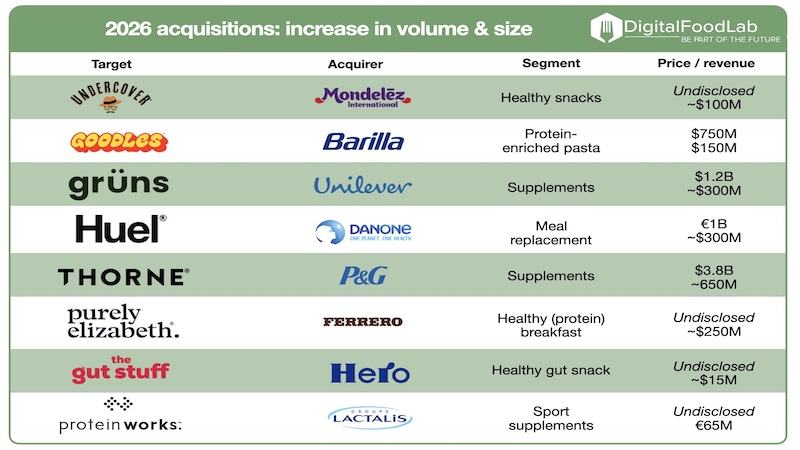
Since the start of the year, the list of acquisitions of emerging brands by leading companies has been impressive. While non-exhaustive, the table below gives a good idea of the scale of this wave of deals. This is not just a temporary shopping spree or global companies signalling to their investors their intent to be more innovative. Something much deeper is happening, on at least four levels:
- Acquisitions are part of a broader portfolio reshuffle: groups such as Nestlé, Danone and Unilever are buying while divesting underperforming categories. Alongside leading companies and the deals spotted in the table, many smaller ones are happening, confirming this trend.
- Acquisition prices are high (3.5 to 6x revenue), but these brands bring substantial and fast-growing revenue. Leading companies are also acquiring the ability to address new markets and, more importantly, new demographics, especially Gen Z and millennials.
- Beyond acquisitions, there is a stream of startups emerging almost daily around promises of healthier food products. Compared to previous years, they are rising faster, often founded by experienced entrepreneurs or celebrities.
- A new definition of what healthy means: most players are focused on providing more protein while delivering great taste. This often comes at a cost in the number of ingredients and the level of processing, illustrating how the debate on UPF is evolving.
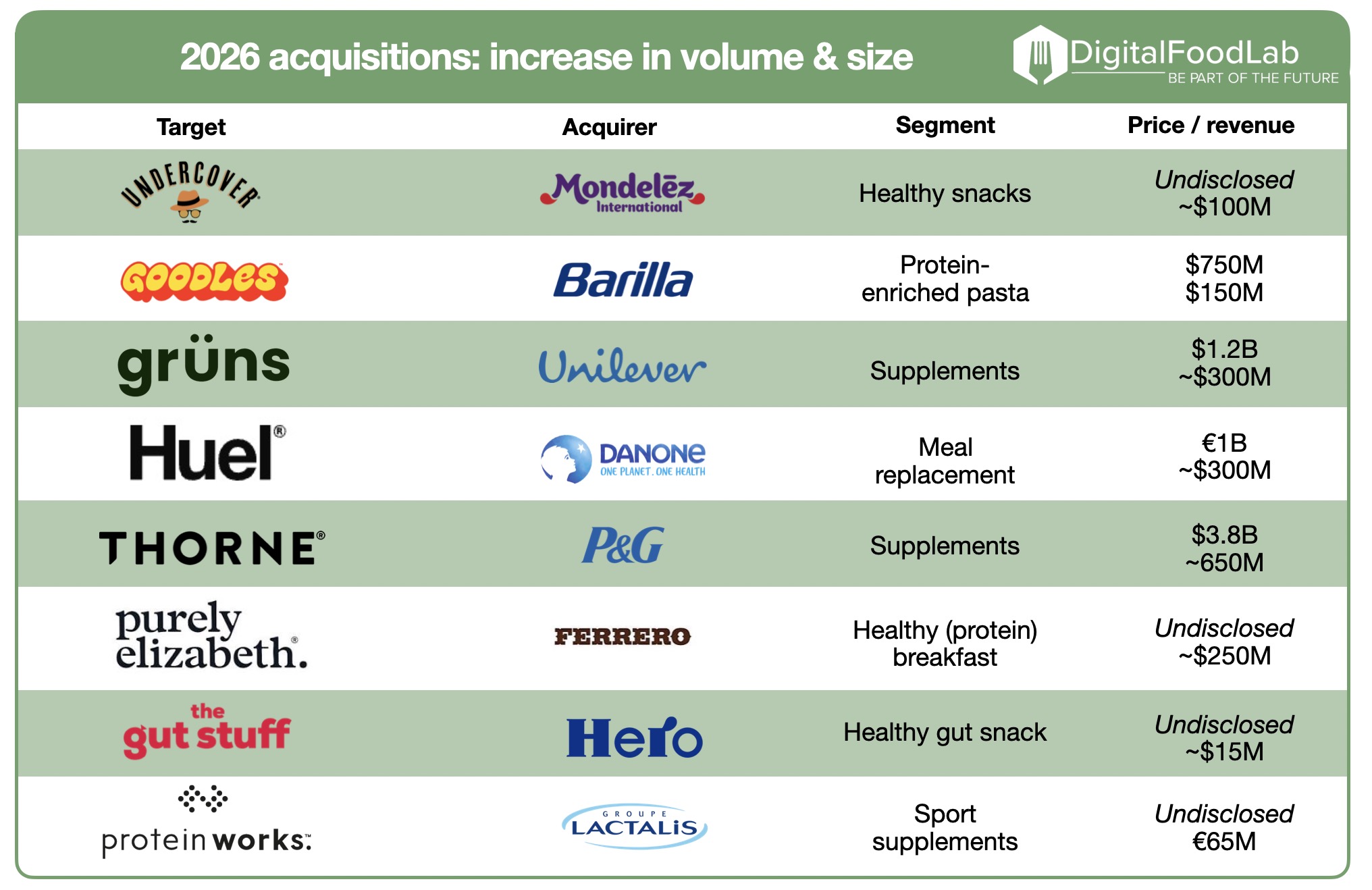
What to watch:
- Supplements: consumers are increasingly investing in their health through supplements. This translates into overall category growth, making it one of the rare bright spots of the CPG industry. New leaders are emerging in new categories such as IM8 (longevity-focused all-in-one supplement) or Lemme (women’s health).
- Food products with a health benefit (mostly protein). This is the space with the most acquisitions, but also the least diversity. Most of the brands are following the same recipe: “something with more protein inside, and combined with a Gen Z marketing angle”. However, beneath the surface, we see the emergence of new types of promises, notably around convenience, as mentioned in our recent insight on the five-minute opportunity.
- Beverages with benefits: it is getting hard to keep track of new beverage brands being launched each week. This space is highly competitive and selective, if only because it depends on retail, where shelf space is limited. However, each year, a handful of notable players succeed in taking market share from incumbents, notably around health and hydration promises.
2 – Agentic e-commerce
The recent release of AI agents such as Muse (Meta, US-only for now) or Instinct is making waves in the food retail industry. You can now configure your agent to do grocery shopping for you, using your inputs and payment information. With millions of daily users, these services are not a niche for early adopters, but rather the solution to reduce the time spent on online grocery shopping.
This is still an emerging space, with far more unknowns than answers. For retailers, this is an existential question about how they will be able to interact with consumers as all the data remains on the side of the AI, which acts autonomously online.
For brands, as for ingredient companies, it opens a whole new world. AI agents will make choices based on the preferences of their users, looking at ingredient lists and eventually at the health benefits of individual ingredients. Brands and ingredient suppliers must start planning how they will interact with AIs to promote and explain the benefits of their products with easily available data inputs.
What to watch: in the short term, the question will be about the reaction of retailers and brands to agentic e-commerce (banning them as Amazon did or being quite open as Walmart). Then, we will be watching how brands and ingredient companies will compete to differentiate themselves in this new world and whether “agentic marketing” will become a thing.
3 – The longevity boom
We know that GLP-1 is disrupting the food industry, but the question is what the second-order impacts will be. One of the main consequences of these drugs and their mass adoption is the spread of the idea that we take our health into our hands with molecules acting on our diet. This relationship between food, health, and molecules can be seen in the rise of the consumption of peptides, but also in the surge in searches for longevity solutions, as illustrated by the Google Trends graph below.
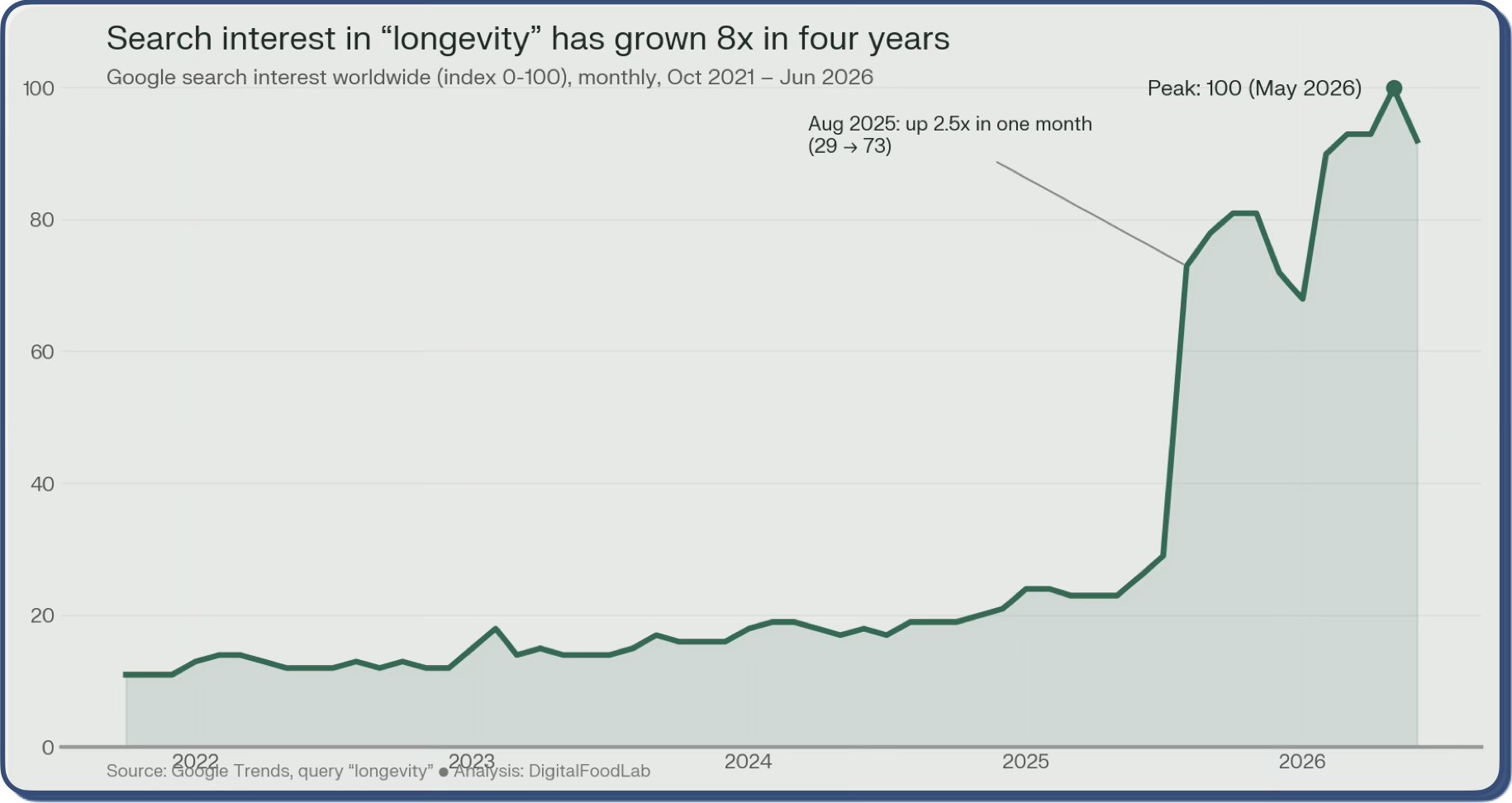
This has not been missed by entrepreneurs and the food industry. We are currently focusing most of our client work on healthy ageing and longevity, as the industry is just starting to grapple with the question of how to address longevity through food.
Solutions with proven longevity benefits are limited for now. Some ingredients positioned on longevity, such as spermidine (produced through biomass fermentation) or lactoferrin (through precision fermentation), are providing a path to market for startups formerly identified as alternative protein producers.
What to watch: as the space is still emerging, we are mostly looking for weak signals coming from adjacent spaces, emerging brands’ ability to make gut-health claims linked to longevity, the rise of peptides in the US, and the post-GLP-1 wave.
Taken together, these three signals tell one story: consumers are changing fast, and those who own the relationship with them may be losing their grip. Young brands are winning new demographics and capturing health-driven consumption, even on topics related to longevity. AI agents are positioning themselves between retailers, brands and shoppers.
This story tells us that for established companies, the question is then less “which trend should we follow?” than “where and how can we have access to tomorrow’s consumer?”
We run this “signals to watch” session for leadership and innovation teams, tailored to their categories. Reply to this email if you would like it for yours.