Wars, trade tensions and disrupted shipping routes have pushed resilience up the agenda of many agrifood companies. El Niño is now adding another layer of uncertainty, with potential consequences for harvests, ingredient availability and production costs.
Diversifying suppliers is one response. But when an ingredient becomes scarce or too expensive across several origins, companies may need to reconsider the recipe itself, how it is produced, or the alternatives they previously dismissed.
This week, we look at what El Niño could mean for the food industry and where innovation can help companies anticipate disruption, protect supply and make alternatives commercially viable.
1 – What is El Niño, and why does it matter?
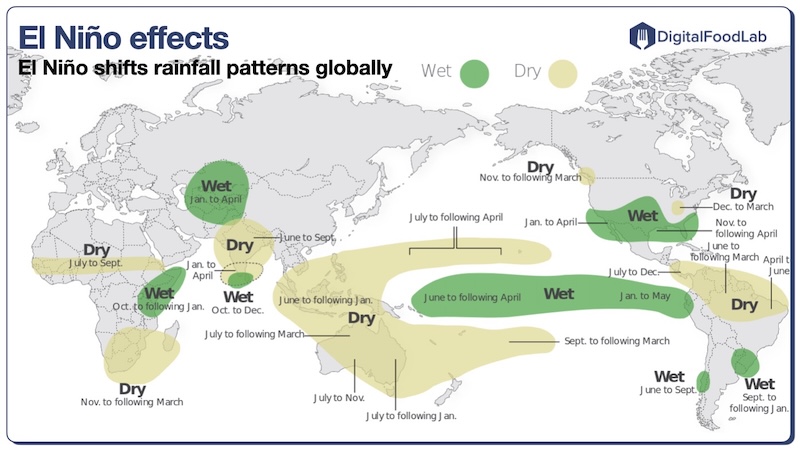
El Niño is a naturally occurring and periodic climate pattern starting with the warming of surface waters in the Pacific. Then, by changing atmospheric circulation, it redistributes rainfall and heat across agricultural regions, sometimes thousands of kilometres away.
Its effects are uneven and highly unpredictable. Some regions face drought, others excessive rainfall, and some crops benefit.
What matters today is that due to the effect of climate change, we are experiencing what could become the strongest episode on record, what some are calling a “Godzilla El Niño”. In its most recent update, NOAA, the US agency responsible for monitoring oceans, climate and weather events, put the probability of a persisting and potentially very strong El Niño at 83%. A stronger event increases the risks of meaningful disruption, notably on the commodity supply chains of the regions affected.
2 – What will be the impact on the food industry?
A 2023 European Central Bank analysis estimated that a strong El Niño could raise global food commodity prices by around 9% at their peak over a period of 6 to 16 months, with particularly pronounced risks for corn, soybeans and rice.
For individual ingredients, increases could be considerably larger. Barclays suggested this summer that prices could rise as much as 30–40% for palm and coconut oils, 20–30% for robusta coffee, and 10–20% for rice.
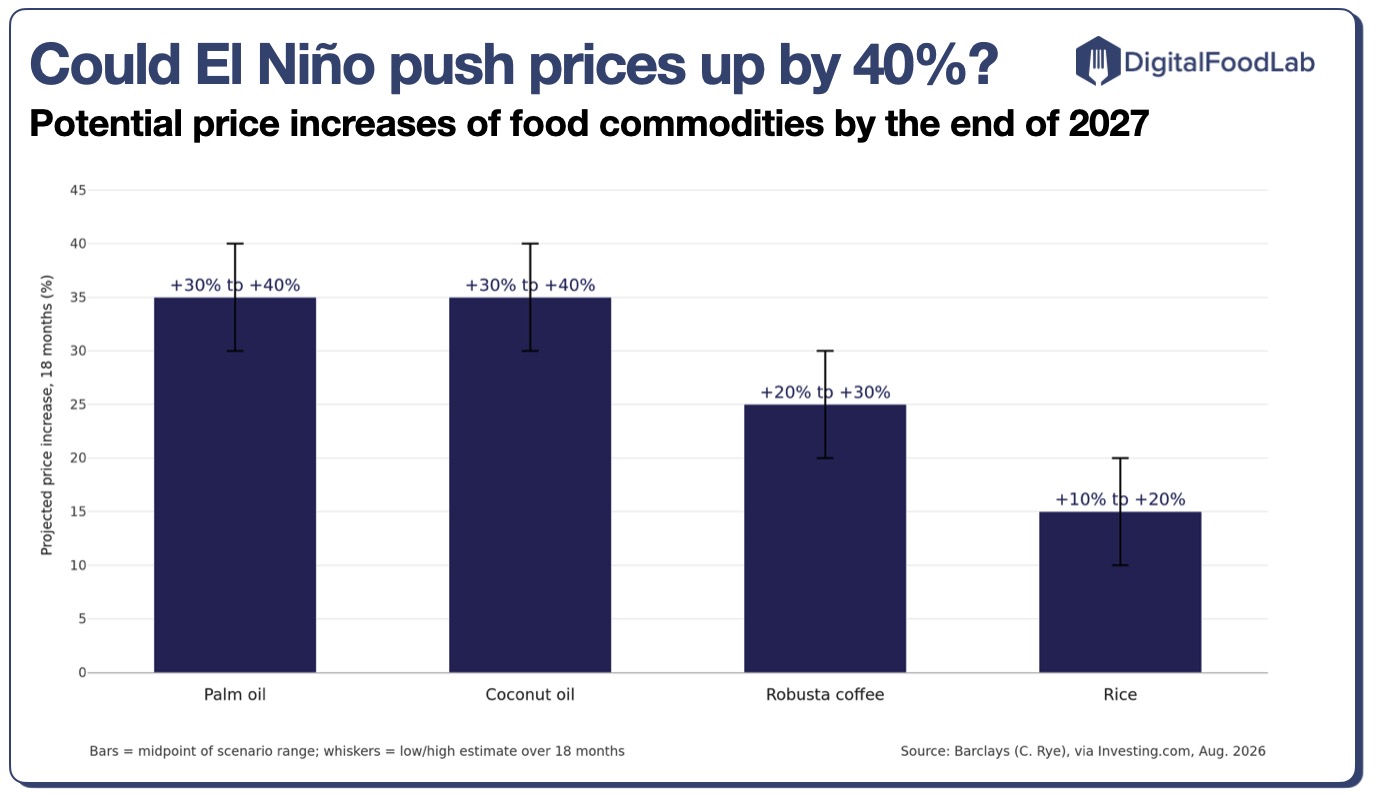
Actual outcomes will depend on regional weather, inventories, harvests elsewhere and policy responses. That is part of what makes El Niño such a complex phenomenon: we can make scenarios such as the ones presented in the graph, but we can’t have any certainty.
El Niño comes on top of other pressures, with some commodity prices already high due to the war in Iran. For example, urea prices remain 20% above their level a year ago. Higher fertiliser costs can encourage farmers to reduce applications, potentially affecting harvests just as weather shocks intensify, putting further pressure on supply chains and costs.
Concretely, for consumers and food companies, this could add additional stress to an already tense situation. In the Philippines, for instance, which is already facing high inflation due to energy costs, the central bank is assessing how a severe El Niño could compound the existing oil shock. For food businesses, this could create a double squeeze: rising production costs and consumers with less room to absorb higher prices.
3 – What does it mean for the innovation ecosystem?
El Niño is a recurring phenomenon, but as we have seen, its consequences can be lasting. In agrifood innovation, we see five areas that could benefit from a severe El Niño.
In agriculture:
- Predictive platforms leveraging AI, weather, crop and supply-chain data to forecast yields, and identify emerging commodity risks. Players like Finches (Germany) and Acclym (Israel) can connect those early signals to purchasing decisions and add resilience to their clients’ supply chain.
- New crop technologies (notably gene editing) focused on more drought- and heat-tolerant varieties, which can then resist severe shocks. Players like Tropic (UK, focused on bananas), Rainbow Crops (Belgium) and Inari (US, corn, soybeans and wheat) show how diverse and attractive to both investors and large players this ecosystem is.
- Precision irrigation, financing for regenerative farming, sustainable livestock and biological inputs are indirectly related, but increasingly relevant as solutions to reduce the impact of agriculture on global warming.
Beyond agriculture itself:
- AI-assisted formulation: these tools help R&D teams become more agile in creating new formulations, notably exploring ingredient substations. As shocks multiply, getting more flexible and having diverse possibilities for the same product will become a differentiating asset.
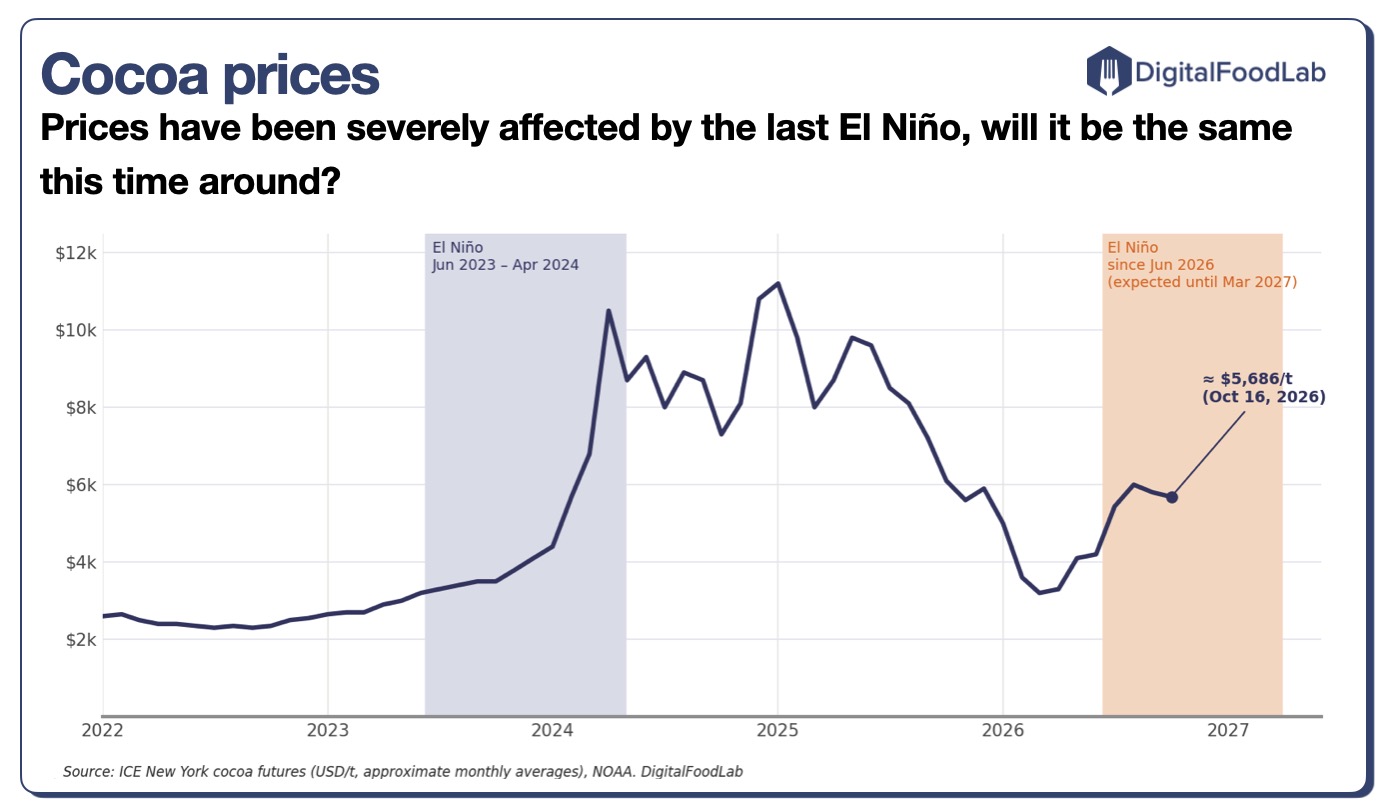
- Alternatives to high-value ingredients: as for the last El Niño episode, cocoa and coffee prices could be among the most affected. This could then provide an additional boost to fermentation alternatives (such as Planet A, Voyage Foods) and support the launch of plant-cell culture (Food Brewer, California Cultured).
While this “Godzilla” El Niño will primarily affect commodity prices, if we take the long view, it could indeed be a boost for the themes of resilience, diversification, and alternatives. Today, many of the solutions shaping the future of food are technically more mature but not yet cost-competitive. The upcoming disruption in prices could reduce the gap and support wider adoption.
Looking beyond prices, there is also a consumer angle to the question: a reformulation designed to improve resilience or to limit price increases may be perceived as more processed or less healthy. For us, this is the key: identifying which innovations can turn supply risks into a durable advantage and which would only make sense during a temporary price spike.
Beyond any single ingredient, the first step is to have a clear view of the innovation opportunities and threats to have on your radar, and which to prioritise. If this is on your agenda, either as a company or as a startup seeking to be on leading players’ radars, let’s talk.