Today, I’d like to share three graphs that recently caught our attention because they highlight the underlying trends shaping the future of food in the short, medium, and long term.
1 – Europe has slowly become a key AgriFoodTech innovation hub
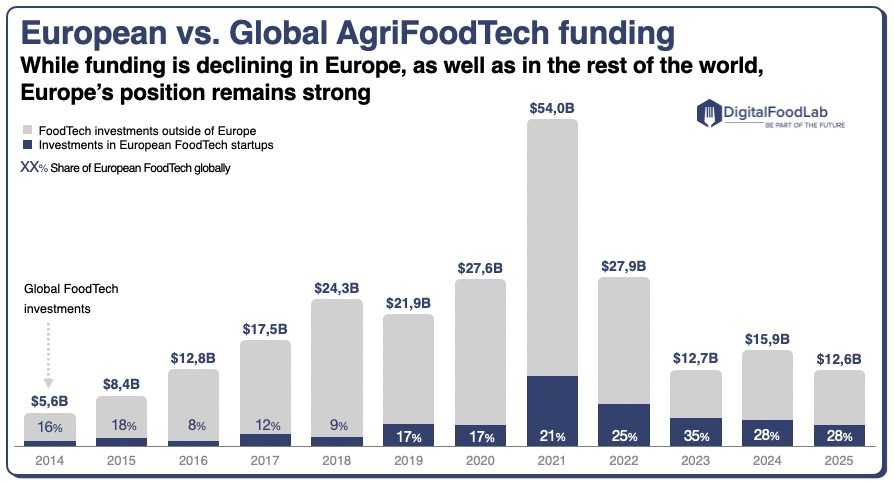
As shown in the chart above, during the period of global funding decline observed since 2022, Europe’s relative share in the agrifood innovation ecosystem has become much more important. Pre-excitement (2020-22), Europe’s relative share was much smaller than what it is now. This is compounded by the fact that previous FoodTech funding in Europe was mostly targeted towards delivery startups, while nowadays it goes to ingredients, brands, agriculture…
In a word: Europe has a bigger share of a much smaller pie. That’s good, but not enough to grow the future of agriculture and food to its full potential. As discussed in a recent insight, it is still lacking the funds (public and private) to support industrialisation.
2 – When whey becomes more valuable than the cheese it comes from
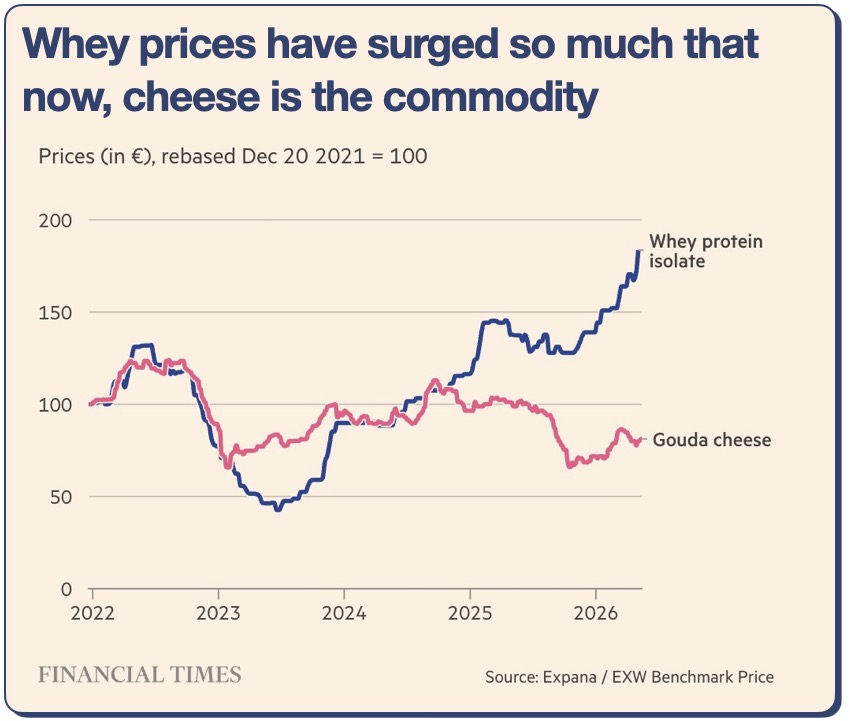
For decades, whey was an afterthought of cheesemaking, with a limited use in sports supplements and in agriculture. With the current GLP-1 boom and the protein craze that followed, it has become one of the hottest commodities in food. This is quite visible in the chart: whey protein isolate prices have nearly doubled since 2021.
For many cheesemarkers, whey demand has now exceeded their production capabilities. At the current levels, we observe a complete reversal of the previous situation: cheese has, in some cases, become the byproduct of whey production.
As for the innovation ecosystem, this is also having consequences: after years of startups focusing on casein (the key ingredient in cheesemaking) rather than whey (seen as a cheap, disposable commodity), the narrative is slowly starting to change. If whey prices remain high, whey obtained through precision fermentation could make a “comeback”, even more so now that the technologies have progressed.
3 – Can your (European) city become self-sufficient using urban agriculture?
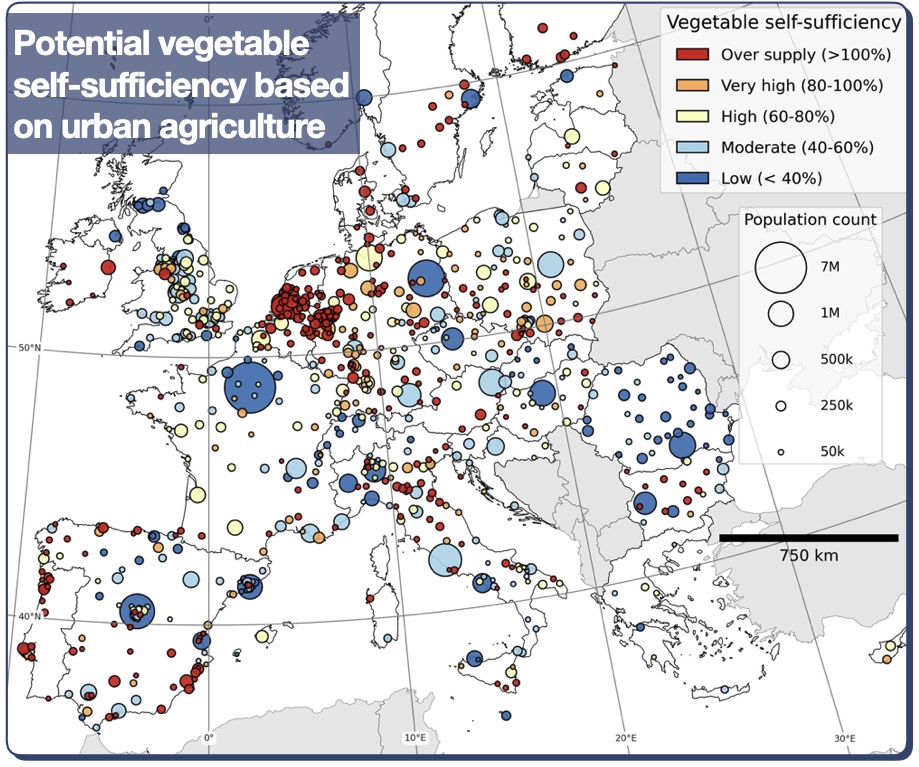
The University of Groningen (Netherlands) recently published an interesting piece, including the map above, that analysed 840 European cities to assess how much urban agriculture could help make them self-sufficient in vegetables.
For major cities, the answer is: not much. Paris, Berlin, Madrid, Warsaw, Bucharest, and Budapest can’t, even in the more optimistic scenario displayed here, reach 40% self-sufficiency. However, that could be expected from dense urban centres (as well as the fact that smaller locations in the Netherlands, Sweden or Spain could produce more than they consume).
What’s interesting is the aggregate: combined, these cities could produce up to 28% of the total vegetable demand of their 190M inhabitants. What’s even more interesting is that it’s based on basic, open-air cultivation (gardens, rooftops…) and it excludes fancy technologies like vertical farming or hydroponics. Combining both approaches could mean reaching much higher levels.
4 – Antimicrobial resistance in livestock could lead to exponential losses in a few decades
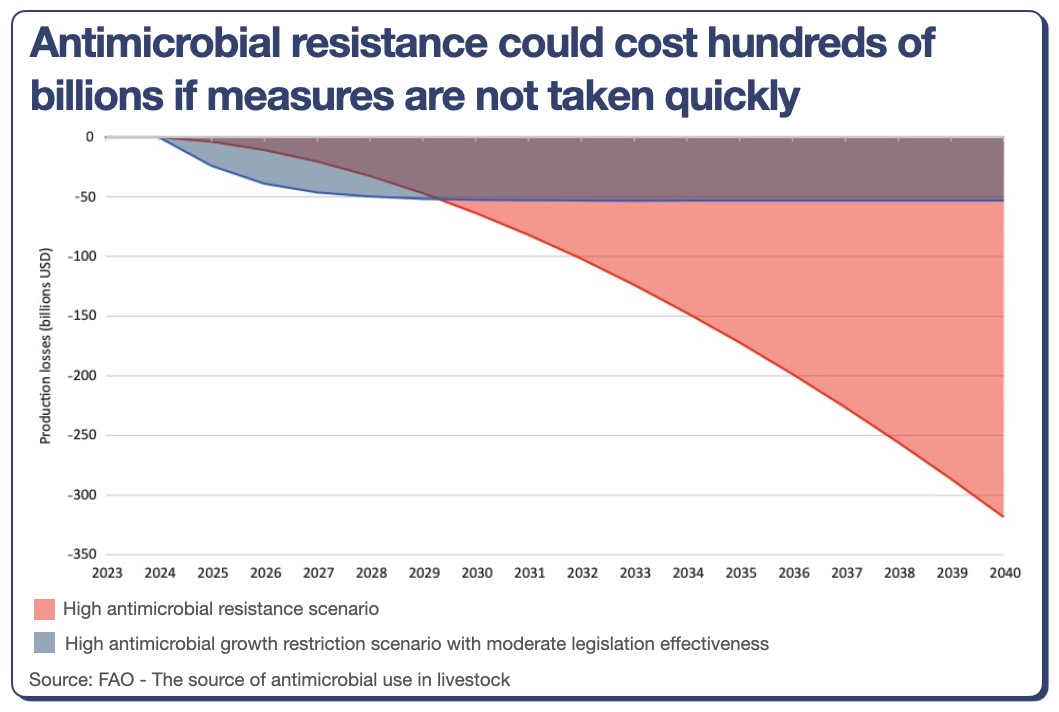
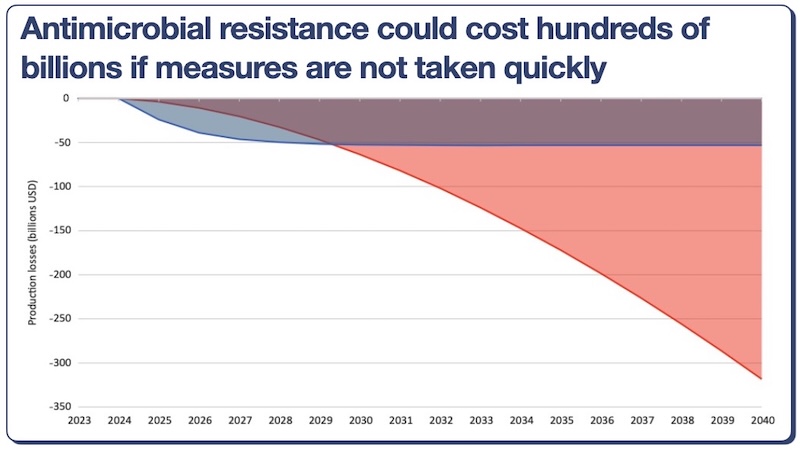
This chart comes from a recently published FAO report that analyses the consequences of the growing antimicrobial resistance in livestock. The red area shows what happens if we do nothing: losses escalate silently, reaching nearly $320 billion by 2040.
The blue area is what happens if we phase out antimicrobial growth promoters, the antibiotics routinely added to animal feed to boost growth. It would have a more immediate, but also more limited impact of about $50 billion, and then plateau.
This is a very interesting view of the cost of inaction and also why the problem persists. The costs of acting are immediate, whereas the impact of inaction is diffuse. This is especially true for Asia and Latin America, which will account for more than 80% of global antimicrobial use by 2040.
For now, regulation is tightening in Europe, but not that much elsewhere. As forward costs build up, securing alternatives will become increasingly relevant.
Do you find these insights useful? You could be interested in DigitalFoodLab’s FoodTech watch offer: we deliver bespoke insights tailored to your needs, helping you to follow what’s important for you in the innovation ecosystem, for your innovation team, R&D, or top management.