25 FoodTech insights and deals to know this week (2026 – week #23)

Published on June 1, 2026

💸 Funding News

🎨🇮🇱 Phytolon, an Israeli startup, raised $23.6M to commercialise yeast-fermented natural food pigments, notably a red dye alternative to synthetic food colours.


🍄🇩🇪 Pacifico Biolabs, a German startup, raised €7M to scale mycelium protein production by repurposing idle German brewery fermentation tanks.


🍺🇨🇦 Terra Bioindustries, a Canadian startup, raised ~$0.8M USD to upcycle brewers’ spent grain into clean-label food ingredients.


🍠🇺🇸 Rootsii, a US startup, raised $1.82M to convert surplus sweet potatoes into plant-based dairy alternatives, such as milk.


🍪🇺🇸 Fields Good, a US startup, raised $1.8M for its brand of functional cookies targeting specific health outcomes (focus, sleep,…).


🥜🇺🇸 Smash Foods, a US startup, raised $5M for its brand of chia- and date-based spreads and snacks.


🥩🇺🇸 Campo Grande, a US startup, raised $4M to bring what it calls the “Wagyu of pork” (a premium Ibérico acorn-fed pork from Spain) to American grocery shelves.


🫙🇮🇳 Anveshan, an Indian startup, raised ~$17.5M for its D2C food brand focused on traditional Indian nutrition.


🧪🇪🇸 Mafer AI, a Spanish startup, raised €2M for its operating system for R&D teams in formulation-driven industries, notably food science.


🤖🇩🇪 Allo, a German startup, raised €12M to scale its AI operating system for restaurants across Europe.


✅🇫🇷 Certo, a French startup, raised $4M for its regulatory compliance platform for beauty and CPG companies.


♻️🇧🇪 Borro, a Belgian startup, raised €1.3M for its digital deposit system for reusable cups across Europe.


🐄🇳🇴 Monil, a Norwegian startup, raised $10M for its virtual fencing solutions for cattle.


🌱 🇺🇸 Contact Biosolutions, a US-based startup, raised $5.4M for its bioherbicides for weed management.


📊🇺🇸 Signos, a US startup, raised $20M for its continuous glucose monitoring (CGM) platform for weight management.


⭐ Acquisitions, Regulation, Bankruptcies & Partnerships

🍄🇩🇪 InfiniteRoots, a German biomass fermentation startup, has acquired Bosque Foods, another German startup. It adds an expertise in solid-state fermentation to its technology portfolio.


🍕🇺🇸 Picnic, a US pizza robot startup, has shut down after 10 years in business. The maker of automated pizza assembly machines is joining the (long) list of food robots that have not found their market.


🥇 Leading Companies

☕🇰🇷 Starbucks is facing a major boycott in South Korea, its third-largest market, after a “Tank Day” tumbler promotion fell on May 18, the anniversary of the 1980 Gwangju massacre. The scandal triggered the departure of Starbucks Korea’s CEO, a government boycott call, and public protests.


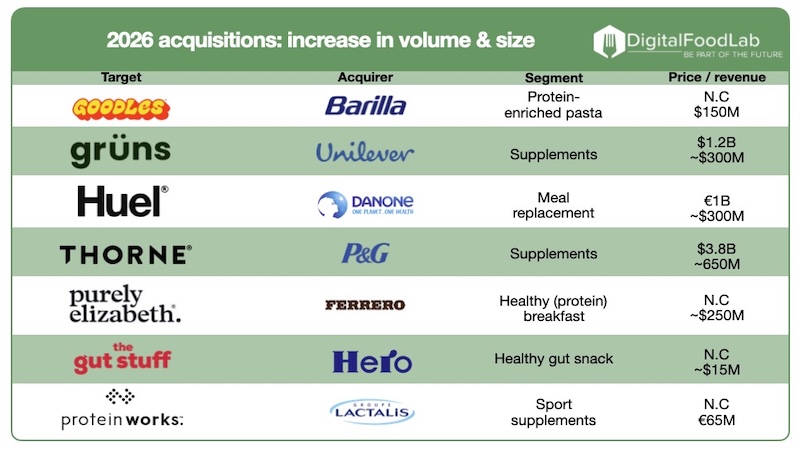
🥤🇬🇧 Danone’s €1bn acquisition of Huel has been placed under review by the British competition authority.


🧪🇺🇸 IFF has agreed to sell its Food Ingredients business to CVC Capital Partners for ~$4.3B. The deal is part of IFF’s portfolio restructuring to focus on higher-growth, higher-margin categories.


🛒🇺🇸 Erewhon, the famous “ultra-expensive grocery store”, has launched a “Reserve” membership tier for customers spending over $15,000/year. Perks include priority checkout, free delivery, and a personal concierge.


📊 Macro Trends

💊🇺🇸 AG1, the “all-in-one supplement”, is facing growing competitive pressure from the “gummification” of wellness. The supplement market is shifting toward candy-like gummy formats that outperform on social media and retail velocity.


🍪🇺🇸🇰🇷 Oreo has launched a limited-edition BTS collaboration featuring hotteok-inspired cream flavour, purple wafers, and collectable packaging, available in 80+ countries from June 1.


🥔🇧🇪 Belgium, the world’s leading exporter of frozen fries, is facing a historic potato surplus. After record yields, Europe has a 5M metric-ton surplus of fry-variety potatoes; prices have stagnated at zero for months, down from €600/tonne three years ago.

You're in a good company

Join the 60+ clients of Digital FoodLab: leading agrifood companies, retailers, banks, investors, startups, and public organisations.

Use case: project for a global F&B company looking to map its AgTech innovation ecosystem and the best startups to partner with

What we did:

  • Mapping of the AgTech ecosystem: startups, research regulators, and other leading companies.
  • Discussion to select areas to focus on.
  • Analysis of the information to reveal the trends and a model to analyse eventual partners.
  • A workshop to validate the opportunities based on our recommendations.
  • Scouting of relevant partners followed by introductions.

Results:

  • Mapping the different categories of innovations in AgTech that should be considered now to create long-term benefits for the business.
  • Identification of key partners (an incubator and a couple of startups).

Use case: project for a CPG company on the healthy ageing ecosystem

What we did:

  • Education of the board through a couple of workshops to define the perimeter
  • Identification of key opportunities and threats created by long-term evolutions (technologies, business models, behavioural changes).
  • Deep dives on each of the priority categories.
  • Co-construction of a vision on how the company should address these challenges.
  • Identification of partners (startups, incubators, funds) to move forward.

Results:

  • Creating a consensus on which categories to prioritise and how to address them.
  • Implementation of an open innovation strategy through the development of partnerships.

Use case: project for a global CPG company to develop a strategy on the healthy ageing ecosystem

What we do (ongoing mission on a subscription model):

  • Kick-off where we present an overview of the AgriFoodTech ecosystem to select with the client the categories to cover and for each, the level of information required.
  • Monthly newsletter: each month we send a newsletter with the articles that we have gathered ranked by relevance, their summaries, and a layer of analysis.
  • Database: we set up a personalised database that will be filled month after month with the information gathered on the companies identified for the watch.
  • Workshops: twice a year with the client’s innovation team and other “innovation curious” team members, we present an overview of the evolutions, key trends and a dashboard of the topics followed by the watch.

Results:

  • A clear, regular and evolutive tool to follow what is happening in terms of innovation on key topics.
  • A forum (through the workshops) to discuss innovation trends and new opportunities.

Use case: opportunity screening for an ingredient company

What we did:

  • Kick-off to define the perimeter of the ecosystem studied.
  • Mapping of the different trends shaping the innovation ecosystem of the client.
  • Analysis of the trends on DigitalFoodLab’s trend curve and other relevant frameworks.
  • Workshop to discuss DigitalFoodLab’s recommendations on key trends to prioritise

Results:

  • Shared view of the innovation ecosystem for the client with a view of the trends to prioritize.
  • Clear document (personalised trend curve) that can be easily shared internaly to explain the company’s innovation choices and which can be then updated each year.

Use case: scouting for an agriculture coop

What we did:

  • Kick-off to define the perimeter of the client, the goals of the scouting (partnerships) and the criteria on which startups should be evaluated.
  • Set-up scouting: we selected the first batch of 20+ key startups following the criteria of the client.
  • On-going scouting: then we set up a quarterly scouting of about ten startups.
  • For each scouted startup, we created an ID card with key information such as the business and technological maturity, funding, and corporate partnerships. We also added an explanation of why we selected this startup.

Results:

  • An ongoing and evolutive scouting are matching the client's criteria and its capabilities in terms of deal flow.

Use case: working on an acquisition process for a CPG company

What we did:

  • Kick-off to define what the client is seeking, notably in terms of maturity.
  • Workshop with the client based on a mapping of the different innovation ecosystems adjacent to its activities to select some priorities and discuss inspiring examples of startup acquisition stories.
  • Identification of 20+ targets.
  • Workshop to select the most relevant to engage with.
  • DigitalFoodLab worked as a sparing partner during the acquisition process, notably to help design how the acquired startup could be integrated into the overall company’s strategy.

Results:

  • Different results from traditional M&A processes with a focus on the client’s innovation strategy.
  • Identification of a good match for an acquisition.

Use case: market due diligence on sugar alternatives

What we did:

  • Kick-off with the client to discuss its interest on this category, its expectations and existing level of information (notably on the target company).
  • Mapping of the ecosystem to analyse the different existing alternatives and technologies to compare them.
  • Interview (calls) with relevant startups made by our internal biotechnology expert.
  • Recommendation on whether to invest or not.

Results:

  • Clear view of the ecosystem and of the reasons to believe (or not) in each sub-category.
  • Enforceable recommendations based on facts and expertise.