New report – the innovation Europe is building but can’t use

Published on May 19, 2026

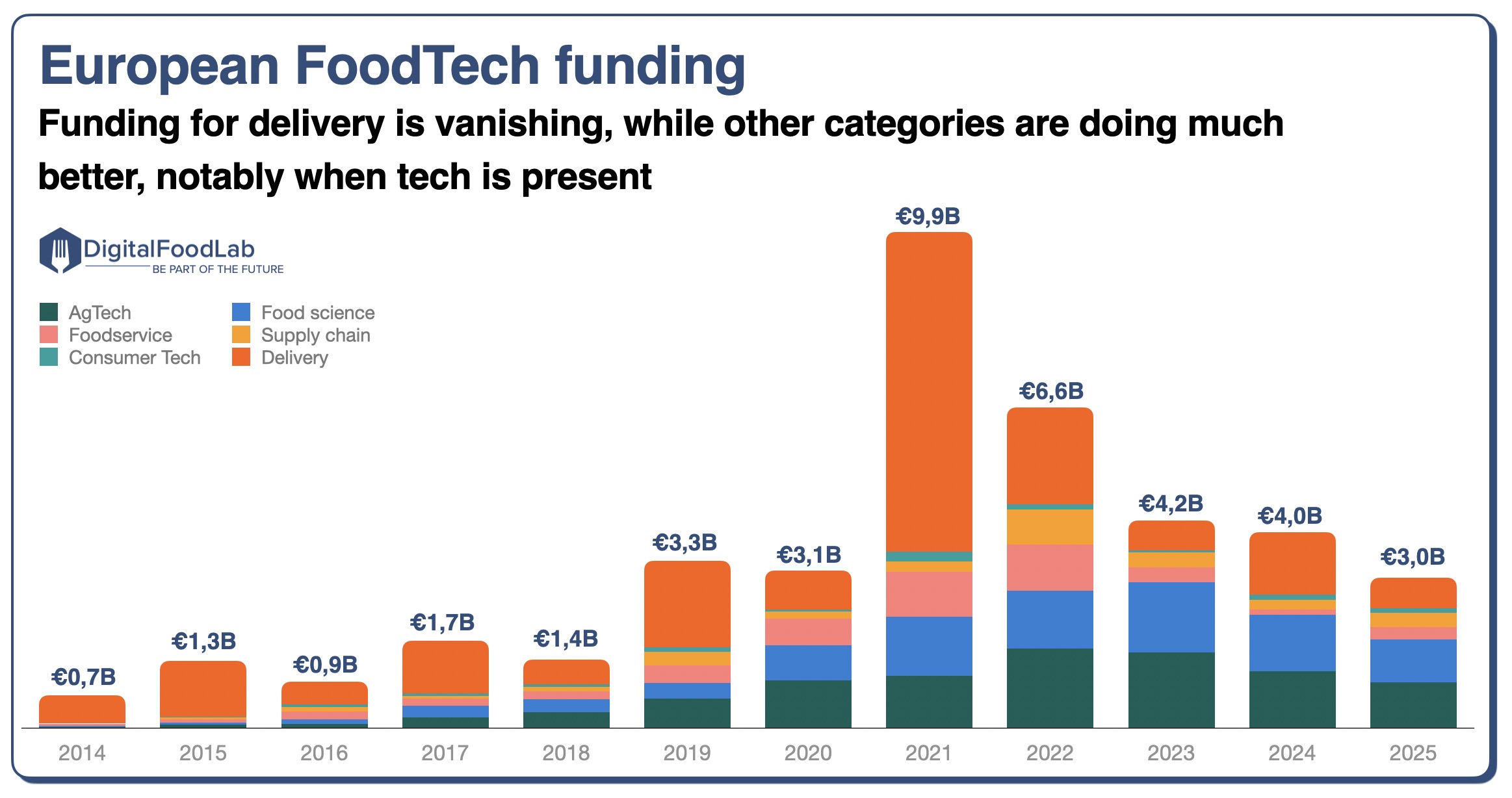
We just released our European FoodTech report. European AgriFoodTech startups raised €3 billion in 2025. But, increasingly, the story is not in the numbers but in what’s behind them. Today, we’ll cover our three main takeaways from the report and the perspectives for the year ahead.

Download the report here

1 – Funding keeps declining, but the fundamentals remain solid

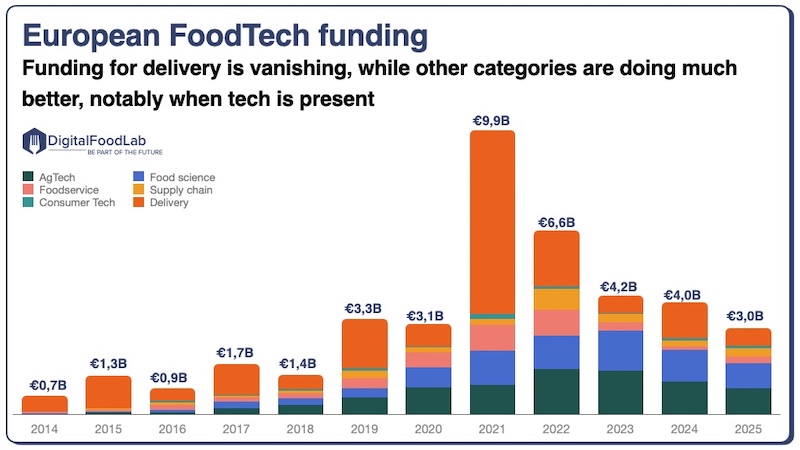
Funding for AgriFoodtech startups dropped (again) by 25% between 2024 and 2025, confirming a return to the pre-hype levels.
DigitalFoodLab-European-FoodTech-funding-categories

Beyond raw investment data, there are many positive signs:

  • A global hub for innovation: Europe continues to perform well relative to the rest of the world and now accounts for 28% of global AgriFoodTech funding.
  • Long-term conviction in the ecosystem: early-stage funding (investments in emerging startups raising their first rounds) remained stable. This means that entrepreneurs (with investors betting on them) are still creating new waves of emerging projects with long-term potential.

2 – New key categories and new hubs

One of the defining features of European FoodTech is the absence of a single, well-established hub of innovation. Instead, there are many competing locations, each with its own logic, governmental incentives, and corporate support. While this is not the best approach to create global leaders, this competition has its own merits and is pretty efficient in times when funding is scarce.

This is well illustrated by the “podium” of national ecosystems. This is notably the case with the rise of Spain, one of the most interesting agrifood innovation hubs, with exciting startups across the whole value chain, from agriculture to ingredients, to new brands. At the other end, usual leaders, and especially Germany, underperformed.
Top-funding-deals-in-European-FoodTech-in-2025

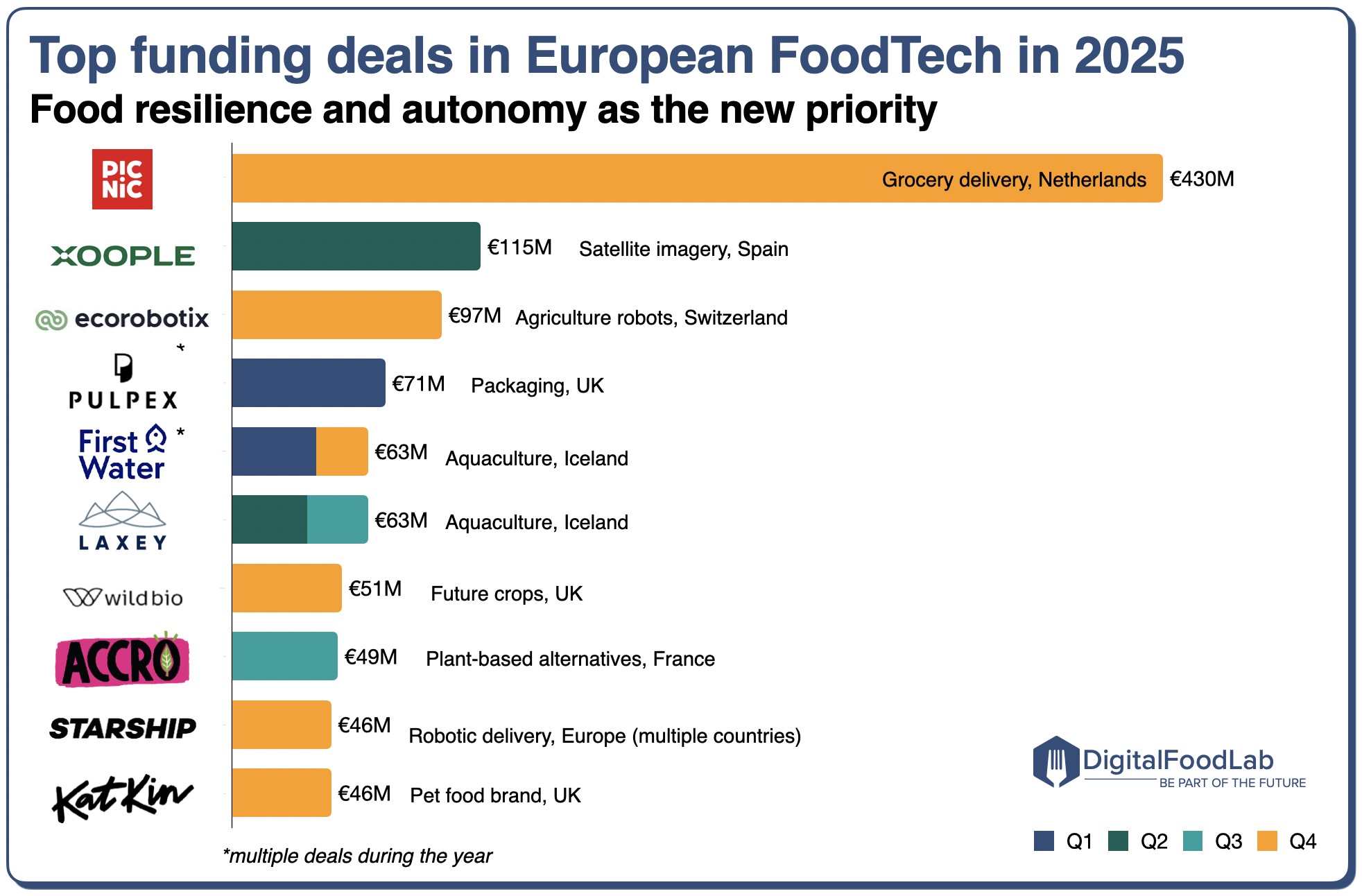
As shown in the funding graph above and in the list of the top deals for the past year, this is also a story of investments in AgTech and Food Science rather than Delivery. This is driven by multiple factors, including:

  • Aqualculture: infrastructure deals in Iceland, Norway and Finland to build large-scale aquaculture farms are supporting AgTech funding.
  • Food resilience, which is emerging as a strong theme across the continent, and which is indirectly helped by rising defence funding (many startups such as Xoople, formerly centred around the use of satellite imagery for agriculture, are refocusing on defence).
  • Alternative protein and new ingredients: while global funding for new proteins fell sharply, Europe is building strong positions in key technologies and becoming the dominant hub, notably for fermentation technologies (as shown with the examples on the trends curve below). European startups, with the B2B-first model, have proven to be well-suited to the current funding environment.
  • DTC Brands: from plant-based (whose sales are still rising in many European countries) to pet food and beverages, we observe the first hints of “European DTC brand moment”, which could become much stronger in the next couple of years.
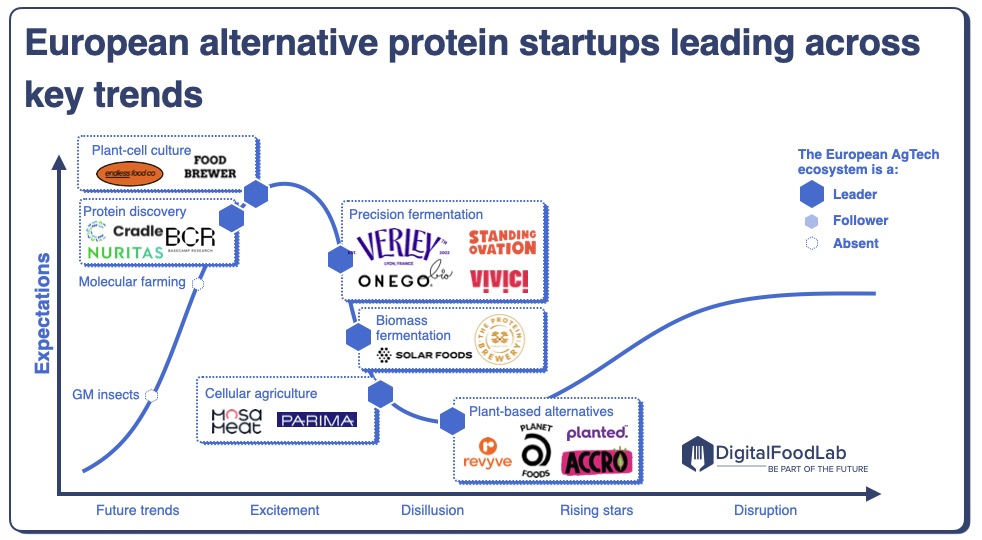
European-alternative-protein-startups-leading-across-key-trends

A structural challenge remains unsolved: Europeans startups are increasingly strong in many advanced technologies… but then they commercialise in the US

Things are far from being perfect for European FoodTech startups. While we measure an increasing number of European startups signing deals and partnerships with global companies, in most cases, this is about commercialisation outside the continent.

In key areas, ranging from biological agricultural inputs to precision fermentation to delivery robots, European startups are often ahead, but as in most of the examples mentioned on the trends curve above, when required, they are seeking (and gaining) US regulatory approvals and see their path forward in the US and Asia.

Beyond commercialisation, this also translates into industrialisation efforts. A good example is the fact that multiple alternative protein startups have recently announced plans to build large-scale facilities in the Middle East.

From a corporate perspective, this is quite positive, as it shows the agility of European startups and their capacity to find the market where it is and to be open to partnerships with companies from across the globe. From a European perspective, it raises questions about the continent’s ability to truly benefit from the innovations it has generated.

What’s the situation after a decade?

Time is flying: this is already the 9th edition of this report. With a decade in the rearview, the evolution of the European FoodTech ecosystem is quite impressive. Once heavily focused on delivery and foodservice software startups, it is now diverse and leading in many of the most advanced technologies. This has been aided by European-level grants and the development of institutions (such as VTT, VIB, and others) that support the “translation” of research into startups.

However, most structural challenges remain; notably, the absence of a unified capital market, combined with strong cultural and regulatory barriers, complicates the emergence of large-scale companies.

From a corporate perspective, this is again not such a negative situation: European startups need corporate support to scale, and even more to commercialise their innovations abroad. That’s why we expect involvement from agrifood companies worldwide, with European AgriFoodTech startups continuing to grow.

Download the 2026 European FoodTech report with a full breakdown by category, stage, country, and trend curves with lists of the most relevant startups to know.

You're in a good company

Join the 60+ clients of Digital FoodLab: leading agrifood companies, retailers, banks, investors, startups, and public organisations.

Use case: project for a global F&B company looking to map its AgTech innovation ecosystem and the best startups to partner with

What we did:

  • Mapping of the AgTech ecosystem: startups, research regulators, and other leading companies.
  • Discussion to select areas to focus on.
  • Analysis of the information to reveal the trends and a model to analyse eventual partners.
  • A workshop to validate the opportunities based on our recommendations.
  • Scouting of relevant partners followed by introductions.

Results:

  • Mapping the different categories of innovations in AgTech that should be considered now to create long-term benefits for the business.
  • Identification of key partners (an incubator and a couple of startups).

Use case: project for a CPG company on the healthy ageing ecosystem

What we did:

  • Education of the board through a couple of workshops to define the perimeter
  • Identification of key opportunities and threats created by long-term evolutions (technologies, business models, behavioural changes).
  • Deep dives on each of the priority categories.
  • Co-construction of a vision on how the company should address these challenges.
  • Identification of partners (startups, incubators, funds) to move forward.

Results:

  • Creating a consensus on which categories to prioritise and how to address them.
  • Implementation of an open innovation strategy through the development of partnerships.

Use case: project for a global CPG company to develop a strategy on the healthy ageing ecosystem

What we do (ongoing mission on a subscription model):

  • Kick-off where we present an overview of the AgriFoodTech ecosystem to select with the client the categories to cover and for each, the level of information required.
  • Monthly newsletter: each month we send a newsletter with the articles that we have gathered ranked by relevance, their summaries, and a layer of analysis.
  • Database: we set up a personalised database that will be filled month after month with the information gathered on the companies identified for the watch.
  • Workshops: twice a year with the client’s innovation team and other “innovation curious” team members, we present an overview of the evolutions, key trends and a dashboard of the topics followed by the watch.

Results:

  • A clear, regular and evolutive tool to follow what is happening in terms of innovation on key topics.
  • A forum (through the workshops) to discuss innovation trends and new opportunities.

Use case: opportunity screening for an ingredient company

What we did:

  • Kick-off to define the perimeter of the ecosystem studied.
  • Mapping of the different trends shaping the innovation ecosystem of the client.
  • Analysis of the trends on DigitalFoodLab’s trend curve and other relevant frameworks.
  • Workshop to discuss DigitalFoodLab’s recommendations on key trends to prioritise

Results:

  • Shared view of the innovation ecosystem for the client with a view of the trends to prioritize.
  • Clear document (personalised trend curve) that can be easily shared internaly to explain the company’s innovation choices and which can be then updated each year.

Use case: scouting for an agriculture coop

What we did:

  • Kick-off to define the perimeter of the client, the goals of the scouting (partnerships) and the criteria on which startups should be evaluated.
  • Set-up scouting: we selected the first batch of 20+ key startups following the criteria of the client.
  • On-going scouting: then we set up a quarterly scouting of about ten startups.
  • For each scouted startup, we created an ID card with key information such as the business and technological maturity, funding, and corporate partnerships. We also added an explanation of why we selected this startup.

Results:

  • An ongoing and evolutive scouting are matching the client's criteria and its capabilities in terms of deal flow.

Use case: working on an acquisition process for a CPG company

What we did:

  • Kick-off to define what the client is seeking, notably in terms of maturity.
  • Workshop with the client based on a mapping of the different innovation ecosystems adjacent to its activities to select some priorities and discuss inspiring examples of startup acquisition stories.
  • Identification of 20+ targets.
  • Workshop to select the most relevant to engage with.
  • DigitalFoodLab worked as a sparing partner during the acquisition process, notably to help design how the acquired startup could be integrated into the overall company’s strategy.

Results:

  • Different results from traditional M&A processes with a focus on the client’s innovation strategy.
  • Identification of a good match for an acquisition.

Use case: market due diligence on sugar alternatives

What we did:

  • Kick-off with the client to discuss its interest on this category, its expectations and existing level of information (notably on the target company).
  • Mapping of the ecosystem to analyse the different existing alternatives and technologies to compare them.
  • Interview (calls) with relevant startups made by our internal biotechnology expert.
  • Recommendation on whether to invest or not.

Results:

  • Clear view of the ecosystem and of the reasons to believe (or not) in each sub-category.
  • Enforceable recommendations based on facts and expertise.