Following the release of DigitalFoodLab’s FoodTech Trends 2026 report, we continue our deep dives into megatrends shaping the future of food. After alternative proteins, resilient farming, and healthy ageing, we turn to one of the most underestimated transformations in food: the shift toward a smarter, more efficient industry.
Why Now? The quiet revolution across the supply chain
While it attracts much less attention than other parts of the innovation ecosystem, the supply chain may be where the most significant, immediately applicable and profitable wave of innovation is happening. Indeed, the food industry is facing multiple challenges that are all converging towards the need to make the supply chain more efficient, notably:
- Decarbonisation, electrification and waste reduction: beyond the political noise around sustainability, large food and beverage companies know they need to reduce emissions, for resilience, regulation and consumer pressure. While most of these emissions are linked to their Scope 3 (agricultural inputs), they only have a hand on Scope 1 and 2 (the part of their carbon footprint they directly control), hence the desire to reduce emissions at the factory level.
- Innovate faster and more successfully: in a world of increasing disruptions, both geopolitical (e.g. tariffs, wars), environmental (e.g. cocoa price volatility) and linked to consumer demand (eg demand for proteins, GLP-1), companies have to adapt really fast by switching ingredients or launching new recipes. However, the success of food and beverage innovation is abysmal. It has then become imperative to leverage in-house data and external tools to improve the success rate.
What makes this moment particularly interesting is that these pressures are intensifying for the industry, while solutions are (finally) becoming available to address some of them. After the great disillusionment around FoodTech investment in 2022, many investors and entrepreneurs have realigned their expectations with the industry’s needs for efficiency and productivity gains. This is now translating into an ecosystem ready to scale (and to solve real-world issues).
What innovations are coming for the supply chain? A look at the trends curve
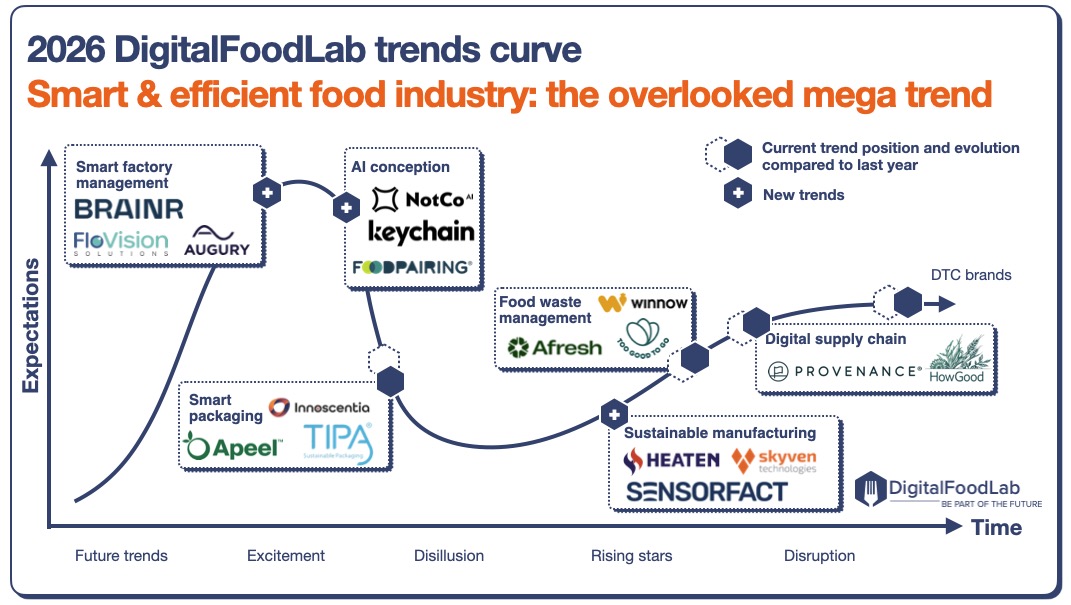
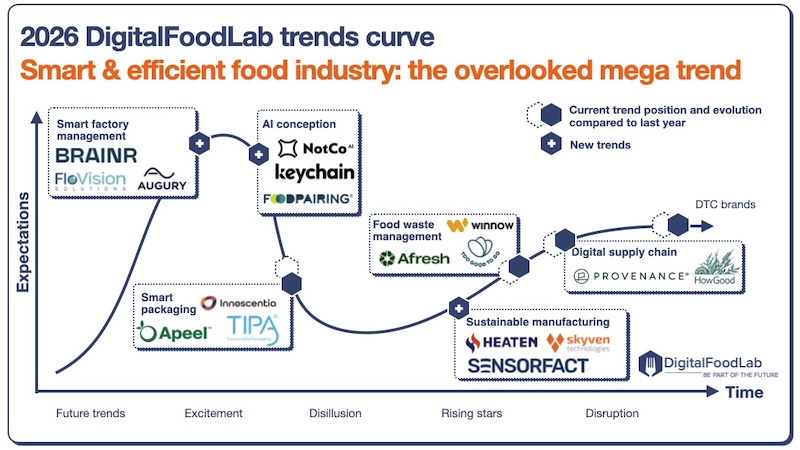
DigitalFoodLab’s 2026 trends curve for the smart and efficient food industry reveals a landscape with trends at different stages of maturity, from proven solutions to emerging technologies still in the excitement phase.
At the disruption stage: digital supply chain. The use of digital tools to increase traceability, transparency, and quality control across the food value chain is more a maturing topic than a new one. Players are delivering concrete value through quality controls, carbon labelling, and product verification, even if end-to-end traceability remains a challenge.
Rising Stars: Food Waste Management & Sustainable Manufacturing
- After years of focus on consumer-facing food waste management solutions, attention is now well set on B2B companies such as Afresh (a platform that manages fresh food product orders for retailers with AI-powered predictions), which help foodservice players and retailers use data and artificial intelligence to manage their supply.
- Sustainable manufacturing is gaining momentum as Scope 1 and pressures intensify. Here, the solutions for food and beverage production facilities are mostly around energy reduction (Sensorfact) and electrification (Heaten).
Disillusion with packaging: interesting solutions are being developed in all categories (alternatives to plastic, solutions to reduce waste through biocoatings or to add a layer of intelligence to packaging). However, adoption remains elusive due to cost concerns. As for other categories of the agrifood innovation ecosystem, it seems that either an increase in regulatory pressure, or an uptick in adoption in other industries, notably fashion, cosmetics or home-care products, with less technical constraints, will be required before anything meaningful happens for food.
In the Excitement phase: AI for efficiency gains
- Smart factory management, with digital and AI tools that monitor, coordinate and optimise food production in real time.
- AI Conception, or the dream of turning artificial intelligence into a tool to accelerate product development, from idea generation to ingredient and supplier discovery to recipe improvement.
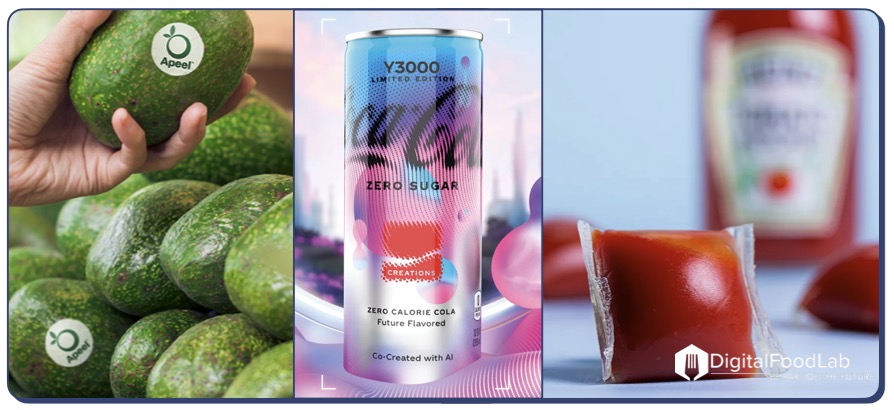
A note of realism is required: beyond the hype, very few solutions have yet been deployed at scale. After all the hype, we don’t have much beyond a can of Coca-Cola “co-designed with AI”. Similarly, for packaging innovations, which are also among the elements that are quite prone to attract journalists’ interest with bold promises (from Algae-Bo sprays reducing produce waste), adoption is slow. This is not defeatism, but a reminder that we are still in the early stages of these technologies and should be wary of promises that are too good to be true.
How to manage these topics within an innovation strategy?
This is where the smart and efficient megatrend becomes even more complex. For most agrifood players, managing disruptive innovation means a focus on their core product. This often means that innovation teams overlook supply chain topics (”it’s not in our mandate”) and operations (”we want proven solutions that are ready to scale”).
Based on our observations across our portfolio of global clients, we recommend creating a second innovation mandate or team: either add a second mandate with dedicated goals to the innovation team, or, ideally, create a second team. Factory efficiency gains can’t really be managed through the same innovation pipeline, as evaluation criteria, timelines, and internal sponsors differ fundamentally.
In a word, supply chain innovation is often overlooked, with a focus instead on ingredient or product innovations. This is slowly shifting toward an increasing focus on efficiency gains, as we observe in application calls and open innovation strategies. This space deserves more attention, as it is the only part of the innovation ecosystem where immediate and measurable financial benefits are achievable.