For weeks, I have read multiple articles on whether the new Trump administration would positively or negatively impact the AgriFoodTech ecosystem. Frankly, I had no real opinion on this topic until very recently.
Now, it seems pretty straightforward, at least in the short term, that the impact will be far less favourable than some may have anticipated. First, and that part may evolve fast, the rising uncertainties in the economic policy are not creating the perfect context to stimulate investments. We may have to wait longer for the expected bounce back in deals and funding. Also, and that’s where I’d like to focus today, the evolution of the regulatory landscape may be the point at which we should focus our attention.
1 – Where will the US go regarding regulation for sustainable ingredients?
Recently, the United States signalled a major shift as the US food regulatory administration (the FDA) explores eliminating the current pathway that allows companies to self-affirm food ingredients as safe (something known as being self-GRAS). This regulatory change was promised by the new Health Secretary R.F. Kennedy and is seen as a loophole that enables too many unsafe ingredients to be sold in the US.
While there is some truth in that argument, for most startups developing new ingredients, notably using precision fermentation, the self-GRAS status was a very convenient way to enter the market for early experiments before going for a full review (a full-GRAS). It was also often a step to start negotiating partnerships with leading companies to use their ingredients and raise funds. Such a tightening could significantly raise hurdles for emerging startups, increasing the already high level of uncertainty linked to developing new ingredients.
As if things were not complex enough, multiple US states are considering an even stronger stance by banning alternative meat products. Mississippi just passed a bill that made it the third US state to ban lab-grown meat. In other states, bills are being written to define dairy and meat products as being only the output of animals, making all plant, fermentation and cultivated-based ingredients more complex to market to the consumer.
In the short term, we can expect multiple startups to rush towards the self-GRAS status as long as it is still available. Nonetheless, the current regulatory review is demonetising the status, making investors and large companies seeking deals with startups ready for a more stringent full review.
In the medium to long term, combining the regulatory evolution and the spread of bans could have negative consequences for the US alternative protein and sustainable ingredient ecosystem. First, as the US government and many companies are moving away from sustainability goals, the desire to use alternatives to reduce their impact is much less present than only six months ago. Then, a more complex regulation will make innovations seeking to develop their solutions elsewhere.

2 – It could be worse; now there are alternative markets
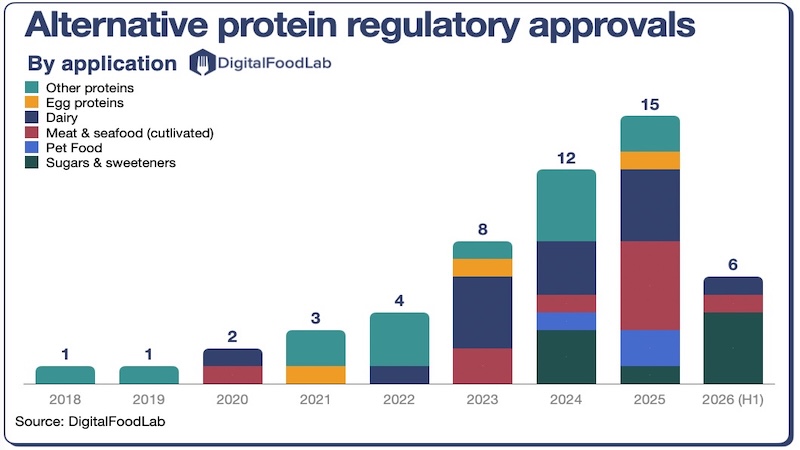
Recently, multiple other countries have shown their appetite to compete in the alternative protein ecosystem by being more friendly towards them, notably from a regulatory point of view. In the past couple of weeks alone:
- South Korea opened a centre dedicated to cellular agriculture. Alongside $10M in public investment, this centre is part of a broader strategy towards biotechnologies and has strong political support.
- China seems more and more open to alternative proteins.
- Even Europe is moving forward, or at least the UK is: the British regulatory body wants to complete the safety assessment of two lab-grown food products within two years. At the EU level, multiple grants to alternative protein projects also show a willingness to move forward.
While only a year ago, the world of alternative protein was limited to Singapore, Israel, and the US, with the latter being the primary target market, things are looking very different now. If the US becomes much more complex to enter (which could have some positive effects in the long term by increasing the trust American consumers have in the food products they eat), new markets are opening up, notably in Asia.
These contrasting regulatory directions illustrate an ever-more complex landscape for AgriFoodTech innovation. Not only are things moving fast in terms of innovations being developed, but it is also becoming increasingly important to consider the geopolitical view when making decisions. That is even more true as these innovations get closer to the consumer.
Agrifood companies, investors, and startups must proactively monitor and engage with these evolving regulatory environments. Being able to adapt quickly or even to anticipate which will be the best markets to launch sustainable ingredients today could create a competitive advantage tomorrow.