Earlier this month, the US Food and Drug Administration proposed making GRAS notifications mandatory. This would be a major shift from the current situation, in which companies can reach their own GRAS conclusion without notifying the FDA.
For many alternative-protein companies, however, the change would be less radical than it may appear: submitting a GRAS notice has already become the de facto route to reassuring industrial partners.
If finalised, the rule would increase regulatory oversight and transparency, while turning what was once a differentiating milestone into a standard requirement.
This raises a more useful question: after years of companies presenting regulatory clearance as a decisive business milestone, what has it actually unlocked? My conclusion is simple: not so much. Receiving a regulatory approval is a necessary step; it can even be a booster, but it does not make a product scalable or desirable by itself.
Backstory: we confused regulation with momentum
For much of the past decade, a large part of the alternative protein ecosystem worked under the same assumption: once the first products were approved, everything else would follow.
Regulatory approval would lead to more funding (this part happened) and initial product launches. These launches would reassure infrastructure investors that would then bet on the scale-up facilities. With scale, costs would decline, consumers would become familiar with the technology, acquisitions would happen, and everybody would be very happy to have solved one of the world’s biggest challenges.
In other words, approval was expected to create a snowball effect. Regulatory approval became the equivalent of a record funding round: a visible, easy-to-communicate milestone that was often mistaken for evidence that the business itself had been de-risked, notably on the technology front and in its ability to scale.
The approvals eventually arrived, but the snowball didn’t.
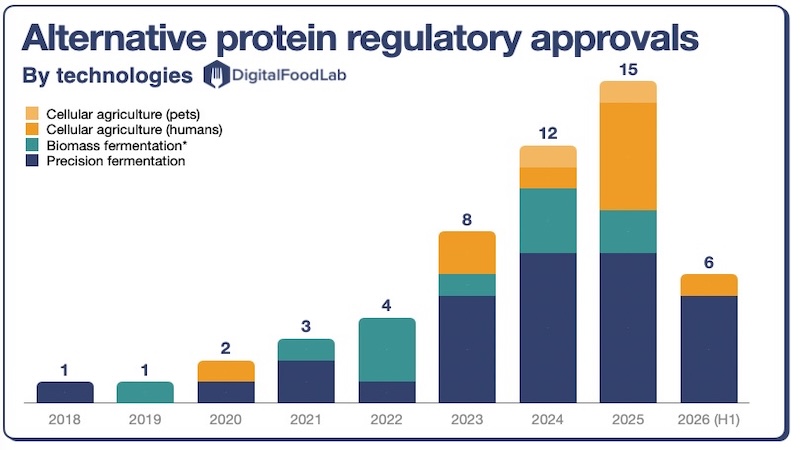
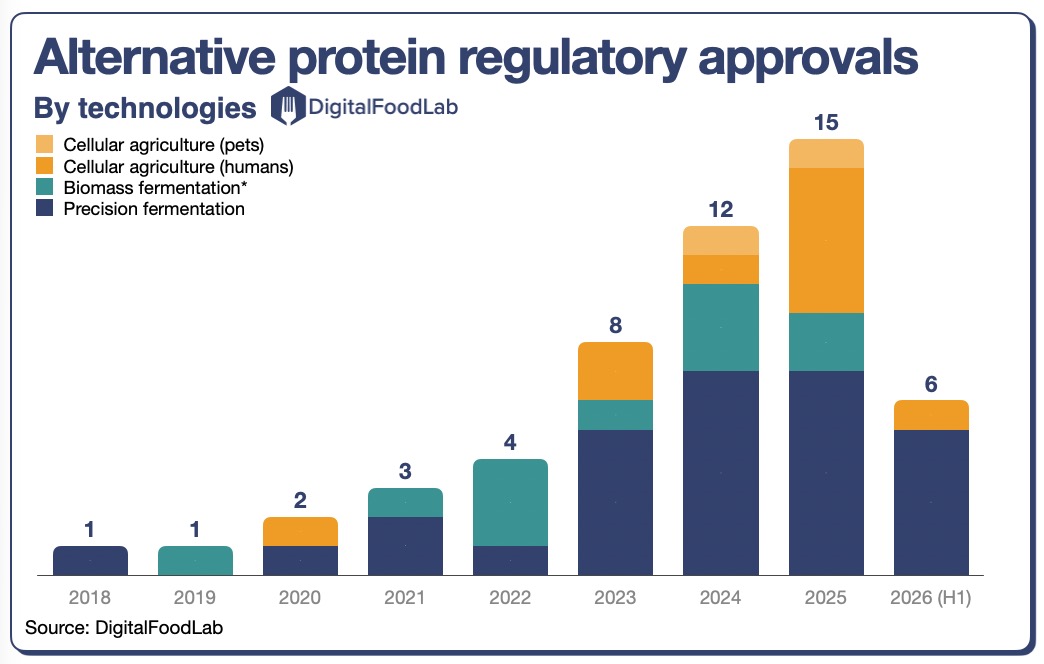
DigitalFoodLab now counts more than 50 approvals worldwide for cultivated meat, precision fermentation, and biomass fermentation ingredients. Yet commercialisation remains limited to a handful of restaurant items, and large agrifood companies that launched test products on the market have largely retreated to the sidelines.
Regulation was only the first of four gates
Regulatory approvals are piling up for various technologies and ingredient categories across an expanding array of countries. Yet, consumers would have a hard time finding products on shelves.
Among the startups that received clearance to sell their products first, Perfect Day (precision fermentation dairy) and Upside Foods (cultivated meat) brought several products to the market, either on their own or through partnerships. They indeed demonstrated that commercialisation was legally and technically possible.
What they didn’t do is demonstrate that a scalable market would automatically follow. Of the many brands built around Perfect Day’s ingredient, most were sold and eventually closed, and Upside’s availability remains extremely limited.
Looking back, the ecosystem focused too much on regulation, maybe because it was the first “closed gate” to open. But reaching the market requires crossing at least four gates:
- Regulatory permission: can the product legally be sold?
- Industrial capacity: can it be produced reliably, at scale and at a competitive cost?
- Commercial commitment: is a large partner willing to launch, distribute and support it beyond a pilot or press release?
- Consumer relevance: how to explain to consumers that this new ingredient delivers value on taste, price, nutrition, or convenience?
The graph shows that alternative protein companies are crossing the first gate at an increasing rate. Progress through the other three gates is more uneven and, for the most part, happens “under the radar,” notably in industrial capacity and commercial/corporate commitment.
Consumer acceptance, however, is mostly unresolved. We are still in the early days, with very few answers to key questions such as “How do we explain this technology to consumers?” and “Why should consumers care about these innovations?” This is probably why most of the focus is shifting towards ingredients with a clear value proposition, including:
- health benefits, such as novel sugars or lactoferrin
- supply-chain resilience, in categories such as cocoa and coffee
- pet food
Conclusion: approval is a milestone, not a strategy
The lesson from the first wave of alternative protein approvals is not that regulation is useless. But approval alone creates neither factories, nor competitive production costs, nor committed distribution, nor consumer demand.
Contrary to what many expected, it is as if regulators moved too quickly relative to the startups’ and their partners’ ability to scale up production and identify viable commercial and consumer strategies.
For agrifood companies assessing this space, the practical implication is to move beyond the question, “Who will be approved first?”. The better questions are:
- Who has a credible path through all four gates and could become a threat or opportunity for our current business?
- Which applications could become viable faster by leveraging our existing capabilities?
The winners will not necessarily be the first to receive permission. They will be the first to align regulatory permission, economics, commercial commitment and consumer relevance. Strong partnerships and the choice of the right first market will make the difference.
At the end of the day, the regulatory race wasn’t so much a race.