🧪🌱 Molecular farming: the hot new trend

Published on June 12, 2024

Trends can shift quite fast, notably in tech. Take, for example, alternative proteins:

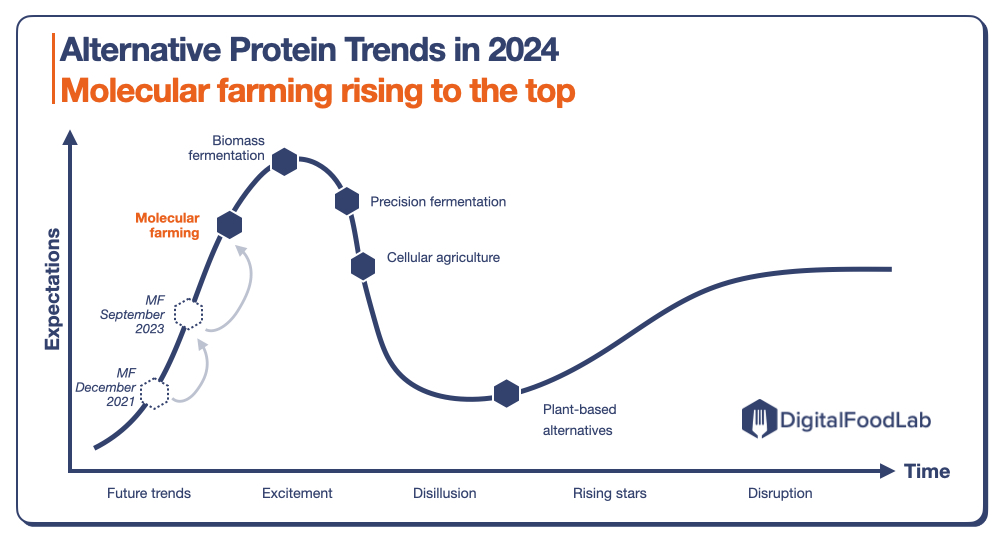
  • Just a year ago, the spotlight was on cellular agriculture startups as a couple gained regulatory approval for their meat products in the US. However, their inability to scale quickly put a shadow on that trend, which is now moving fast toward the pit of disillusion.
  • Then, precision fermentation, using micro-organisms to produce proteins through fermentation, climbed to the top of the hype as numerous startups received regulatory approval while announcing large-scale facilities and new products. For similar reasons (scale), the hype has watered down.

So, is it over, and are we waiting for these technologies to be mastered or used differently (for new ingredients, for example, coffee, sugar, or cacao)? Obviously not; there is a new hot tech in town: molecular farming.


Above is DigitalFoodLab’s hype curve with the curent state of the different alternative protein technologies (for more information look at our full trends report). Molecular farming is moving forward with increasing speed. From a niche topic that was barely considered between 2021 and the end of 2023, it has become a major topic of discussion in the overall alternative protein ecosystem.

How does molecular farming work?

First, it is important to note that this technology as many others in the alternative protein ecosystem derives from the pharmaceutical industry. That’s why, this technology is often referred as “molecular pharming”.

Then, also quite similarly to other technologies in this space, it is quite simple on paper: instead of using large fermenters, the goal is to use plants as bioreactors. Plants, such as soy, tobacco, canola or potatoes, are genetically engineered to produce desired molecules. They are then grown, and through well-known processes (used widely for the extraction of ingredients in today’s food industry), the desired substances are extracted and then isolated.

Finally, depending on the type of plant used, you can either have an extract which is a solid (powder) or a liquid which can be directly used in a recipe.

The goal is to achieve large-scale production of these molecules at a very low cost, notably compared to the technologies mentioned themselves.

Who is doing what with molecular farming?

As explained above, we observe a new hype around molecular farming. Startups are mostly working around two types of applications in food:

  1. Ingredients for other alternative protein technologies, notably growth factors used in cellular agriculture. These are the most expensive ingredients used in the process of cultivating meat, and producing them at scale in plants could be one of the keys (with scaling up production) that would make this technology viable.
    BioBetter, an Israeli startup, is one of these startups.
  2. Dairy proteins, notably caseins: here molecular farming (MF) the technology is in direct competition with precision fermentation (PF). Some consider that PF could be efficient for “small” proteins such as whey, but not for larger ones, such as caseins (the proteins you want to produce cheese). From a single company (Alpine Bio, US), the ecosystem of MF startups focusing on dairy proteins has expanded a lot in the past year with now a handful of players in Israel, France and in the US.
  3. Meat alternatives: this is a much smaller space, embodied by Moolec, one of the precursors in this space, with its “piggy” soy which includes pork proteins and which received regulatory approval to grow it in the US.

What’s next?

This space is moving fast with the first authorizations to grow these crops. It has yet many challenges ahead, notably:

  • demonstrating the ability to scale at an affordable cost
  • showing the potential to create highly-concentrated ingredients that can be used in food products
  • facing regulatory challenges around genetically modified crops in Europe: we should note that technically, the end product (the purified molecule) is not genetically modified, so it could be authorized in the EU.
  • explaining the technology to consumers

These challenges appear to be impossible to meet due to the experience we have with genetically modified plants. We do not expect to see products on the shelves with their key ingredients made with molecular farming in the near future. However, some applications for high-value ingredients could be visible in 3 to 5 years. That’s why we consider molecular farming as one of the elements that dairy and bakery companies should put at the top of their innovation agendas.

You're in a good company

Join the 60+ clients of Digital FoodLab: leading agrifood companies, retailers, banks, investors, startups, and public organisations.

Use case: project for a global F&B company looking to map its AgTech innovation ecosystem and the best startups to partner with

What we did:

  • Mapping of the AgTech ecosystem: startups, research regulators, and other leading companies.
  • Discussion to select areas to focus on.
  • Analysis of the information to reveal the trends and a model to analyse eventual partners.
  • A workshop to validate the opportunities based on our recommendations.
  • Scouting of relevant partners followed by introductions.

Results:

  • Mapping the different categories of innovations in AgTech that should be considered now to create long-term benefits for the business.
  • Identification of key partners (an incubator and a couple of startups).

Use case: project for a CPG company on the healthy ageing ecosystem

What we did:

  • Education of the board through a couple of workshops to define the perimeter
  • Identification of key opportunities and threats created by long-term evolutions (technologies, business models, behavioural changes).
  • Deep dives on each of the priority categories.
  • Co-construction of a vision on how the company should address these challenges.
  • Identification of partners (startups, incubators, funds) to move forward.

Results:

  • Creating a consensus on which categories to prioritise and how to address them.
  • Implementation of an open innovation strategy through the development of partnerships.

Use case: project for a global CPG company to develop a strategy on the healthy ageing ecosystem

What we do (ongoing mission on a subscription model):

  • Kick-off where we present an overview of the AgriFoodTech ecosystem to select with the client the categories to cover and for each, the level of information required.
  • Monthly newsletter: each month we send a newsletter with the articles that we have gathered ranked by relevance, their summaries, and a layer of analysis.
  • Database: we set up a personalised database that will be filled month after month with the information gathered on the companies identified for the watch.
  • Workshops: twice a year with the client’s innovation team and other “innovation curious” team members, we present an overview of the evolutions, key trends and a dashboard of the topics followed by the watch.

Results:

  • A clear, regular and evolutive tool to follow what is happening in terms of innovation on key topics.
  • A forum (through the workshops) to discuss innovation trends and new opportunities.

Use case: opportunity screening for an ingredient company

What we did:

  • Kick-off to define the perimeter of the ecosystem studied.
  • Mapping of the different trends shaping the innovation ecosystem of the client.
  • Analysis of the trends on DigitalFoodLab’s trend curve and other relevant frameworks.
  • Workshop to discuss DigitalFoodLab’s recommendations on key trends to prioritise

Results:

  • Shared view of the innovation ecosystem for the client with a view of the trends to prioritize.
  • Clear document (personalised trend curve) that can be easily shared internaly to explain the company’s innovation choices and which can be then updated each year.

Use case: scouting for an agriculture coop

What we did:

  • Kick-off to define the perimeter of the client, the goals of the scouting (partnerships) and the criteria on which startups should be evaluated.
  • Set-up scouting: we selected the first batch of 20+ key startups following the criteria of the client.
  • On-going scouting: then we set up a quarterly scouting of about ten startups.
  • For each scouted startup, we created an ID card with key information such as the business and technological maturity, funding, and corporate partnerships. We also added an explanation of why we selected this startup.

Results:

  • An ongoing and evolutive scouting are matching the client's criteria and its capabilities in terms of deal flow.

Use case: working on an acquisition process for a CPG company

What we did:

  • Kick-off to define what the client is seeking, notably in terms of maturity.
  • Workshop with the client based on a mapping of the different innovation ecosystems adjacent to its activities to select some priorities and discuss inspiring examples of startup acquisition stories.
  • Identification of 20+ targets.
  • Workshop to select the most relevant to engage with.
  • DigitalFoodLab worked as a sparing partner during the acquisition process, notably to help design how the acquired startup could be integrated into the overall company’s strategy.

Results:

  • Different results from traditional M&A processes with a focus on the client’s innovation strategy.
  • Identification of a good match for an acquisition.

Use case: market due diligence on sugar alternatives

What we did:

  • Kick-off with the client to discuss its interest on this category, its expectations and existing level of information (notably on the target company).
  • Mapping of the ecosystem to analyse the different existing alternatives and technologies to compare them.
  • Interview (calls) with relevant startups made by our internal biotechnology expert.
  • Recommendation on whether to invest or not.

Results:

  • Clear view of the ecosystem and of the reasons to believe (or not) in each sub-category.
  • Enforceable recommendations based on facts and expertise.