Hey,
I hope you had a great summer, even in the peculiar circumstances we all face. After a couple of weeks of vacation in Portugal (chasing after the recently elected seven sweet wonders of the country, which to my dismay, don’t include my beloved Pastel de Nata), it is time to get back to business. I thought that, due to the context, not so many things could have happened during the summer. I can’t have been more wrong. I dived into the latest deals and news and selected what that I think you need to know:
Geltor raised $93.3M in late July
Geltor, founded in 2015, is known for its cultivated collagen used notably in cosmetics, pharmaceuticals, and food. This deal is significant in many ways. Outside of the initial funding of Motif Bioworks, it is the biggest deal of a “supplier” using cultivated technology and looking to provide its products to either big corporations and other startups. As for Cubiq Foods, which raised earlier this year, we observe the development of a whole ecosystem of such cultivated-tech suppliers. Geltor’s funding was led by CPT Capital, a British family office, also an investor in many cellular agriculture protein startups such as Memphis Meat.
More here
Aryballe, the French startup that helps large companies to collect, analyse and match odors raises €7M
Aryballe, a French startup dedicated to odor analytics, raised €7M. Combining biochemical sensors, advanced optics, and machine learning, the company’s devices can be used to assess consistency and quality in food products. Other food and beverage use cases include assessing the freshness of raw products and using their scents to compare them to its database.
More here
Plant Jammer, the Danish plant-based cooking recipes app raises €4M
You want to eat more plant-based dishes but don’t know what to do with all these veggies? Plant-jammer may be the solution for you. Using AI, it matches users’ tastes and available ingredients to recipes. It convinced thousands of households to use it and leading companies such as Dr Oetker and Miele to invest €4M to grow. It will use the funding to grow its user base and its API that companies such as retailers can use to create recipe-related experiences for their customers.
More here
Atomo
Atomo, the molecular coffee startup, raises $9M in seed funding from various investors, including Horizons Ventures, Bessemer Ventures, and AgFunder. Basically, Atomo’s goal is to create coffee without the bean. As leading plant-based startups have done with eggs, dairy, and meat products, the team has mapped coffee’s taste and recreated using upcycled plant ingredients. The first products should reach the market in early 2021 and will use the funding to grow its production by building its own “roastery”.
Investments bounce back in European FoodTech
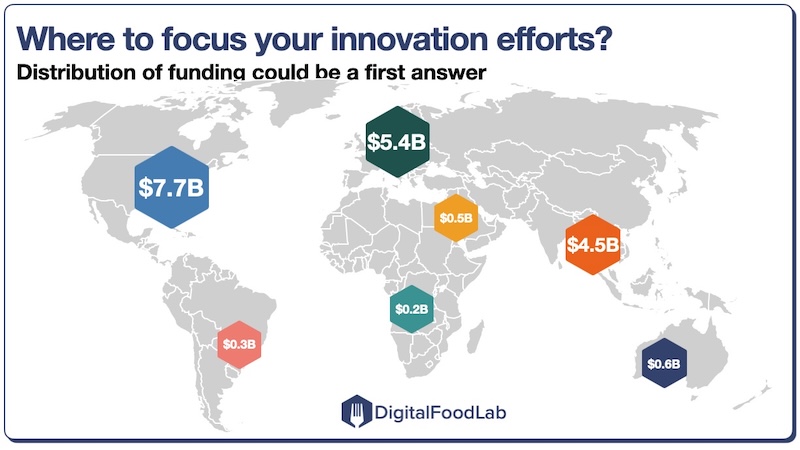
We did a quick update to our report of the fundings in European FoodTech startups. Contrary to what many could expect, European Foodtech is on a path to sustain the amounts raised last year, which was a record year! From what we observe, the second semester will be at least as good as the first one, with many big deals in the making in Europe and elsewhere. Indeed if some FoodTech sub-categories are deeply affected (notably for startups working in the restaurant industry), many already existing trends have been bolstered by COVID-19. It’s particularly the case for grocery delivery and alternative proteins.
More here
iFarm, an urban farming Finnish startup raises $4M
Finnish startup iFarm just raised $4M. What’s interesting in this deal, in a quite similar fashion to Geltor’s, is that iFarm is not building urban farms, but it is an enabler. It develops software that other urban farming companies will be able to use. In a growing ecosystem, some leaders have the means to develop their own technology and software, but most projects don’t. iFarm was not the only European urban farming deal this summer as Dutch startup Plant Lab raised €20M.
More here

Ocean Rainforest, a seaweed startup from the Faroe Islands raised $1.5M in a deal led by the WWF
Ocean Rainforest is developing seaweed (or micro-algae) farms in the ocean near the Faroe Islands. Producing seaweed has many benefits for the environment: it consumes CO2 and doesn’t require any pesticide or freshwater. However, cultivation in the open ocean is still a challenge. With this funding ($1.5M raised, $850K of which from the World Wild Fund for Nature or WWF), Ocean Rainforest will scale its production in its two farms (in the Faroe Islands and California).
More here
Impossible Foods raises another $200M
With this new round of funding, the plant-based meat alternative startup’s total amount nears a staggering $1.5B. It will be notably used to keep scaling its production capabilities and retail presence. At the start of COVID-19 lockdowns in March, the Impossible Burger was only available in 150 US stores. Shoppers can now find it in more than 8,000 grocery stores. In the meantime, it launched is direct-to-consumer online sales.
More here
MissFresh, one of China’s FoodTech unicorns raises $495M
Lockdowns have been a boon for many grocery deliveries. It seems to have been the case for China’s MissFresh. Already active in 16 locations, the startup is able to offer 30-minutes deliveries with its warehouses located inside cities. As for Europe’s Picnic, this deal shows that competing in grocery deliveries requires huge amounts of money. It seems that investors are more ready than ever to bet on it to compete against traditional retail.
More here
I hope this recap was enough of a boost! In many ways, FoodTech has been reinforced by the COVID-19 crisis, and many trends have been accelerated. The next couple of years will be really exciting. In the meantime, if you are an entrepreneur or a large company looking for expertise on how to identify and act on FoodTech opportunities, give us a call.
Have a great week and keep safe!
Matthieu
YOU LIKE THIS CONTENT? SHARE IT WITH SOMEONE WHO MIGHT LEARN SOMETHING FROM IT!
We grow with your help. So, if you like this content and feel that it might help someone to understand how Ag, Food and Retail will be disrupted in the incoming years, share this newsletter or subscribe him or her here!
As you can see, FoodTech is indeed moving faster than ever in 2020. But you are not alone. DigitalFoodLab is here to help you :
- Stay at the top of your domain. We prove exclusive insights and information through talks and our FoodTech watch.
- Prepare for the future. We help you make plans for long term trends and their implication on your business and to identify the right startup to work on your current issues.
- Innovate faster. We work with you to define the innovation strategy fitted to your business means and needs.
No matter if you are a startup or a food giant, we are here to work with you and change the world of food! (contact us).