Hi,
Finally! Everywhere, people are hitting the streets again and getting out of lockdown. From a Paris point of view, the difference is, however, hard to grasp as restaurants and bars are closed, and people are told to keep working at home.
However, now that fear is leaving room to reason, and since we have a bit of time to think, we can wonder what we should do in the “world of after”. Among the many articles that I have read on this theme, very few were relevant. Indeed, most of them were pointing toward a pre-crisis agenda (from the environment, capitalism to immigration). However, in early May, one essay from Mark Andreessen (entrepreneur and investor) echoed to what I think should be the entrepreneurial way to think in the aftermath of this crisis. In his piece, It’s time to build, Andreessen underlines that in many sectors, from housing to transportation, the problem is not money, as it is abundant, it is inertia. “We need to want these things more than we want to prevent these things”. Regulation and the lack of desire for innovation to happen is what slows the drive toward innovation that is the only way forward.
How is that relevant to food? Covid-19 revealed that our food system is resilient but not as strong as we would like it to be. In many ways, food needs to reinvent itself from farm to shelves to fork. Obvious facts, such as our reliance on unsustainable animal proteins or overstretched supply chains have been laid open bare during the crisis. That’s why we need to build new answers, services and products. Here, entrepreneurs are essential. Disruption won’t come from big agribusinesses (or the public sector), it will come from innovators that will try and learn new ways to grow produce in urban farms, deliver food with robots or grow proteins in labs. Some of these new ventures will become tomorrow’s leaders. Many will be absorbed by the best current corporate leaders, helping them to sustain their path of incremental innovation.
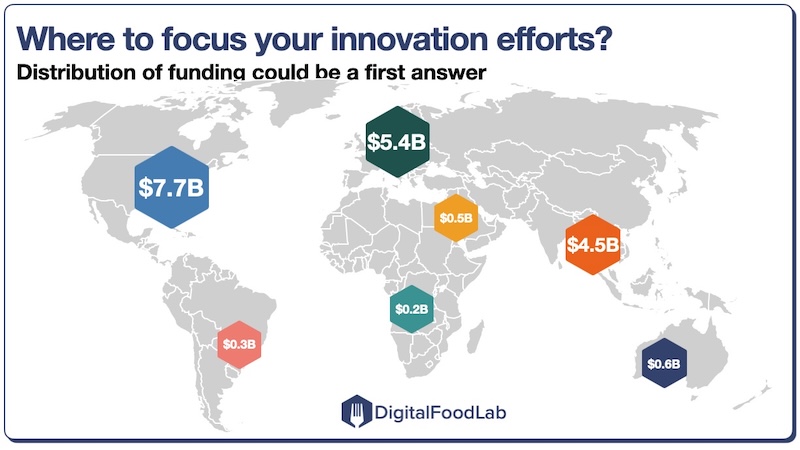
To do so, we need a strong and local FoodTech (and AgTech) ecosystem. If money is not everything, it is important to sustain innovation. However, for a country like France, investments in FoodTech (including AgTech) account for less than 6% of the total amounts invested in startups, when the agribusinesses’ share in GDP is 15%. As food is more defensive than many other sectors, it is now, maybe more than ever, a good time to invest in the future! The opportunities are immense. Here are three domains that revealed themselves during the crisis:
- Robotics is now seen as a safe and efficient way to replace some strenuous jobs in restaurants and then deliver food with robots, drones and autonomous cars.
- Food marketplaces, such as Instacart, have proven their ability to scale fast. Entrepreneurs can and should reinvent grocery retail.
- For meat alternatives, either plant-based or lab-grown, this crisis is a boon. Consumers are more ready than ever to switch to alternatives and are even ready to pay more for it.
Let’s start to build!
Matthieu
TWO REPORTS TO START BUILDING THE FUTURE OF FOOD

Our take on the impact of COVID-19 on Food(Tech) and how it may reshape the industry

#1 – The 8 cities that make the European FoodTech
As observed in the report on European FoodTech investments, these cities are not distributed evenly across the continent. In fact, it is quite the opposite. And even inside leading countries, it is often one city that leads in terms of deals and investments. Eight cities alone account for more than 72% of the investments. Five of them make 66% of the total.
#2 – Robots finally hit the streets
With lockdowns, the rise of delivery was inevitable, but it is often at the cost of social distancing with the delivery drivers. Companies already involved with robots and drones are moving their experiments into the streets at the service of consumers.
#3 – Instacart, the Uber for groceries is booming during COVID-19
Instacart, the uber for groceries (that is enabling you to order your groceries to your local supermarket with independent workers going to pick items in the shelves and then deliver to your door) was already growing fast both in terms of revenues and critiques before the crisis. Instacart’s rise is impressive. It should make $35 billion in grocery sales this year.
You still want more, here are some of our favourite reads of the last couple of weeks:
- PepsiCo launched two direct to consumer sites, one for snacks, one with bundles of favorites
- New Crop Capital invests in Heura, a leading European plant-based alternatives startups
- Consumers are willing to pay 40% more for cultivated meat over regular meat
As you can see, FoodTech is indeed moving faster than ever in 2020. But you are not alone. DigitalFoodLab is here to help you :
- Stay at the top of your domain. We prove exclusive insights and information through talks and our FoodTech watch
- Prepare for the future. We help you make plans for long term trends and their implication on your business and to identify the right startup to work on your current issues.
- Innovate faster. We work with you to define the innovation strategy fitted to your business means and needs.
No matter if you are a startup or a food giant, we are here to work with you and change the world of food! (contact us).