FoodTech recap: let’s talk about FAT

Published on May 29, 2020

Hi,

The weeks (or months) of lockdown have had a lot of positive effects such as putting us back in the kitchen, enabling us to think about the need to build a better future and about the FoodTech trends that will benefit of the COVID-19 crisis. They also added some weight on our wais as many of us have spent (too much) time looking at TikTok videos and cooking eating food (here is the recipe for the famous 3-ingredients peanut butter cookie).

So, we are entering “the world of after”, maybe smarter but certainly larger. As often, we decided to look at “fat” from another angle.

First, we looked at the keto trend, which has surely been one of the hottest food trends in the last five to ten years. We have mapped and categorised some of the most interesting startups of this ecosystem to identify its underlying trends. Basically, Keto is the idea that fat is good and the real enemies are carbohydrates. This trend comes from the ’70s when the low carb Atkins diet started to get famous in the US.

Keto mapping dfl

In this mapping and analysis mini-report, we consider the various categories and their potential.

Then, keeping our journey on the world of fat, we crossed the path of Cubiq, a Spanish startup that raised €5M for its lab grow fats. Almost all of the lab-grown ecosystem is concentrated around the reproduction of animal protein. But both dairy and meat are a mixture of proteins and a significant share of fat. Now, both in plant-based products (alternative milk, burgers such as Beyond Meat’s and Impossible Foods’) and lab-grown, companies work with saturated plant-based fats. Cubiq Foods has developed what it calls “smart fat”, a less energetic (fewer calories), sustainable and healthier fat. If it keeps with its promise, Cubiq could help define the future of fat.

Should these considerations not be enough for you to trim the extra weight you have added, the French startup Qilibri raised €3.5M to help you rebalance your diet with delivery of meals, nutritional advice and soon online sports sessions.

Let’s diet!
Matthieu


TWO REPORTS TO START BUILDING THE FUTURE OF FOOD

Covid 346x216

Our take on the impact of COVID-19 on Food(Tech) and how it may reshape the industry

Europe

The Investments in Europe FoodTech report, in partnership with Eutopia, Kea&Partners, Nestlé and Vitagora


#1 – (Interview): Camille from Eutopia on how to invest in the future of food

Camille KRIEBITZSCH, investment director and co-founder of Eutopia, a sponsor of our last report on the State of Europe’s FoodTech, answers some questions that many entrepreneurs ask on what a fund with a specific interest for food brands is looking after.

More here

#2 – Three startup trends that will benefit from COVID-19

As COVID-19 is not yet behind us, it may seem presumptuous to think about “what will be different after”. However, a few trends that were more or less already present have been certainly boosted by the current crisis, and it is hard to think we will go back. We have listed three trends: robotic delivery, Lab-grown proteins and plant-based alternatives, and grocery marketplaces.

More Here

#3 – The surprising top 10 European FoodTech countries

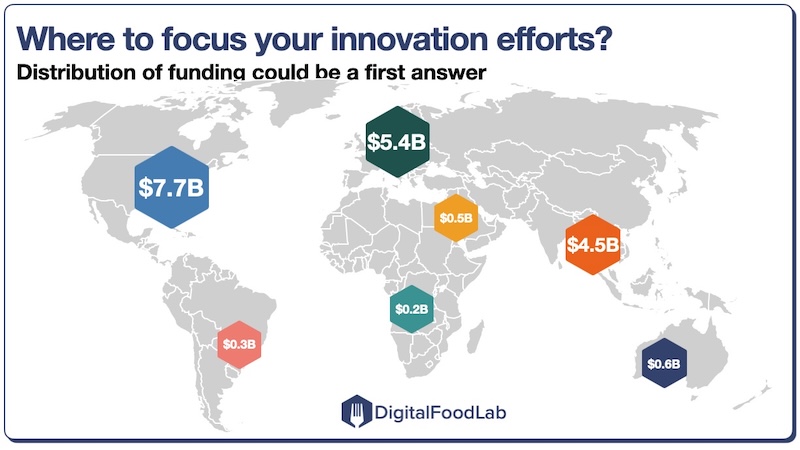
Investments in European FoodTech by countries in 2019 (with the growth from 2018), are divided into four groups, which remained stable for the last couple of years:

  • The United Kingdom, leader for the last six years
  • Co-leaders: France, Germany, The Netherlands, joined more recently by Spain (primarily due to Glovo)
  • Small and dynamic ecosystems in the Nordic countries (united, the five countries would easily take the fourth place), Switzerland, Belgium and Italy (falling a bit behind).
  • The remaining 30 countries lagging behind have local FoodTech ecosystems but little funding.

More Here

#4 – Investments in future foods decrease sharply in Europe

As investments in European FoodTech have risen sharply between 2018 and 2019 (and even more if we compare on a 5-year scale), this is absolutely not the case for foodscience. As one of the 6 categories of FoodTech, foodscience startups are developing new food products answering the need for more transparency, health and environmental concerns. Why didn’t we observed a “Beyond Meat” effect on investments?

More here


You still want more, here are some of our favourite reads of the last couple of weeks:

As you can see, FoodTech is indeed moving faster than ever in 2020. But you are not alone. DigitalFoodLab is here to help you :

  • Stay at the top of your domain. We prove exclusive insights and information through talks and our FoodTech watch
  • Prepare for the future. We help you make plans for long term trends and their implication on your business and to identify the right startup to work on your current issues.
  • Innovate faster. We work with you to define the innovation strategy fitted to your business means and needs.

No matter if you are a startup or a food giant, we are here to work with you and change the world of food! (contact us).

You're in a good company

Join the 60+ clients of Digital FoodLab: leading agrifood companies, retailers, banks, investors, startups, and public organisations.

Use case: project for a global F&B company looking to map its AgTech innovation ecosystem and the best startups to partner with

What we did:

  • Mapping of the AgTech ecosystem: startups, research regulators, and other leading companies.
  • Discussion to select areas to focus on.
  • Analysis of the information to reveal the trends and a model to analyse eventual partners.
  • A workshop to validate the opportunities based on our recommendations.
  • Scouting of relevant partners followed by introductions.

Results:

  • Mapping the different categories of innovations in AgTech that should be considered now to create long-term benefits for the business.
  • Identification of key partners (an incubator and a couple of startups).

Use case: project for a CPG company on the healthy ageing ecosystem

What we did:

  • Education of the board through a couple of workshops to define the perimeter
  • Identification of key opportunities and threats created by long-term evolutions (technologies, business models, behavioural changes).
  • Deep dives on each of the priority categories.
  • Co-construction of a vision on how the company should address these challenges.
  • Identification of partners (startups, incubators, funds) to move forward.

Results:

  • Creating a consensus on which categories to prioritise and how to address them.
  • Implementation of an open innovation strategy through the development of partnerships.

Use case: project for a global CPG company to develop a strategy on the healthy ageing ecosystem

What we do (ongoing mission on a subscription model):

  • Kick-off where we present an overview of the AgriFoodTech ecosystem to select with the client the categories to cover and for each, the level of information required.
  • Monthly newsletter: each month we send a newsletter with the articles that we have gathered ranked by relevance, their summaries, and a layer of analysis.
  • Database: we set up a personalised database that will be filled month after month with the information gathered on the companies identified for the watch.
  • Workshops: twice a year with the client’s innovation team and other “innovation curious” team members, we present an overview of the evolutions, key trends and a dashboard of the topics followed by the watch.

Results:

  • A clear, regular and evolutive tool to follow what is happening in terms of innovation on key topics.
  • A forum (through the workshops) to discuss innovation trends and new opportunities.

Use case: opportunity screening for an ingredient company

What we did:

  • Kick-off to define the perimeter of the ecosystem studied.
  • Mapping of the different trends shaping the innovation ecosystem of the client.
  • Analysis of the trends on DigitalFoodLab’s trend curve and other relevant frameworks.
  • Workshop to discuss DigitalFoodLab’s recommendations on key trends to prioritise

Results:

  • Shared view of the innovation ecosystem for the client with a view of the trends to prioritize.
  • Clear document (personalised trend curve) that can be easily shared internaly to explain the company’s innovation choices and which can be then updated each year.

Use case: scouting for an agriculture coop

What we did:

  • Kick-off to define the perimeter of the client, the goals of the scouting (partnerships) and the criteria on which startups should be evaluated.
  • Set-up scouting: we selected the first batch of 20+ key startups following the criteria of the client.
  • On-going scouting: then we set up a quarterly scouting of about ten startups.
  • For each scouted startup, we created an ID card with key information such as the business and technological maturity, funding, and corporate partnerships. We also added an explanation of why we selected this startup.

Results:

  • An ongoing and evolutive scouting are matching the client's criteria and its capabilities in terms of deal flow.

Use case: working on an acquisition process for a CPG company

What we did:

  • Kick-off to define what the client is seeking, notably in terms of maturity.
  • Workshop with the client based on a mapping of the different innovation ecosystems adjacent to its activities to select some priorities and discuss inspiring examples of startup acquisition stories.
  • Identification of 20+ targets.
  • Workshop to select the most relevant to engage with.
  • DigitalFoodLab worked as a sparing partner during the acquisition process, notably to help design how the acquired startup could be integrated into the overall company’s strategy.

Results:

  • Different results from traditional M&A processes with a focus on the client’s innovation strategy.
  • Identification of a good match for an acquisition.

Use case: market due diligence on sugar alternatives

What we did:

  • Kick-off with the client to discuss its interest on this category, its expectations and existing level of information (notably on the target company).
  • Mapping of the ecosystem to analyse the different existing alternatives and technologies to compare them.
  • Interview (calls) with relevant startups made by our internal biotechnology expert.
  • Recommendation on whether to invest or not.

Results:

  • Clear view of the ecosystem and of the reasons to believe (or not) in each sub-category.
  • Enforceable recommendations based on facts and expertise.