Welcome back for a new and exciting year of FoodTech insights. 2021 has been a great year for the ecosystem. We have started our work on our report on the FoodTech investments and the first data we have shows a truly impressive growth (teaser) in most geographies and categories. Many of the predictions I made one year ago have been surpassed. Here are DigitalFoodLab’s predictions and bets for 2022:
🚚 Accelerated concentration and convergence between grocery and meal delivery startups
For those interested in the future of retail, 2021 had all the ingredients of a good tv show with startups raising billions after billions, rumors of collapse, bad startup culture and, at the very last minute (like at 11 PM on the 31st of December) a major acquisition changing the landscape (see below).
In 2022, we think we will see three things:
- A convergence between grocery and meal delivery with acquisitions from both sides. At the end of the day, maybe only one to three players will survive in each city.
- Following that, we anticipate a major concentration of grocery delivery players: too many have been launched and have raised too little to face the giants. Most may disappear (ex: FarmDrop, see below), some will merge.
- A divergence in the offerings: today, most have the same offerings of products and meals. Small players and giants may try to differentiate by diverging from the standard. More broadly, the evolution of the economic situation will make most of the delivery startups run after profitability.
🧪 Fermentation up, plant-based and cellular agriculture down
2021 has seen a notable increase in the amounts invested in alternative proteins from plant-based startups (notably those working on something else than a beef burger), cellular agriculture and fermentation (from cheese-making companies such as Remilk to those creating new mycelium-based proteins like Nature’s Fynd).
In 2022, we think these three ecosystems will diverge:
- Plant-based startups focusing on consumer products, from burgers to fish replacement, will have a hard time. In the last semester, sales have decreased and Beyond Meat stock has plummeted. Simply put, consumers want better tasting and less processed products. Hence, we expect that many startups with little funding and non-compelling products will simply fail. In other words, entrepreneurs and investors will be reminded that first and foremost a food product should taste great, and then it should be better for you than what it intends to replace.
- Similarly, cellular agriculture startups have made a lot of promises in 2021. In 2022 they will have to deliver, and some won’t be able to. On the bright side, we expect to see (and taste) more experimental products and to move forward on the regulation. However, we also think that many more voices will rise against cellular agriculture, maybe moving the consensus and creating some difficulties.
- Precision Fermentation will have a huge boost with Perfect Day’s planned IPO and new products launches. This technology, often ignored, between plants and cellular agriculture could become the headline. We expect many more deals, products launches, approvals and announcements from corporations around precision fermentation and biomass fermentation.

🏬 Huge investments in the boring infrastructure that will be the backbone of the food of the future
We expect that the shift of investments toward infrastructure will go further in 2022 with more money for B2B companies building the architecture of the food of the future, notably in:
- large vertical farms
- new texturing technologies that will help solve the challenges in plant-based alternatives
- bioreactors and growth factors companies providing the tools for fermentation and cellular agriculture to work
This is a somehow large bet, but in a word, our prediction is that boring to become the new sexy for investors.
📦 The rise of reusable packaging
As countries (such as France just did) will ban single-use packaging more and more in our daily life, we can expect an increase in alternatives. If the obvious answer would be recycling or compostable packaging, we don’t anticipate that much will change in food. Things may have to evolve first in higher-margin ecosystems.
In the last couple of years, we have observed an increase both in the number of startups and in investments around reusable packagings (Pyxo), their cleaning and management, notably for restaurants (Vytal, a German startup that lends you reusable packaging when you buy a takeaway or meal delivered at your door and lets you give it back when you receive another delivery). We expect these solutions to get much more traction in 2022 (especially in Europe), maybe with partnerships with large foodservice chains.
🤖 What about robotics, foodservice, food brands and the future of agriculture
The trends already analyzed earlier will keep shaping these categories. There we only expect “more of the same”:
- more robots experiments in delivery, more funding for food robots, but we don’t expect any major change here as we don’t think that neither delivery nor cooking robots will be ready for their big debut in 2022.
- we will see if the digital-marketplace-for-foodservice (think about Choco, Cheetah, Collectiv Food) will have an impact if things go back to normal.
- more of the same D2C (Direct-to-Consumer) food brands launched around beverage (no or low alcohol, coffee) or supplements, more and more heat-and-eat meal kits (inspired by Freshly, AllPlants, etc.) and finally some major acquisitions by large companies (mostly around plant-based and everything related to the link between food and health)
- the border between Agtech and Biotech will become even thinner with startups working on new intrants. We also think that some of the insects-for-animal-feed startups will consider an IPO.
🎉 The party will continue
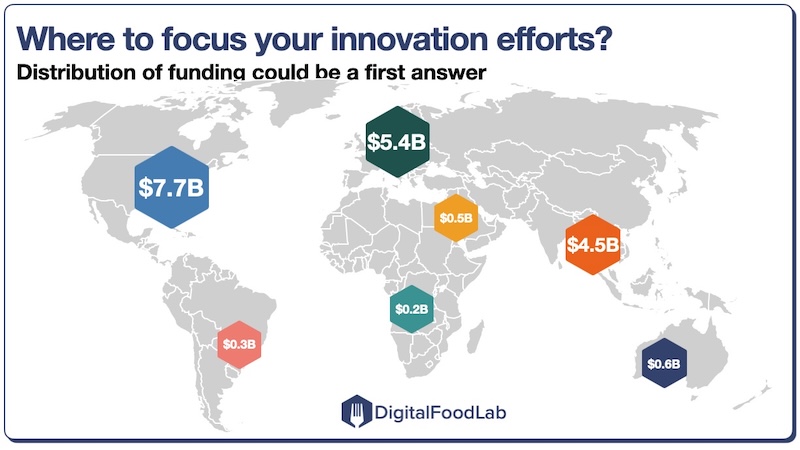
As I said, investments rose significantly last year in most categories and geographies. We’ll have more data later, but it seems to have been especially the case in Europe which may be finally taking its place.
In 2022, we can expect to see many more megadeals (€50M+ investments) as the investments increase in infrastructure, growing brands and new trends.
On the other side of the investment funnel, we observe with a keen interest that more deals are made by angels syndicates. These groups of informed investors are somehow threatening the role of early-stage VC. We expect that some of them will professionalise and get some fame in the coming year.