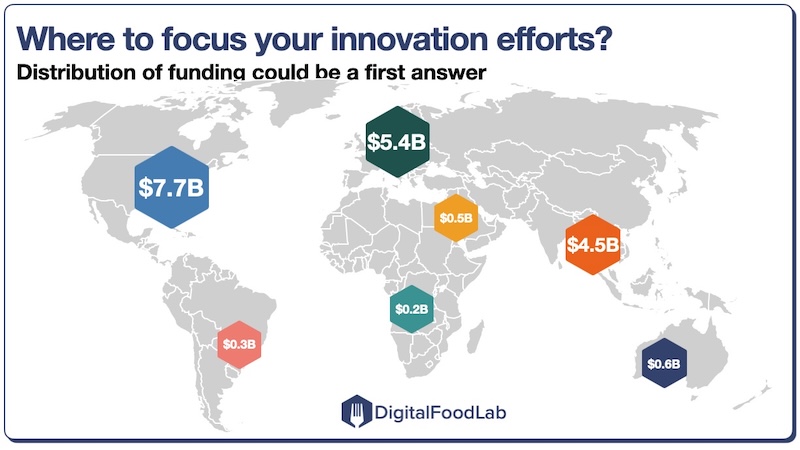
Looking at DigitalFoodLab’s FoodTech innovation trends, I often get one question: “What should we prioritise?” Indeed, even now, with much less funding going into startups, there are so many things happening simultaneously in innovation that it can get pretty overwhelming. So, today, I’ll present the outline of our reasoning when we work on such challenges for our clients.
First, it is key to be clear about the different time horizons. Even if it may seem obvious that there are different types of innovation for different horizons, this doesn’t always translate into clear goals and an efficient allocation of resources.

We use the framework presented above, which separates the future into three horizons and where:
Horizon 1️⃣ is about topics that are either:
- Already mature (restaurant delivery);
- Moving quickly (less than 3 years) towards maturity and a large market adoption with viable and validated business models and technologies.
There are still uncertainties, but there is much more on the path to market rather than on the innovation itself. This type of incremental innovation should be managed by the “business-as-usual” teams with support from the innovation teams. A good rule of thumb is that it should take about 70% of the innovation resources of most companies, including internal and external research, open innovation, partnerships, and M&A (which should be key here).
Here, we observe two common mistakes:
- efforts being put only on what we could call “horizon 1.1”, which is about mature technologies or mature markets;
- the omission of horizons 2 and 3 with all the resources and energy being put into short-term and incremental innovation.
Horizon 2️⃣ is about topics that are a bit farther away from being ready, with a time horizon of about 3 to 5 years, while Horizon 3️⃣ comprises longer-term topics (5 years and beyond) and are, hence, neither technology nor market-proven. To manage such levels of uncertainty, it is best to have a separate innovation team, which will give 2/3 of its resources to Horizon 2 topics (and then 1/3 to Horizon 3). These resources are the team’s time, open innovation, R&D, partnerships and investments.

Suppose we translate these horizons with a vision of the different topics (with, once again, the idea that each company should have its vision of the different opportunities it should follow depending on its geography and category). In that case, we can see that all horizons appear clearly on the trend curve.
As explained above, the common error is focusing only on horizon 1. Another one lies in the “danger zones” where the time horizons overlap with risks of:
- Under-investment in “disliked” categories;
- Over-investment in “hype” categories: without the right set of metrics and rationale, it is easy to be influenced by the media and to bet most resources on topics that are making the most noise.
Said bluntly, innovation, notably long-term innovation, shouldn’t be based on uninformed guesses. Also, the top management should be aligned with the idea that to create meaningful value in the future; most agrifood industry players will be required to go through a transformational journey. To achieve this, it is vital to have a shared vision of where a company should play, an agreement on the amount of internal and external resources that could be dedicated to innovation, and a set of metrics to measure progress.