FoodTech in France: is it the place to be? – DFInsights December 18

Published on December 11, 2018

Hi,

it may seem weird to wonder if France is the place to be for innovation in the middle of the gilet jaune‘s crisis. Though, we think it may be quite the opposite. Indeed, some are analyzing this movement as a resistance against the “startup nation” movement that Emmanuel Macron is trying to boost in France. We also hear a lot about “Paris is becoming the place to be for FoodTech in Europe”. And if you know us, you may then know that we prefer facts to statements. So let’s see: where is France’s FoodTech going?

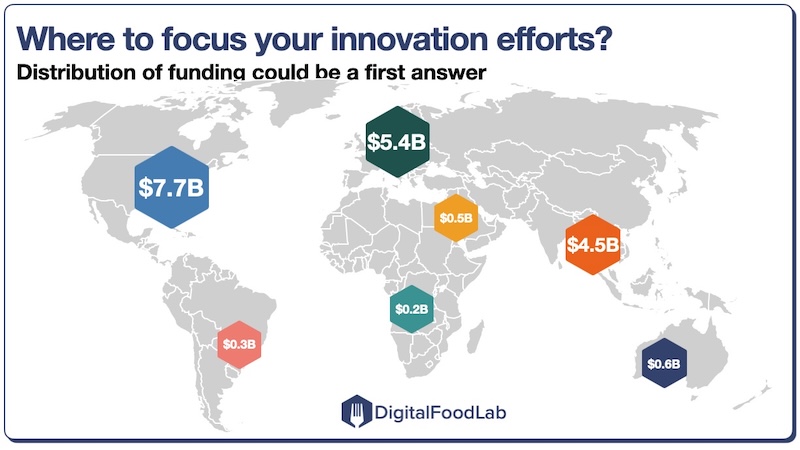
First, where are we going from? As you can see in our free European FoodTech report, France was only fourth in terms of investments in 2017 (behind the UK, Germany and the Netherlands). This year, while investments have risen in France, they have sharply slowed down in the UK and Germany. So, at this stage, our data (for those who don’t know we have the most complete AgTech and FoodTech investment database on the market) tells us that France will be Europe’s number #1 in terms of investment in 2018.

DigitalFoodLab

So here are the investments in the French FoodTech ecosystem (as of the date of this newsletter). This data will be accessible in our (premium) report about French FoodTech ecosystem. With €216 million, French FoodTech startups have raised a lot more money than in 2017.

Paris is a synonym to France’s FoodTech ecosystem: its startups have received more than 70% of the nation’s funding. Bellow is a mapping of the French FoodTech leaders (in terms of investment or media coverage). In red are the data-driven sub-domains. As you can see, all FoodTech domains are not created equal. If Delivery & Retail startups account for more than 80% of investments in Europe, as you can see on the mapping, they are less important France than in Foodservice.

DigitalFoodLab

That being said, things are not that rosy in Paris (when they are not in flames). Two things are putting the brakes on the French ecosystem. First, there is a lack of small pre-seed investments. We see a lot of startups spending a lot of time and energy trying to find 50 to 200k€. Then, we observe a lack of interest from European (and so French) food and retail corporates. Few of them invest in local startups (even if they have funds, they are often located in the US and in Asia).

Be the master of France’s FoodTech with the best report and startup list

You can pre-order (with early bird price until the end of the year) here. You will then have access to exclusive data on the French FoodTech ecosystem and a list of all startups (with its domain, description and funding if available).

Have a great week,

Matthieu


Big (French) Deals

Grubmarket

InnovaFeed (specialised in insect feed proteins) announced a €40 million funding led by Creadev (the PE branch of the Mulliez family). This comes after a €15 million series A earlier this year.


Grubmarket

Agricool raises €25 million to grow its model. The urban farming startup will use this capital to develop its network of containers (using LEDs and aeroponics to grow strawberries then sold in nearby supermarkets).


Top News

A device to know if your meal is Keto: we talked in a previous note about the rise of specific diets, among which is keto. Basically, keto diet is high fats, high proteins and low carbs (and so say welcome to the butter coffee). Keyto has raised $2.5 million to build a device that will help you keep up with the new diet fad by measuring the level of acetone in your breath and then the app will help you make analyse the results and make better choice matching your diet goals. More than the device itself, it is astonishing to see how fast a new diet trend has been transformed into products, apps and now IoT devices.
The Spoon

Can I trust corporate venture capital funds (CVC)? This is a recurring question from entrepreneurs. This article gives some answers. A key point is to understand what is the reasoning of a CVC and how different it can be from a VC. If in both cases, they want to create value, the mean is pretty different. While the last will create value fast by exiting the startup it has invested in, the former is often here to add value to the corporation’s long-term strategy. The difference in terms of timing and goals (exiting before the end of the fund v.s. long-term) makes the cohabitation rather difficult. So, the answer is “yes you can trust CVCs” but only if it fits your own strategy as an entrepreneur.

AgFunder

You're in a good company

Join the 60+ clients of Digital FoodLab: leading agrifood companies, retailers, banks, investors, startups, and public organisations.

Use case: project for a global F&B company looking to map its AgTech innovation ecosystem and the best startups to partner with

What we did:

  • Mapping of the AgTech ecosystem: startups, research regulators, and other leading companies.
  • Discussion to select areas to focus on.
  • Analysis of the information to reveal the trends and a model to analyse eventual partners.
  • A workshop to validate the opportunities based on our recommendations.
  • Scouting of relevant partners followed by introductions.

Results:

  • Mapping the different categories of innovations in AgTech that should be considered now to create long-term benefits for the business.
  • Identification of key partners (an incubator and a couple of startups).

Use case: project for a CPG company on the healthy ageing ecosystem

What we did:

  • Education of the board through a couple of workshops to define the perimeter
  • Identification of key opportunities and threats created by long-term evolutions (technologies, business models, behavioural changes).
  • Deep dives on each of the priority categories.
  • Co-construction of a vision on how the company should address these challenges.
  • Identification of partners (startups, incubators, funds) to move forward.

Results:

  • Creating a consensus on which categories to prioritise and how to address them.
  • Implementation of an open innovation strategy through the development of partnerships.

Use case: project for a global CPG company to develop a strategy on the healthy ageing ecosystem

What we do (ongoing mission on a subscription model):

  • Kick-off where we present an overview of the AgriFoodTech ecosystem to select with the client the categories to cover and for each, the level of information required.
  • Monthly newsletter: each month we send a newsletter with the articles that we have gathered ranked by relevance, their summaries, and a layer of analysis.
  • Database: we set up a personalised database that will be filled month after month with the information gathered on the companies identified for the watch.
  • Workshops: twice a year with the client’s innovation team and other “innovation curious” team members, we present an overview of the evolutions, key trends and a dashboard of the topics followed by the watch.

Results:

  • A clear, regular and evolutive tool to follow what is happening in terms of innovation on key topics.
  • A forum (through the workshops) to discuss innovation trends and new opportunities.

Use case: opportunity screening for an ingredient company

What we did:

  • Kick-off to define the perimeter of the ecosystem studied.
  • Mapping of the different trends shaping the innovation ecosystem of the client.
  • Analysis of the trends on DigitalFoodLab’s trend curve and other relevant frameworks.
  • Workshop to discuss DigitalFoodLab’s recommendations on key trends to prioritise

Results:

  • Shared view of the innovation ecosystem for the client with a view of the trends to prioritize.
  • Clear document (personalised trend curve) that can be easily shared internaly to explain the company’s innovation choices and which can be then updated each year.

Use case: scouting for an agriculture coop

What we did:

  • Kick-off to define the perimeter of the client, the goals of the scouting (partnerships) and the criteria on which startups should be evaluated.
  • Set-up scouting: we selected the first batch of 20+ key startups following the criteria of the client.
  • On-going scouting: then we set up a quarterly scouting of about ten startups.
  • For each scouted startup, we created an ID card with key information such as the business and technological maturity, funding, and corporate partnerships. We also added an explanation of why we selected this startup.

Results:

  • An ongoing and evolutive scouting are matching the client's criteria and its capabilities in terms of deal flow.

Use case: working on an acquisition process for a CPG company

What we did:

  • Kick-off to define what the client is seeking, notably in terms of maturity.
  • Workshop with the client based on a mapping of the different innovation ecosystems adjacent to its activities to select some priorities and discuss inspiring examples of startup acquisition stories.
  • Identification of 20+ targets.
  • Workshop to select the most relevant to engage with.
  • DigitalFoodLab worked as a sparing partner during the acquisition process, notably to help design how the acquired startup could be integrated into the overall company’s strategy.

Results:

  • Different results from traditional M&A processes with a focus on the client’s innovation strategy.
  • Identification of a good match for an acquisition.

Use case: market due diligence on sugar alternatives

What we did:

  • Kick-off with the client to discuss its interest on this category, its expectations and existing level of information (notably on the target company).
  • Mapping of the ecosystem to analyse the different existing alternatives and technologies to compare them.
  • Interview (calls) with relevant startups made by our internal biotechnology expert.
  • Recommendation on whether to invest or not.

Results:

  • Clear view of the ecosystem and of the reasons to believe (or not) in each sub-category.
  • Enforceable recommendations based on facts and expertise.