The food system runs on different clocks

Published on March 10, 2026

This week, we selected four graphs that capture the different time horizons shaping the food system.

On one side, consumer priorities and commodity markets can shift rapidly. On the other hand, agricultural practices and food innovation are evolving much more slowly. Understanding these different timelines (and aligning expectations) is essential to set realistic expectations about how the food system can change.

1 – Long-term and hard to shift: the environmental price of crop farming

While we often mention the impact of animal farming on the environment, which accounts for about 15% of total emissions, growing crops also takes its toll. A recently published dataset and maps from Cornell University show that emissions from cropland are far from negligible. First, they account for 5% of global human-caused greenhouse gas emissions (much more than aviation). Then, they are highly concentrated with:

  • 67% of the emissions coming from four crops (rice, maize, wheat, and palm oil), but the distribution is quite surprising.
  • 61% of the emissions coming from six countries (China, Indonesia, India, United States, Thailand and Brazil).
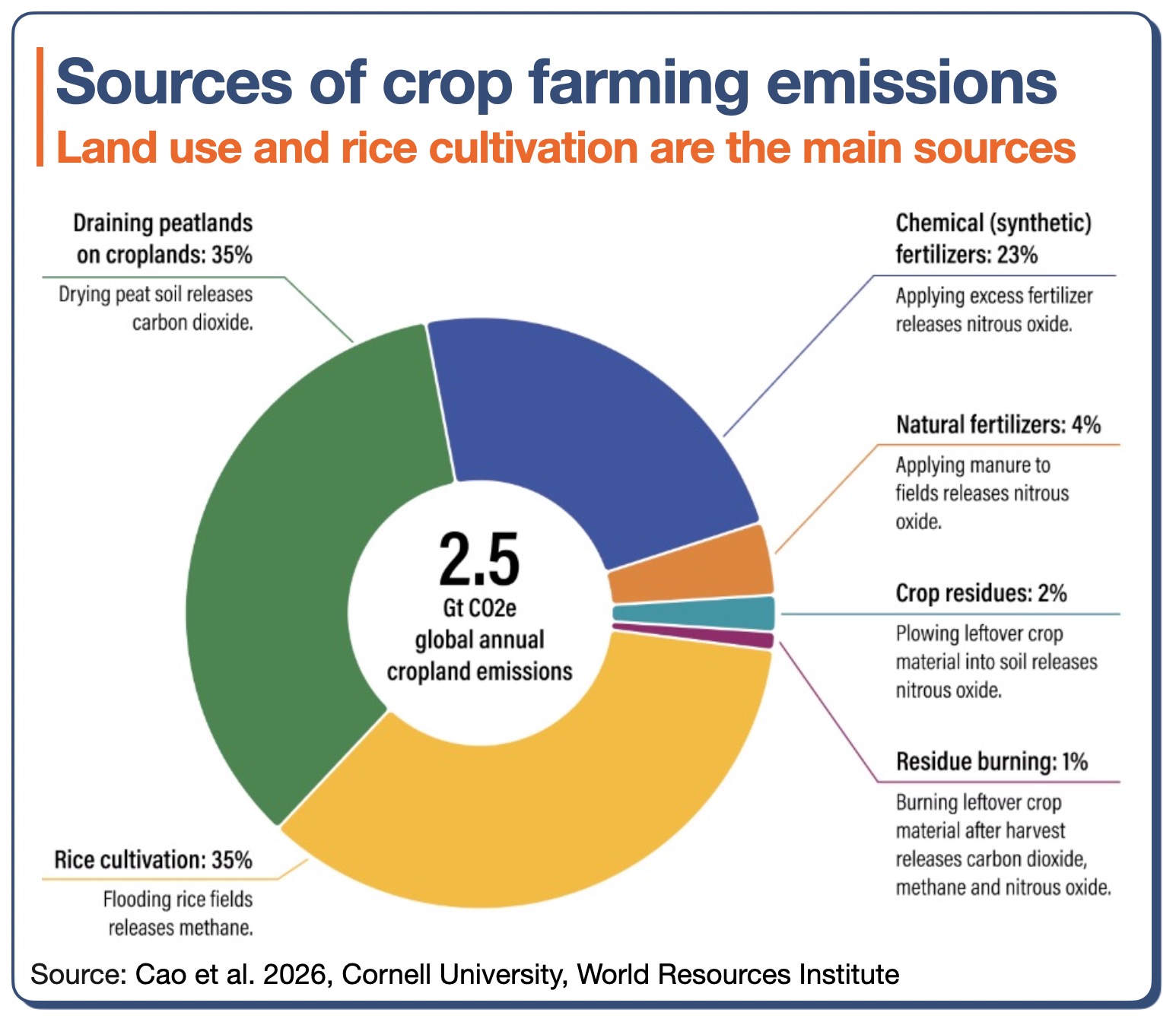
Sources-of-Crop-farming-emissions-DigitalFoodLab

And, as shown on the graph, three agricultural practices dominate emissions from crop production:

  • Peatland drainage: when peatlands are cleared and drained for agricultural production, such as in Indonesia for palm oil cultivation.
  • Flooded rice cultivation, which releases large amounts of methane.
  • Synthetic fertilisers use.

Crop production increased by 50% between 2000 and 2020, while cropland emissions rose by “only” 17%. Productivity gains are not enough to reverse emissions growth. As the population continues to increase this century, more energy should be invested in supporting and financing the transition away from more emissions-intensive practices.

2 – The long timeline of innovation: when is the future coming?

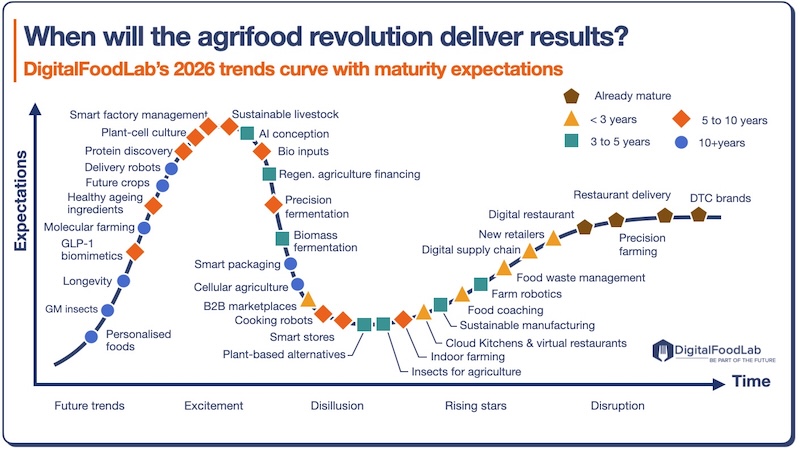
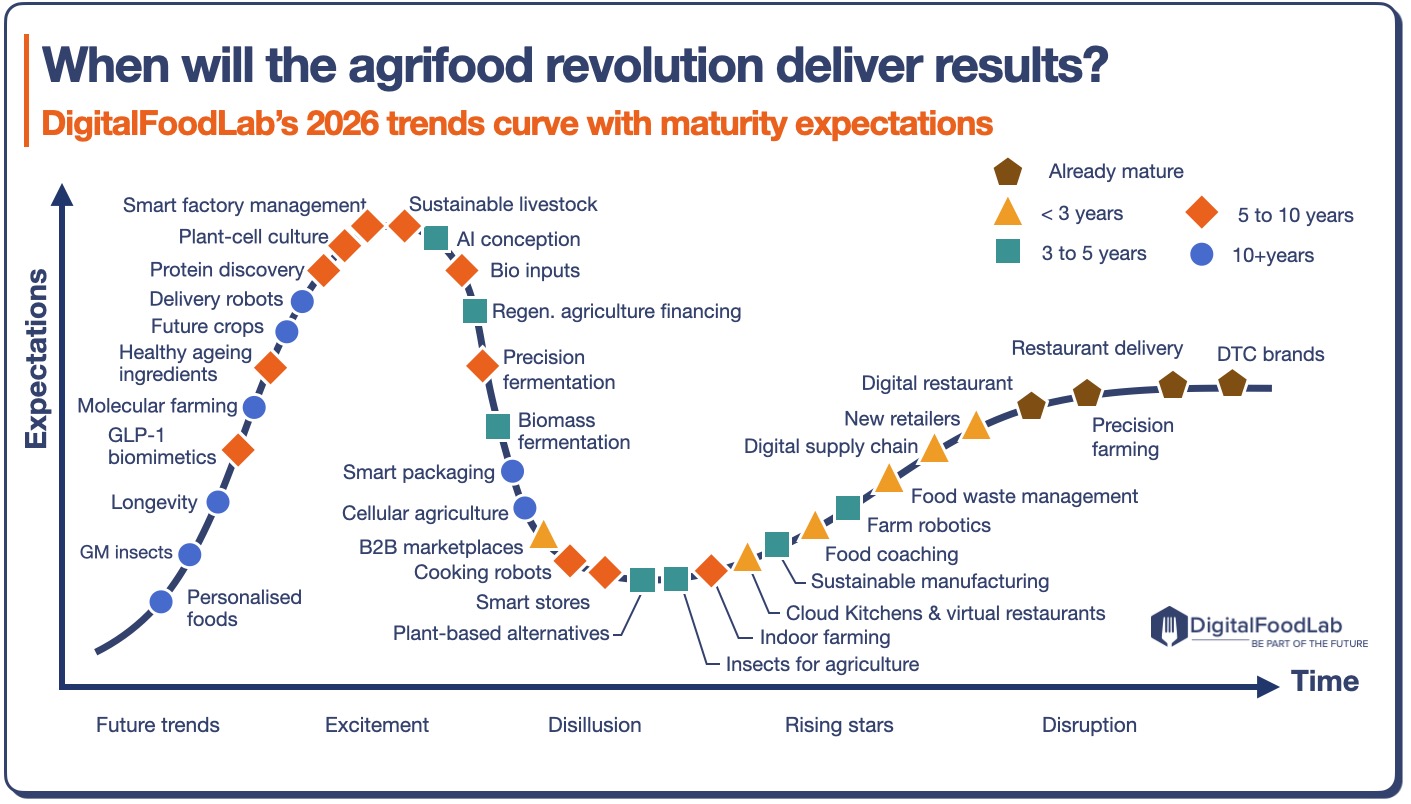
Last month, we published DigitalFoodLab’s yearly report on the trends shaping the future of food and agriculture. One way to look at these trends is also to consider when they will have an impact.
DigitalFoodLabs-2026-trends-curve-with-maturity-expectations

The graph displays our estimation of when each of the 36 trends will enter maturity, or put in another way, when its applications will be:

  • Viable from a technical and economical point of view
  • Widely understood and understood by its beneficiaries (a good rule of thumb is to have 30% of an industry using a new technology).

There is almost an alignment between the position on the curve and the timeline, with the bulk of the most disruptive technologies having an impact in an horizon in 5 years or more. For instance, even if alternative protein technologies are moving forward, they will still take some time to have a real impact. We should never forget that “food is a long game” and that the industry is very complex to disrupt.

3 – Short-term consumer signals: protein and fiber are rising at the top of the consumer’s mind
Protein-and-fiber-rising-at-the-top-of-the-consumers-mind

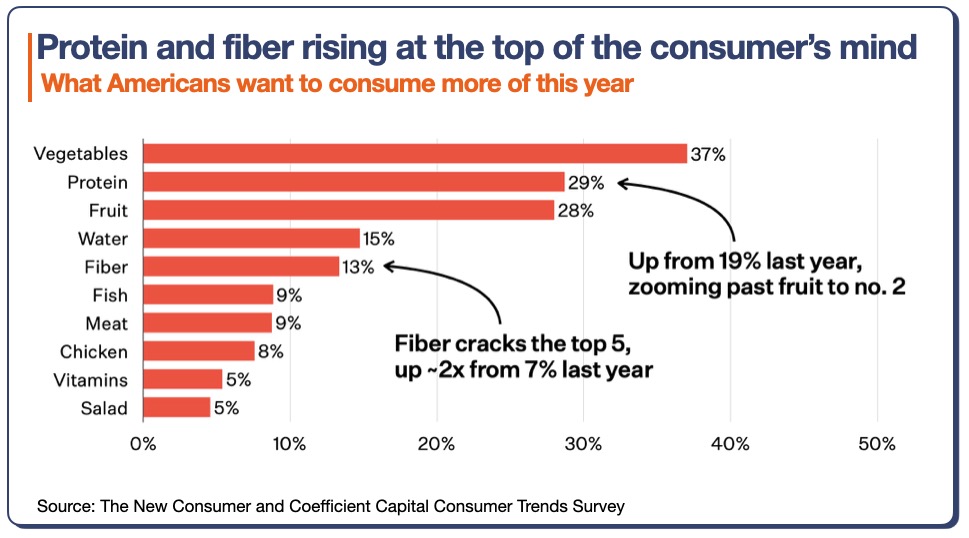
A recent survey of American consumers asked them to name the three products they would like to consume more of this year. While many of them are still looking to eat fruits and vegetables, it’s the other answers which are worthy of our attention :

  • 29% of respondents want to eat more protein, 10 points more than in 2025 at the same period. The number of people mentioning fish, meat or chicken is noticeable (I am surprised that so few people are looking to eat more ice cream or cheese, I’d love to see the results of the same question asked in different countries).
  • 13% mentioned fiber, which is becoming “the new protein”, with a growing number of products displaying how much they contain on their packaging.
  • 15% thought about water, boosted by the “hydration” trend and the belief that we don’t drink enough of it.

4 – The fast pace of commodity prices: cacao prices are crashing

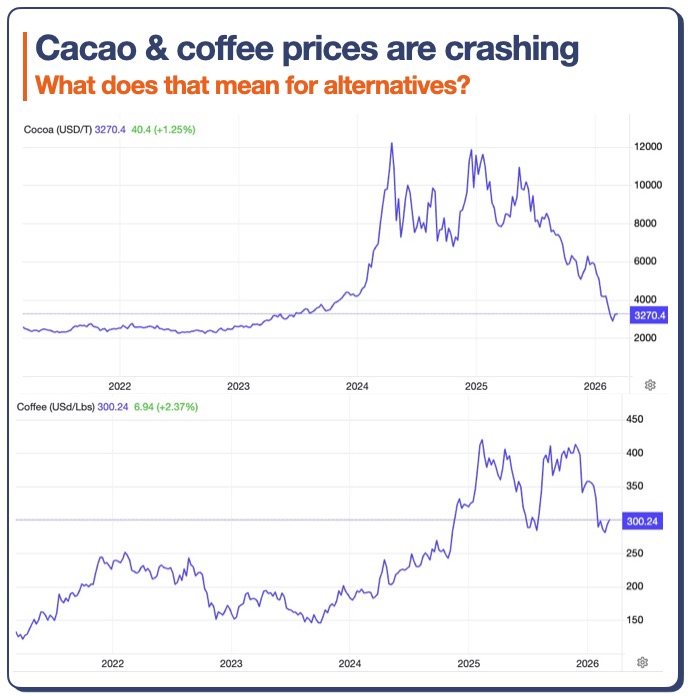
Cacao and coffee prices have skyrocketed in 2024 and 2025 (x5 for cacao, x3 for coffee) due to a combination of factors, including climate shocks and unmet demand. As both supply chains return to normal, prices are slowly returning to pre-crisis levels.
Cacao-coffee-prices-are-crashing

As explained in our detailed insight into coffee alternatives, a whole ecosystem has emerged with a range of short-term to long-term solutions to substitute both products. As the price bubble bursts, we do not expect a similar deflation in the appetite for alternatives. Actually, there are structural challenges that make alternatives relevant:

  • Climate events such as those observed over the past years are almost sure to come back, and to have a similar impact as supply chains are tight with a rising demand for both commodities.
  • Climate impact: both products have a high environmental cost, notably due to land use.
  • Geopolitical risks (such as the recent tariffs on coffee).

In a word, for commodity players and food companies, having a set of alternatives to include in their portfolios and eventually leverage if prices increase again is great insurance against volatility.

You're in a good company

Join the 60+ clients of Digital FoodLab: leading agrifood companies, retailers, banks, investors, startups, and public organisations.

Use case: project for a global F&B company looking to map its AgTech innovation ecosystem and the best startups to partner with

What we did:

  • Mapping of the AgTech ecosystem: startups, research regulators, and other leading companies.
  • Discussion to select areas to focus on.
  • Analysis of the information to reveal the trends and a model to analyse eventual partners.
  • A workshop to validate the opportunities based on our recommendations.
  • Scouting of relevant partners followed by introductions.

Results:

  • Mapping the different categories of innovations in AgTech that should be considered now to create long-term benefits for the business.
  • Identification of key partners (an incubator and a couple of startups).

Use case: project for a CPG company on the healthy ageing ecosystem

What we did:

  • Education of the board through a couple of workshops to define the perimeter
  • Identification of key opportunities and threats created by long-term evolutions (technologies, business models, behavioural changes).
  • Deep dives on each of the priority categories.
  • Co-construction of a vision on how the company should address these challenges.
  • Identification of partners (startups, incubators, funds) to move forward.

Results:

  • Creating a consensus on which categories to prioritise and how to address them.
  • Implementation of an open innovation strategy through the development of partnerships.

Use case: project for a global CPG company to develop a strategy on the healthy ageing ecosystem

What we do (ongoing mission on a subscription model):

  • Kick-off where we present an overview of the AgriFoodTech ecosystem to select with the client the categories to cover and for each, the level of information required.
  • Monthly newsletter: each month we send a newsletter with the articles that we have gathered ranked by relevance, their summaries, and a layer of analysis.
  • Database: we set up a personalised database that will be filled month after month with the information gathered on the companies identified for the watch.
  • Workshops: twice a year with the client’s innovation team and other “innovation curious” team members, we present an overview of the evolutions, key trends and a dashboard of the topics followed by the watch.

Results:

  • A clear, regular and evolutive tool to follow what is happening in terms of innovation on key topics.
  • A forum (through the workshops) to discuss innovation trends and new opportunities.

Use case: opportunity screening for an ingredient company

What we did:

  • Kick-off to define the perimeter of the ecosystem studied.
  • Mapping of the different trends shaping the innovation ecosystem of the client.
  • Analysis of the trends on DigitalFoodLab’s trend curve and other relevant frameworks.
  • Workshop to discuss DigitalFoodLab’s recommendations on key trends to prioritise

Results:

  • Shared view of the innovation ecosystem for the client with a view of the trends to prioritize.
  • Clear document (personalised trend curve) that can be easily shared internaly to explain the company’s innovation choices and which can be then updated each year.

Use case: scouting for an agriculture coop

What we did:

  • Kick-off to define the perimeter of the client, the goals of the scouting (partnerships) and the criteria on which startups should be evaluated.
  • Set-up scouting: we selected the first batch of 20+ key startups following the criteria of the client.
  • On-going scouting: then we set up a quarterly scouting of about ten startups.
  • For each scouted startup, we created an ID card with key information such as the business and technological maturity, funding, and corporate partnerships. We also added an explanation of why we selected this startup.

Results:

  • An ongoing and evolutive scouting are matching the client's criteria and its capabilities in terms of deal flow.

Use case: working on an acquisition process for a CPG company

What we did:

  • Kick-off to define what the client is seeking, notably in terms of maturity.
  • Workshop with the client based on a mapping of the different innovation ecosystems adjacent to its activities to select some priorities and discuss inspiring examples of startup acquisition stories.
  • Identification of 20+ targets.
  • Workshop to select the most relevant to engage with.
  • DigitalFoodLab worked as a sparing partner during the acquisition process, notably to help design how the acquired startup could be integrated into the overall company’s strategy.

Results:

  • Different results from traditional M&A processes with a focus on the client’s innovation strategy.
  • Identification of a good match for an acquisition.

Use case: market due diligence on sugar alternatives

What we did:

  • Kick-off with the client to discuss its interest on this category, its expectations and existing level of information (notably on the target company).
  • Mapping of the ecosystem to analyse the different existing alternatives and technologies to compare them.
  • Interview (calls) with relevant startups made by our internal biotechnology expert.
  • Recommendation on whether to invest or not.

Results:

  • Clear view of the ecosystem and of the reasons to believe (or not) in each sub-category.
  • Enforceable recommendations based on facts and expertise.