China’s Silent AgriFoodTech Takeover: From Delivery Wars to Cultivated Meat

Published on September 16, 2025

What’s happening in China? That’s a question I often hear in conferences or when talking to clients seeking to understand new AgriFoodTech trends. Indeed, few geographies create as much curiosity as China, with a mix of anticipation of great innovation and anxiety of missing something significant.

1 – Funding: a large ecosystem, but not at the frontier of AgriFoodTech trends

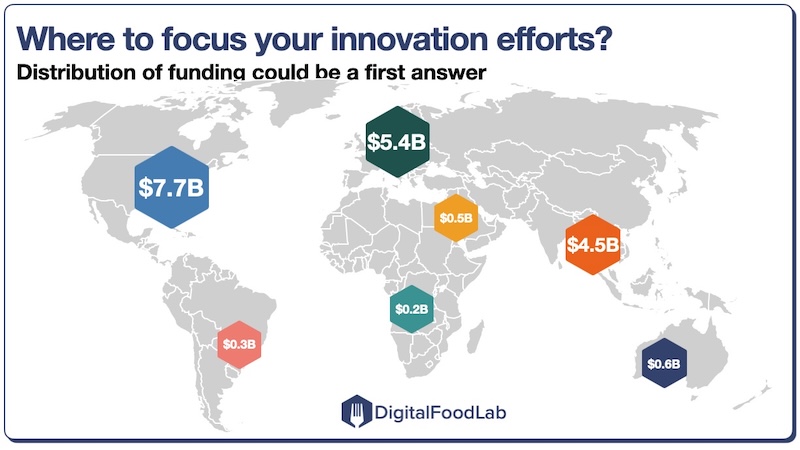
If we use the standard “measures of innovation” such as the amount of funds being raised by startups, China is an interesting hub, third behind the US and India. As shown on the graph, after the highs reached between 2016 and 2021 linked to food delivery startups, funding has decreased to extremely low levels and is now mostly going towards innovative brands.

It is hard to spot more than a handful of deals in areas such as alternative proteins, agricultural resilience, or healthy ageing. Indeed, more broadly, if we use DigitalFoodLab’s AgriFoodTech trends, there are not many Chinese startups active in the most “hype” or disruptive technologies.

2 – China innovating behind the curtains

However, innovation is not limited to startups, far from it. Recently, a fascinating piece published by Green Queen looked at the top 20 cultivated meat patent applications globally. Leading are the most well-funded Western startups such as Upside Foods, Aleph Farms (Israel) and Mosa Meat (Netherlands). But, the surprise is below: 8 of the top 20 applicants are Chinese universities and a local startup.

This rise in interest from Chinese organisations is supported by an increasing public support (such as this new $11M cultivated meat centre). While things are slowing down in the West with much less funding for alternative proteins (even if government support is somewhat increasing), China is moving forward with its own model, which relies much more on already established organisations.

Beyond cellular agriculture, this can be seen in other alternative protein technologies such as precision fermentation. In many ways, what we are observing now could look like an accelerated version of what happened to the solar panel industry a few decades ago: the initial technology and efforts had been financed in the US and Europe, but due to a lack of political will, the scale up didn’t happen there but and Chinese companies which are now selling us cheap and efficient panels that we can’t compete with. The geopolitical consequences of a world where high-value, alternative proteins, healthy ageing, and agricultural inputs are all produced in China are immense and should be considered more seriously.

3 – The second Chinese delivery war: is it something that will happen elsewhere?

To illustrate the fact that innovation in food is coming from players beyond startups, consider food delivery. As for other markets, food delivery exploded in China a decade ago, with around tens of startups, and then after a war of attrition and concentration, a couple of leaders emerged (Meituan and Alibaba). Also, as in the rest of the world, after a long period of non-profitable growth, these leaders started to deliver healthy benefits to their shareholders.

However, what’s different in China is that a new delivery war has started recently. The new players are not startups, but deep-pocketed companies like ByteDance (the owner of TikTok). While this increased competition is good for consumers (who say no to €1 latte deliveries?), it is quite damaging:

  • For the companies themselves: Alibaba posted quite awful results due to the increasing competition and additional marketing and delivery costs;
  • Drivers who are paid less and are getting ever more pressure to multiply deliveries at great speed;
  • Restaurants which are getting squeezed by this intensified competition;
  • Food quality (the €1 lattes and food items don’t tend to be of the highest quality).

As for the ” first delivery war”, this one will probably land on a new equilibrium. As it is China, at any moment, the government can put a stop to this raging competition. However, for the rest of the world, the outcome will be quite significant: it is hard to imagine a different scenario than the previous situation with two to three leaders on a single market. If they are different from the “former leaders”, this may give ideas to tech companies in other countries to do the same and enter their own delivery war.
To answer the question with which I started, “no”, China is not a hot startup market, notably in terms of funding, but “yes”, it is very much a leading place for AgriFoodTech. In many ways, it is a leader and could even become a hegemony in the most disruptive technologies.

You're in a good company

Join the 60+ clients of Digital FoodLab: leading agrifood companies, retailers, banks, investors, startups, and public organisations.

Use case: project for a global F&B company looking to map its AgTech innovation ecosystem and the best startups to partner with

What we did:

  • Mapping of the AgTech ecosystem: startups, research regulators, and other leading companies.
  • Discussion to select areas to focus on.
  • Analysis of the information to reveal the trends and a model to analyse eventual partners.
  • A workshop to validate the opportunities based on our recommendations.
  • Scouting of relevant partners followed by introductions.

Results:

  • Mapping the different categories of innovations in AgTech that should be considered now to create long-term benefits for the business.
  • Identification of key partners (an incubator and a couple of startups).

Use case: project for a CPG company on the healthy ageing ecosystem

What we did:

  • Education of the board through a couple of workshops to define the perimeter
  • Identification of key opportunities and threats created by long-term evolutions (technologies, business models, behavioural changes).
  • Deep dives on each of the priority categories.
  • Co-construction of a vision on how the company should address these challenges.
  • Identification of partners (startups, incubators, funds) to move forward.

Results:

  • Creating a consensus on which categories to prioritise and how to address them.
  • Implementation of an open innovation strategy through the development of partnerships.

Use case: project for a global CPG company to develop a strategy on the healthy ageing ecosystem

What we do (ongoing mission on a subscription model):

  • Kick-off where we present an overview of the AgriFoodTech ecosystem to select with the client the categories to cover and for each, the level of information required.
  • Monthly newsletter: each month we send a newsletter with the articles that we have gathered ranked by relevance, their summaries, and a layer of analysis.
  • Database: we set up a personalised database that will be filled month after month with the information gathered on the companies identified for the watch.
  • Workshops: twice a year with the client’s innovation team and other “innovation curious” team members, we present an overview of the evolutions, key trends and a dashboard of the topics followed by the watch.

Results:

  • A clear, regular and evolutive tool to follow what is happening in terms of innovation on key topics.
  • A forum (through the workshops) to discuss innovation trends and new opportunities.

Use case: opportunity screening for an ingredient company

What we did:

  • Kick-off to define the perimeter of the ecosystem studied.
  • Mapping of the different trends shaping the innovation ecosystem of the client.
  • Analysis of the trends on DigitalFoodLab’s trend curve and other relevant frameworks.
  • Workshop to discuss DigitalFoodLab’s recommendations on key trends to prioritise

Results:

  • Shared view of the innovation ecosystem for the client with a view of the trends to prioritize.
  • Clear document (personalised trend curve) that can be easily shared internaly to explain the company’s innovation choices and which can be then updated each year.

Use case: scouting for an agriculture coop

What we did:

  • Kick-off to define the perimeter of the client, the goals of the scouting (partnerships) and the criteria on which startups should be evaluated.
  • Set-up scouting: we selected the first batch of 20+ key startups following the criteria of the client.
  • On-going scouting: then we set up a quarterly scouting of about ten startups.
  • For each scouted startup, we created an ID card with key information such as the business and technological maturity, funding, and corporate partnerships. We also added an explanation of why we selected this startup.

Results:

  • An ongoing and evolutive scouting are matching the client's criteria and its capabilities in terms of deal flow.

Use case: working on an acquisition process for a CPG company

What we did:

  • Kick-off to define what the client is seeking, notably in terms of maturity.
  • Workshop with the client based on a mapping of the different innovation ecosystems adjacent to its activities to select some priorities and discuss inspiring examples of startup acquisition stories.
  • Identification of 20+ targets.
  • Workshop to select the most relevant to engage with.
  • DigitalFoodLab worked as a sparing partner during the acquisition process, notably to help design how the acquired startup could be integrated into the overall company’s strategy.

Results:

  • Different results from traditional M&A processes with a focus on the client’s innovation strategy.
  • Identification of a good match for an acquisition.

Use case: market due diligence on sugar alternatives

What we did:

  • Kick-off with the client to discuss its interest on this category, its expectations and existing level of information (notably on the target company).
  • Mapping of the ecosystem to analyse the different existing alternatives and technologies to compare them.
  • Interview (calls) with relevant startups made by our internal biotechnology expert.
  • Recommendation on whether to invest or not.

Results:

  • Clear view of the ecosystem and of the reasons to believe (or not) in each sub-category.
  • Enforceable recommendations based on facts and expertise.