New crops are seed varieties developed through advanced breeding, gene editing or seed microbiome engineering. The goal is to get plants that cope better with climate stress, need fewer inputs and keep yields up.
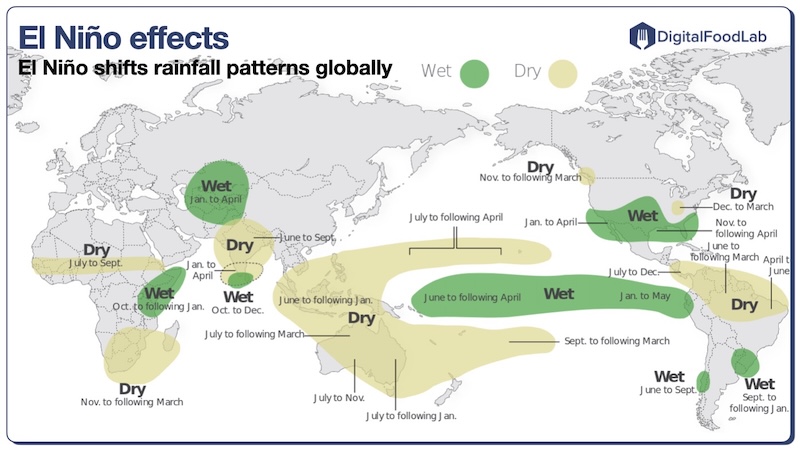
The topic is becoming very concrete. A strong El Niño has been building in the Pacific since the summer and should peak this winter (we talked about it last week). Climate scientists expect extreme events like this one to become more frequent as the planet warms.
Regulators are moving too: on 17 June, after three years of negotiations, the EU adopted its regulation on new genomic techniques. From mid-2028, most gene-edited plants will be treated like conventionally bred ones. After 25 years of keeping GMOs out of its fields, Europe is changing course.
I won’t cover everything we did on the subject here, but here is the big picture in three slides.
1 – Climate impact on yields
Agriculture has to feed a growing population while climate change makes its key producing regions less productive. And this time, the answer cannot be to clear more land or add more fertiliser. Farming has not faced such pressure since the food shortages of the mid-20th century.
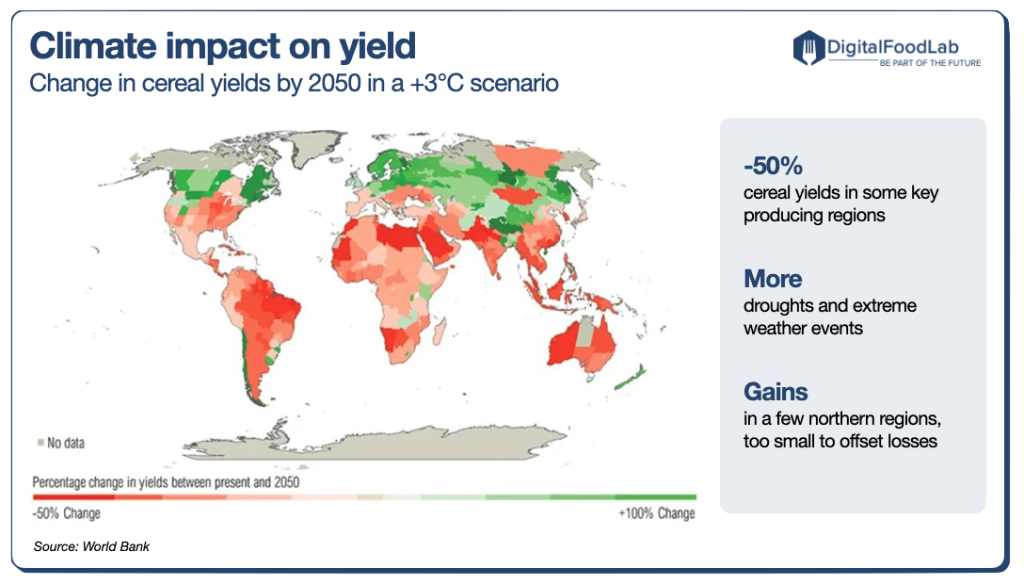
Between the 1940s and the 1970s, the Green Revolution answered the last challenge of this scale with high-yield varieties and massive fertiliser use. Fertilisers are not going away: roughly half of the world’s population is fed thanks to synthetic nitrogen. The goal is to get the same yields with fewer inputs, on plants that will have to cope with an increasingly hostile climate. All of that needs to be achieved quickly and faster than the 6 to 10 years a traditional breeding cycle still takes. This is the promise of new crops.
2 – Four technologies with four levels of maturity
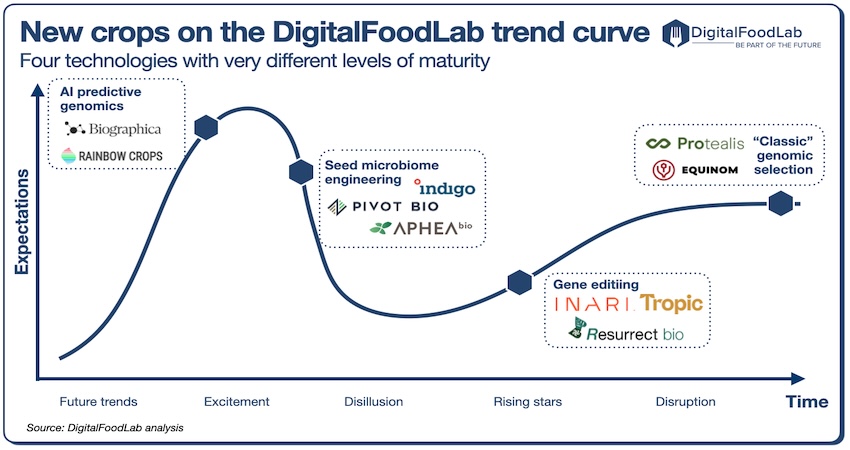
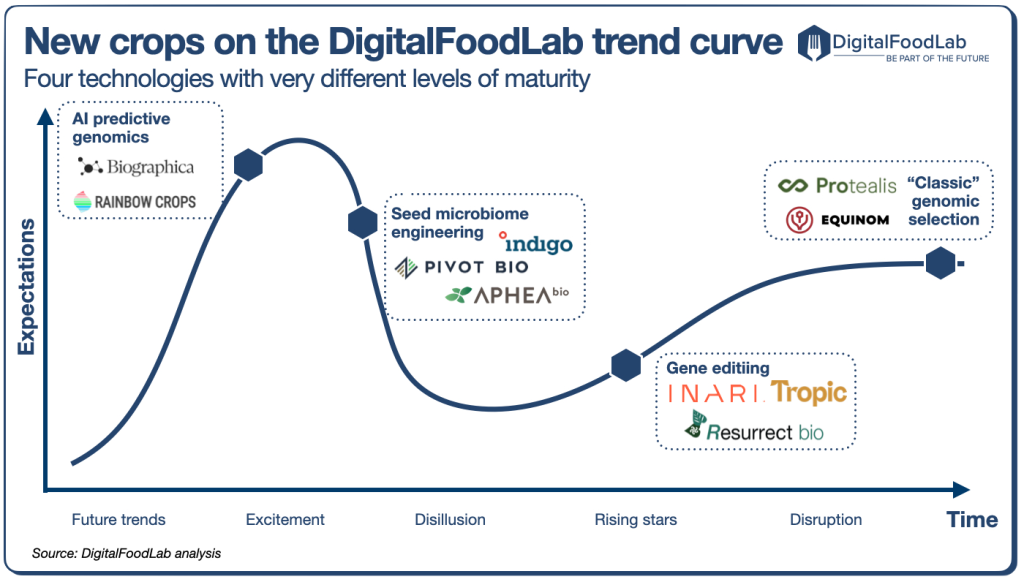
AgBiotech, which covers most of these technologies, raised $1.4B in 2025, making it one of the two largest AgriFoodTech categories by funding. Here is where each technology stands on our trend curve:
Actual outcomes will depend on regional weather, inventories, harvests elsewhere and policy responses. That is part of what makes El Niño such a complex phenomenon: we can make scenarios such as the ones presented in the graph, but we can’t have any certainty.
El Niño comes on top of other pressures, with some commodity prices already high due to the war in Iran. For example, urea prices remain 20% above their level a year ago. Higher fertiliser costs can encourage farmers to reduce applications, potentially affecting harvests just as weather shocks intensify, putting further pressure on supply chains and costs.
Concretely, for consumers and food companies, this could add additional stress to an already tense situation. In the Philippines, for instance, which is already facing high inflation due to energy costs, the central bank is assessing how a severe El Niño could compound the existing oil shock. For food businesses, this could create a double squeeze: rising production costs and consumers with less room to absorb higher prices.
- AI predictive genomics (rising excitement): AI models that identify the genes behind a trait and design the edits to improve it. A new generation of startups links prediction directly to gene editing and lab validation (Biographica, Rainbow Crops).
- Seed microbiome engineering (part of the bioinputs): coating seeds with beneficial bacteria or fungi to improve nutrient uptake and stress resistance. The largest ecosystem, with giants like Indigo ($1.4B raised) and Pivot Bio ($620M).
- Gene editing: precise changes to a plant’s own genome, mostly with CRISPR. It’s a mature technology with first seeds on the market and regulation opening up.
- “Classic” genomic selection: using genomic markers to pick the best plants. It’s now a standard practice at every major seed company, it cut breeding cycles from 10–15 years to 6–10.
Business models also differ widely from one category to another (product sales, licensing, platform access), and they largely determine who will capture the value.
3 – GMO, CRISPR, NGT: what’s the difference, and where is it allowed?
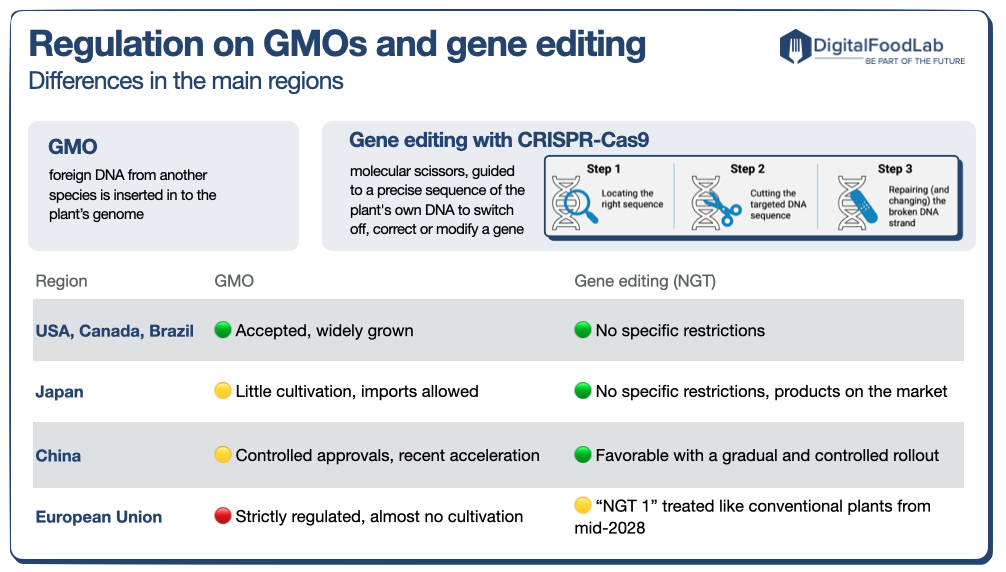
A GMO (genetically modified organism) is a plant whose genome was modified by inserting foreign DNA from another species. CRISPR-Cas9 works differently: it acts like molecular scissors, guided to a precise sequence of the plant’s own DNA to switch off, correct or modify a gene, often without adding anything foreign. NGT (new genomic techniques) is the regulatory umbrella for these methods. In many cases, they reproduce mutations that could occur naturally or through conventional breeding, just years faster.
In terms of NGT regulation, the world is converging at different speeds:
- US, Canada, Brazil: no specific restrictions on gene-edited crops without foreign DNA.
- Japan: no restrictions and products already on shelves. Sanatech’s GABA-enriched tomato launched in 2021, at around €20/kg, and was a commercial flop. The price and an unclear benefit put consumers off.
- China: a supportive but controlled approval process, framed as a matter of food sovereignty (mildew-resistant wheat, for instance).
- EU: long treated like GMOs.The new regulation creates an “NGT 1” category for plants with up to 20 targeted genetic modifications, treated like conventional plants, applicable from mid-2028. This could trigger a wave of investment and new projects for European breeders and startups, who until now had to develop their traits for other markets.
Today, very few edited crops are on the market yet (Calyxt’s soybean oil, Pairwise’s salad greens, drought-tolerant rice in India in 2025). Bringing a new trait to market takes years and significant funding. Who ends up paying for it (seed companies, farmers through seed prices, food companies or consumers), and how much of that cost is offset by productivity gains, is a key question, and one we look at closely with our clients.
4 – The seed majors keep the keys
Partnerships between startups and agribusiness giants are multiplying across all technologies:
- Gene editing: Pairwise with Bayer on short-stature CRISPR corn.
- Predictive genomics: Profluent with Corteva on genomic data.
- Seed microbiome: Ginkgo with Bayer on nitrogen-fixing microbes.
But each large group has its own approach, mixing partnerships, acquisitions and in-house development. On predictive genomics in particular, the competitive edge comes from proprietary data, so most of the work stays internal. For the seed majors, startups are a complement to their own R&D.
Food companies are almost absent from these partnerships. Coca-Cola’s work with Avalo on climate-adapted sugarcane in Australia is one of the few examples. This is surprising, as agricultural raw materials make up the bulk of most food companies’ Scope 3 emissions.
What it means for food companies
Genetics and bio-inputs are the next agriculture revolution. Value is shifting towards genomics and data, and it will be captured by those who combine IP, platforms and proprietary data. Today, that means American, German and Chinese seed majors.
Food companies are also concerned directly, for three reasons:
- Supply: the crops they rely on (wheat, maize, soy, cocoa, coffee, sugar) are the ones climate is hitting, and every bad harvest ends up in their purchasing costs.
- Climate targets: most of their emissions come from farms, and nitrogen fertiliser is a large part of them. Seeds that need fewer inputs are one of the few levers that cut these emissions at the source.
- Products: the varieties designed today will set the taste, nutrition and processing properties of the ingredients they buy in ten years.
This newsletter covers only part of our work on the topic: startup-by-startup analysis, business models, partnership structures, and what it means for a specific supply chain. If you want to explore where new crops fit in your own strategy, reply to this email and let’s have a look at how DigitalFoodLab could support you.