China imports more than $215B in food products, and has been a net importer since 2004. But it wants to stop being so reliant on the rest of the world. Recently, China unveiled its 15th Five-Year Plan, a set of priority policies and targets for the 2026-2030 period. Among more detailed goals related to artificial intelligence, robotics and other key industries, the document stated that China will actively develop synthetic biology technologies to explore new protein sources. The question is: if China sets its goal on alternative proteins and other new technologies in agriculture and food, what does it mean for the future of food and for the rest of the world?
1 – From food security to an industrial strategy
To understand China’s approach to food innovation, we need to start with food security. China imports huge amounts of food from the rest of the world, and as for other key industries (and even more so for food), it wants to be as independent as possible. That’s why the plan mentions increasing grain production and diversifying imports.
But the plan goes beyond conventional agriculture. For agriculture, it notably addresses improving access to high-yield, stress-resistant varieties, agricultural machinery, and digital agriculture. For ingredients and food products, biomanufacturing is mentioned as one of China’s industries of the future.
More specifically, it calls for the development and industrialisation of synthetic biology and the expansion of new protein sources, including technologies for microbial proteins and functional food ingredients. It would be easy to mix that with the “aspirational language” we are used to, especially in Europe. However, here, in the complex, top-down Chinese system, it could trigger a massive movement if it translates into provincial targets, state bank lending priorities, and procurement standards.
2 – Examples from other industries and where we stand for AgriFoodTech
Last month, the Financial Times published a series of articles on what it calls the “China shock 2.0”. It is named after the first shock of the 2000s, when many low-value industries were rapidly dominated by cheap manufactured goods imported from China. The second shock is already underway, and this time it is about advanced manufacturing, with the most notable examples being EVs and solar panels. A simple figure tells everything: China now account for 70% of global manufacturing of major green technologies.
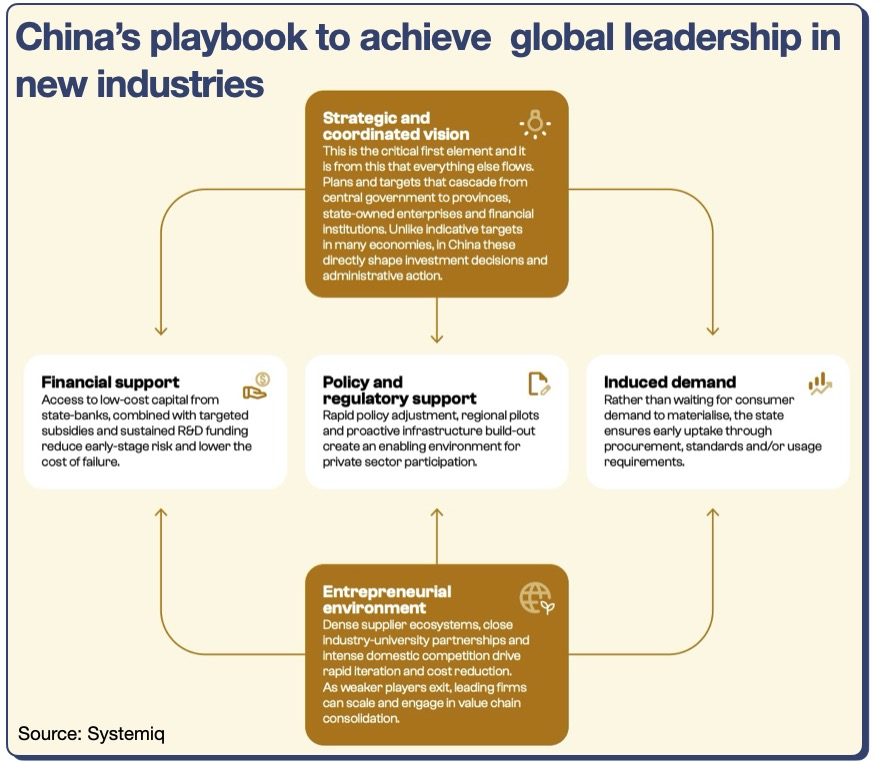
This didn’t happen all of a sudden. Actually, it followed a pattern that we could very well see applied to future agriculture and food technologies, recently illustrated in a report published by Systemiq.
It starts from a clear national strategy cascading from Beijing to the provinces, state-owned enterprises, and financial institutions, combined with a dense entrepreneurial and research ecosystem. This is supported by strong financial support, policy and regulatory support, and, most importantly, induced demand with procurement standards and usage requirements. Finally, once this playbook is applied, the newly created industry produces at a scale that makes it unbeatable globally in terms of volume and price.
All five mechanisms are now increasingly visible in agriculture and food. Examples include:
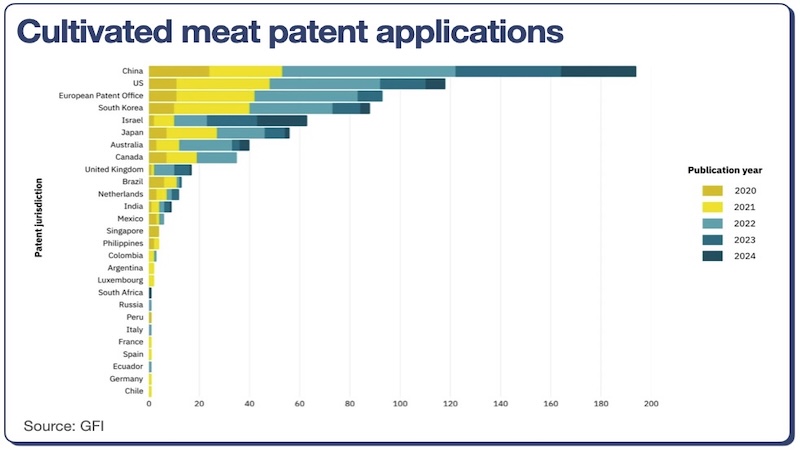
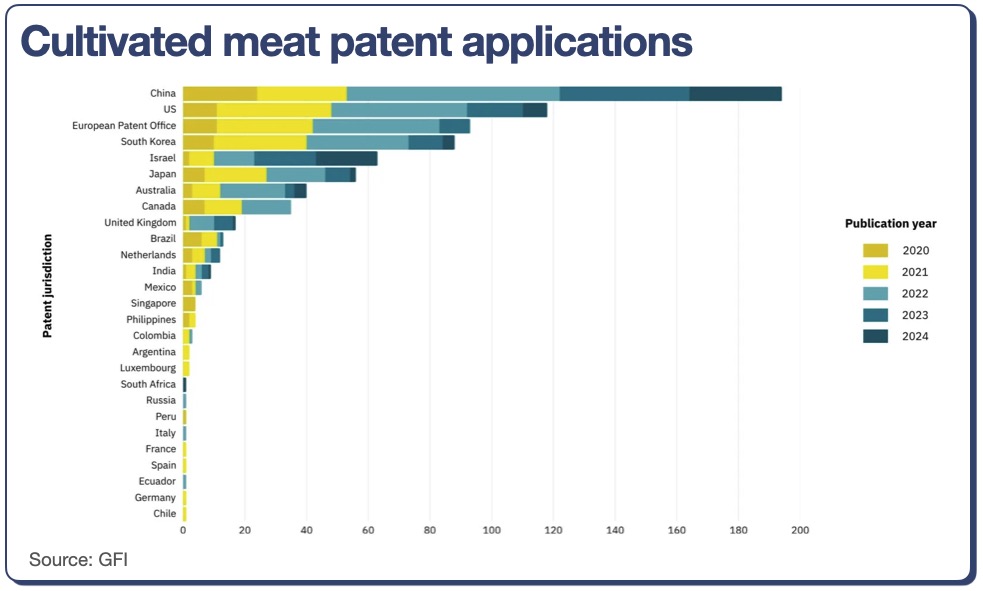
- Chinese research institutions are now leading in patents in cultivated meat. This should continue in the future, as the latest Nature Index of leading institutions in the natural sciences shows that Chinese universities hold 8 of the top 10 spots.
- Rising investments in biomanufacturing and biosolutions from large companies, state-owned and private, which we can now observe almost every week.
- The opening of a $11M cultivated meat centre in Beijing in 2025.
- The application by Chinese companies for regulatory approval of synthetic biology compounds in the US (where they would directly compete with startups).
It is then important to understand that we are not talking about a “standard” startup ecosystem that spontaneously emerges. It is rather planned and involves state organisations, public funding, and state-owned and large companies. This explains why, from the outside, this ecosystem is hard to read and decipher. Now that it has received “formal” backing from the central government in the form of this plan, we can expect it to grow quickly and try to apply its playbook.
3 – Is this a BYD moment for food?
Can we expect China to build food equivalents of BYD that will initially displace foreign brands in its domestic market and then go on to conquer global markets? The solar panel-EVs analogy is powerful, but it has its limitations. Agriculture and food have frictions that panels and batteries don’t.
Where the analogy holds: in many instances, the future of agriculture and food is less and less a question of disruptive technology but a matter of production at scale. Fermentation technologies (from biomass to precision fermentation), cellular agriculture, bio-solutions and robotics for agriculture now need to be optimised and scaled. This is exactly where China’s industrial playbook excels.
Where it breaks down: consumer adoption is not a procurement decision, especially in foreign markets where regulators are less than keen on food imports competing with their farmers and industries. If China develops demand-side policies that incentivise its own consumers to buy innovative products (for example, precision fermentation-made ingredients), this would be a game-changer.
In other words, the “BYD of food” may not be a food brand: it won’t apply to all industries, and it will take time, but in the current context, we could expect to see “Food BYDs” appearing in a decade. China is playing a long game, and developing the technologies, scaling them internally and starting to conquer new markets will be a decade-long process. It won’t necessarily apply to consumer products (even if we start to see Chinese consumer brands expanding in the West). We rather expect it to industrialise, scale, reduce costs in specific “future of agriculture and food” industries such as bioreactors, fermentation capabilities, ingredients (including enzymes, functional proteins, notably peptides), biosolutions, or agriculture robotics.
4 – What does it mean for the global food industry?
For large food & ingredient companies: beyond investments or collaborations with “non-Chinese” startups that are developing the key technologies of the future, there are three questions that need to be answered:
- Beyond investing in new technologies, what are our plans to scale them up, and how realistic are they? (I often hear about declarations of intent that rely on someone else doing the dirty job of building and operating the scale-up facility).
- At scale, what is our plan to bring these products to consumers quickly to create a competitive advantage?
- And finally, the most critical one: what price difference with a Chinese-made ingredient will we be ok to pay in order to have a resilient supply chain?
These are not long-term questions, but rather points that should be addressed now, notably because some technologies and ingredients are much closer to market readiness than is often anticipated.
For Western startups, the threat is structural but not immediate. If Chinese biomanufacturing infrastructure matures and scales, it will apply downward pressure on global costs and inputs. This is good for the industry’s adoption curve (but potentially catastrophic for startups that have built their moat on manufacturing cost advantages).
For regulators and policymakers: this should be a wake-up call. In many ways, it has been received in the US, which wants to compete and remain the leading biomanufacturing hub. In Europe, there is still a gap between intent and action…
So now, for industry players and startups alike, it has become clear that looking at China is no longer optional. If setting up an intelligence platform to stay informed about the future of food, including what’s happening in China and other megatrends, is a priority, that’s something we can help you with our bespoke FoodTech watch offer.