Let’s have a look at DigitalFoodLab’s seven predictions for 2025.
💬 First, let’s start with two words for this year: uncertainty and shocks. Said more directly: buckle your belts; the road ahead will be bumpy.
- Uncertainty: until the end of the year, it seemed clear that rates would go down with inflation easing out and a quite resilient economy. Then, the reward for investing in risky assets, notably venture capital, would increase, and hence, we would see more funding for AgriFoodTech startups. But, the US elections and some recent economic data point in another direction where inflation and rates could remain higher for longer. For FoodTech, it means a double uncertainty:
- Shocks: extreme climate events are occurring more regularly, and a wave of protectionism is creating the conditions for additional shocks on agricultural prices in 2025.
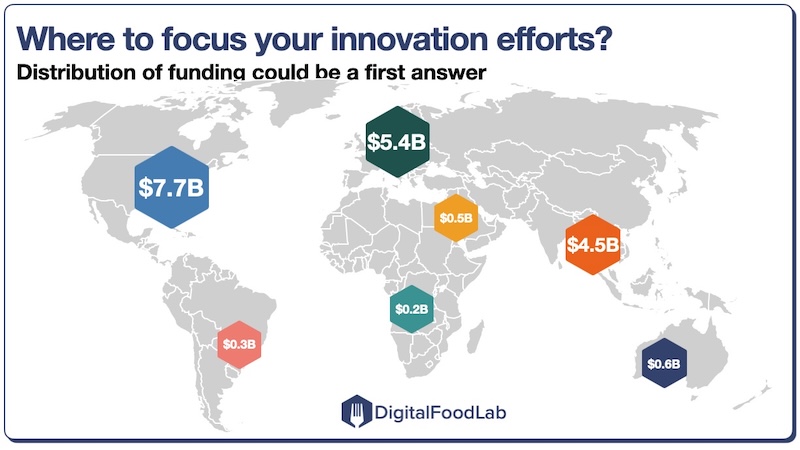
1️⃣ We don’t expect any significant bounce back or venture creation in funding in 2025 with an ecosystem oriented towards quality rather than quantity. While the situation has been relatively homogeneous over the past years in terms of geography, this year could be different:
- North America: a small to moderate improvement in terms of funding could be felt quite early in the year
- Europe: we expect that the situation will deteriorate significantly further. While the decrease in funding was smoother than in the rest of the world, due to significant public money acting as a cushion, 2025 could be really complicated with less funding and fewer new “cool” startups being created.
- Asia-Pacific: we expect an increase in funding, probably still led by delivery startups and the burgeoning ecosystems in AgTech and Food Science all over the continent.
Beyond funding, we expect that after a year of decrease, we’ll observe a stabilisation in the number of early-stage deals.
2️⃣ Relatively high inflation rates will weigh heavily on key FoodTech categories.
- Plant-based sales improved slightly in 2024, but if inflation remains high, notably in the US, we don’t anticipate a return to high-growth rates before the end of the year.
- We expect that alternative proteins, more generally (startups using cellular agriculture, precision fermentation, or biomass fermentation to produce bulk proteins), will have another challenging year as they still can’t prove a road towards price parity.
- Vertical farming, or what remains of this ecosystem, will probably be wiped out by increasing energy costs.
3️⃣ This context will create opportunities for some well-positioned players all along the food value chain:
- AgTech as a whole should do great, notably agriculture robots.
- Applications of Food Science beyond food should become a theme, notably in categories such as materials (packaging, textile,…) and cosmetics.
- B2B applications (notably for alternative proteins) around healthy ingredients should perform well.
4️⃣ We expect high uncertainty around an evolving regulation for alternative proteins and an increasing number of controversies:
- Evolutions in the US regulation for alternative proteins (the GRAS status) and, more broadly, for food additives will increase uncertainties.
- On the positive side, it will create opportunities for innovations “cleaning” the ingredient list with better alternatives.
- As the recent example with Arla in the UK shows, innovations in food can create controversies and conspiracy theories. The increased number of innovations in agriculture (methane blockers, new crops, robots…, etc.) and food products (precision fermentation, new healthy ingredients…, etc.) reaching the market, combined with the current political polarization, will create the conditions to trigger new controversies in 2025.
5️⃣ We expect large agrifood businesses to keep moving towards a “venture clienting” open innovation model, hence being less involved with early-stage startups. This means more partnerships with mature startups matching identified needs and much less support for younger ventures.
6️⃣ New extreme climate events will create new hypes: as it was the case in 2024 for cacao and coffee, climate events in one corner of the world can make prices skyrocket and create the conditions for the emergence of innovations creating alternatives.
- First, high prices on new ingredients, or still high prices on cacao and coffee, will sustain innovations in some niches. We expect some products using advanced biotechnologies will be released to the public by the end of the year.
- Then this will also be beneficial for upstream innovations, both preventive (carbon credits combined with regenerative agriculture) and adaptive (drought-resilient crops, for example).
7️⃣ 💉🧑🌾 🤖 Health, regenerative agriculture and AI will remain the main themes of the year, but we expect that the focus will move from discovery to application. We expect that we’ll go beyond discovery this year and be much more focused on implementing strategies.
In short, as you can see, I am not overly optimistic about the year, but that’s what predictions are about; otherwise, they would be wishlists.
As the year starts, I am sure you all know at least one person who would benefit from reading this newsletter to understand better what the future of food will be made of! You can directly subscribe them to the newsletter here.