📊 Top deals in Q3 – what’s next?

Published on October 18, 2022

The third trimester is always an interesting period in terms of deals because it is mostly made of one month, September, when startups are announcing all the deals concluded in the past months. When you have deals announced in late July or even in August, you know that we are living in a “boom”. If this was the case in 2021, this summer has been more peaceful, but yet, exciting deals were announced.

Again, as often mentioned in this newsletter, we can’t summarize an ecosystem of thousands of startups to 10 super deals. However, if we consider (as I do) that investors may have a somehow sheeplike mentality, it is a good indicator of where the wind is blowing (in which startups the deals are made) and of their current mood (how big they are compared to the previous period).

Looking at the top 10 deals in the third quarter of 2022 in Europe, we can see that massive deals still went ahead, even if they are far less massive than last year:

📈 Unlike what we hear daily, we observe no slowdown compared to the first half of this year. It just looks like the top deals made in 2021 without the eccentricity of quick commerce (massive investments in startups delivering groceries in 15 minutes or less). We expect 2022 to be a very good year for the Foodtech ecosystem in Europe and probably a record year for all the categories (here is a definition of FoodTech and its different sub-categories) with the exception of Delivery. And even there, new retailers (startups like Picnic, Crisp, Motatos, Oda, Rholik… ) are raising impressive amounts for models that look much more sustainable than quick-commerce.

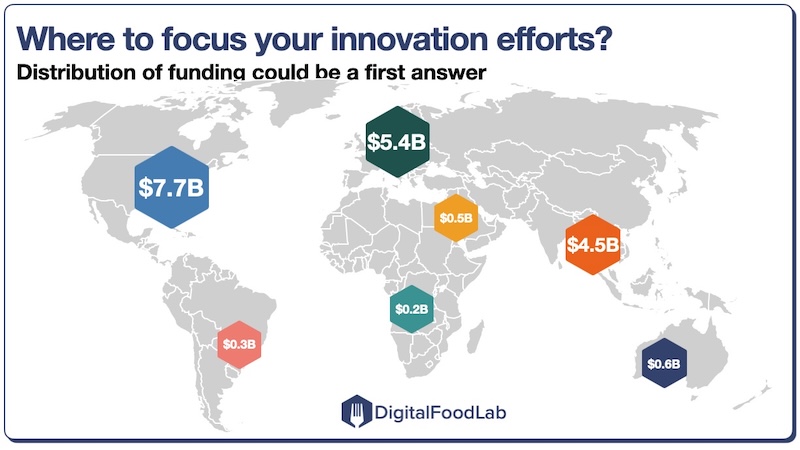
🇫🇷 +🇬🇧 (🇩🇪 ??) French startups are leading this top 10 ranking, followed by British ventures. That’s a first. To be more accurate, French startups raised more than 50% of all the funds that went into European FoodTech startups in Q3!

Also, we observed no massive deals in German startups, which were leading by far in investments in 2021 (due to quick-commerce notably). Is Germany, and notably Berlin losing its (FoodTech) mojo?

🚜  In terms of topics, the evolution is striking year over year. In Q3, half of the investments went to AgTech startups (notably due to the massive InnovaFeed deal) and 25% to Foodscience. Again delivery startups raised much less than they used to.

And now, what’s next?

🔮 Beyond big deals, looking at smaller deals, we observed that 4 topics are emerging fast:  digital solutions for restaurants, anti-food waste solutions (all over the supply chain), carbon credit and carbon counting platforms and alternative proteins.

As we explained recently, for us at DigitalFoodLab, FoodTech is not about startups, it’s about the future that our food system needs to become more sustainable (for us humans and the planet). In the short term, some areas will be disrupted, but in the long term, I remain strongly optimistic, especially for Europe, which has all the elements of success.

If raising funds is getting harder, notably from VCs, I do think that there is still no better time than right now for entrepreneurs to launch a new FoodTech venture. Similarly, for food corporations, it is the best timing to plan for the future by investigating, supporting and investing (at a discount) in the ecosystem!

You're in a good company

Join the 60+ clients of Digital FoodLab: leading agrifood companies, retailers, banks, investors, startups, and public organisations.

Use case: project for a global F&B company looking to map its AgTech innovation ecosystem and the best startups to partner with

What we did:

  • Mapping of the AgTech ecosystem: startups, research regulators, and other leading companies.
  • Discussion to select areas to focus on.
  • Analysis of the information to reveal the trends and a model to analyse eventual partners.
  • A workshop to validate the opportunities based on our recommendations.
  • Scouting of relevant partners followed by introductions.

Results:

  • Mapping the different categories of innovations in AgTech that should be considered now to create long-term benefits for the business.
  • Identification of key partners (an incubator and a couple of startups).

Use case: project for a CPG company on the healthy ageing ecosystem

What we did:

  • Education of the board through a couple of workshops to define the perimeter
  • Identification of key opportunities and threats created by long-term evolutions (technologies, business models, behavioural changes).
  • Deep dives on each of the priority categories.
  • Co-construction of a vision on how the company should address these challenges.
  • Identification of partners (startups, incubators, funds) to move forward.

Results:

  • Creating a consensus on which categories to prioritise and how to address them.
  • Implementation of an open innovation strategy through the development of partnerships.

Use case: project for a global CPG company to develop a strategy on the healthy ageing ecosystem

What we do (ongoing mission on a subscription model):

  • Kick-off where we present an overview of the AgriFoodTech ecosystem to select with the client the categories to cover and for each, the level of information required.
  • Monthly newsletter: each month we send a newsletter with the articles that we have gathered ranked by relevance, their summaries, and a layer of analysis.
  • Database: we set up a personalised database that will be filled month after month with the information gathered on the companies identified for the watch.
  • Workshops: twice a year with the client’s innovation team and other “innovation curious” team members, we present an overview of the evolutions, key trends and a dashboard of the topics followed by the watch.

Results:

  • A clear, regular and evolutive tool to follow what is happening in terms of innovation on key topics.
  • A forum (through the workshops) to discuss innovation trends and new opportunities.

Use case: opportunity screening for an ingredient company

What we did:

  • Kick-off to define the perimeter of the ecosystem studied.
  • Mapping of the different trends shaping the innovation ecosystem of the client.
  • Analysis of the trends on DigitalFoodLab’s trend curve and other relevant frameworks.
  • Workshop to discuss DigitalFoodLab’s recommendations on key trends to prioritise

Results:

  • Shared view of the innovation ecosystem for the client with a view of the trends to prioritize.
  • Clear document (personalised trend curve) that can be easily shared internaly to explain the company’s innovation choices and which can be then updated each year.

Use case: scouting for an agriculture coop

What we did:

  • Kick-off to define the perimeter of the client, the goals of the scouting (partnerships) and the criteria on which startups should be evaluated.
  • Set-up scouting: we selected the first batch of 20+ key startups following the criteria of the client.
  • On-going scouting: then we set up a quarterly scouting of about ten startups.
  • For each scouted startup, we created an ID card with key information such as the business and technological maturity, funding, and corporate partnerships. We also added an explanation of why we selected this startup.

Results:

  • An ongoing and evolutive scouting are matching the client's criteria and its capabilities in terms of deal flow.

Use case: working on an acquisition process for a CPG company

What we did:

  • Kick-off to define what the client is seeking, notably in terms of maturity.
  • Workshop with the client based on a mapping of the different innovation ecosystems adjacent to its activities to select some priorities and discuss inspiring examples of startup acquisition stories.
  • Identification of 20+ targets.
  • Workshop to select the most relevant to engage with.
  • DigitalFoodLab worked as a sparing partner during the acquisition process, notably to help design how the acquired startup could be integrated into the overall company’s strategy.

Results:

  • Different results from traditional M&A processes with a focus on the client’s innovation strategy.
  • Identification of a good match for an acquisition.

Use case: market due diligence on sugar alternatives

What we did:

  • Kick-off with the client to discuss its interest on this category, its expectations and existing level of information (notably on the target company).
  • Mapping of the ecosystem to analyse the different existing alternatives and technologies to compare them.
  • Interview (calls) with relevant startups made by our internal biotechnology expert.
  • Recommendation on whether to invest or not.

Results:

  • Clear view of the ecosystem and of the reasons to believe (or not) in each sub-category.
  • Enforceable recommendations based on facts and expertise.