📈🌱 [Report] – FoodTech Trends in 2025

Published on January 23, 2025

I am glad to share with you the annual update of DigitalFoodLab’s report on trends shaping the future of food globally. You can download the report and its 82 pages here for free. Too long to read? Contact me here; we create bespoke presentations and workshops.

Let’s dive directly into the trends. From our analysis, we have identified 31 trends shaping the future of food. We have grouped them into six megatrends:

  • Sustainable ingredients: the technologies used for alternative proteins and the growing ecosystem of ventures that go beyond animal protein by developing new ingredients (such as alternatives to fats, sugars, cacao…).
  • The resilient farm:  innovations to make farming more sustainable and resilient to climate change.
  • Food as medicine: identifying ingredients and digital solutions to help consumers improve their diet and live longer and healthier lives.
  • The Smart supply chain: digitising the food supply chain to increase efficiency while reducing waste.
  • Food Automation: plan for a future where robots will cook and deliver part of our food.
  • Digital retail: services enabling consumers to access food items more quickly and efficiently from their screens, innovative brands, and the next generation of connected stores.
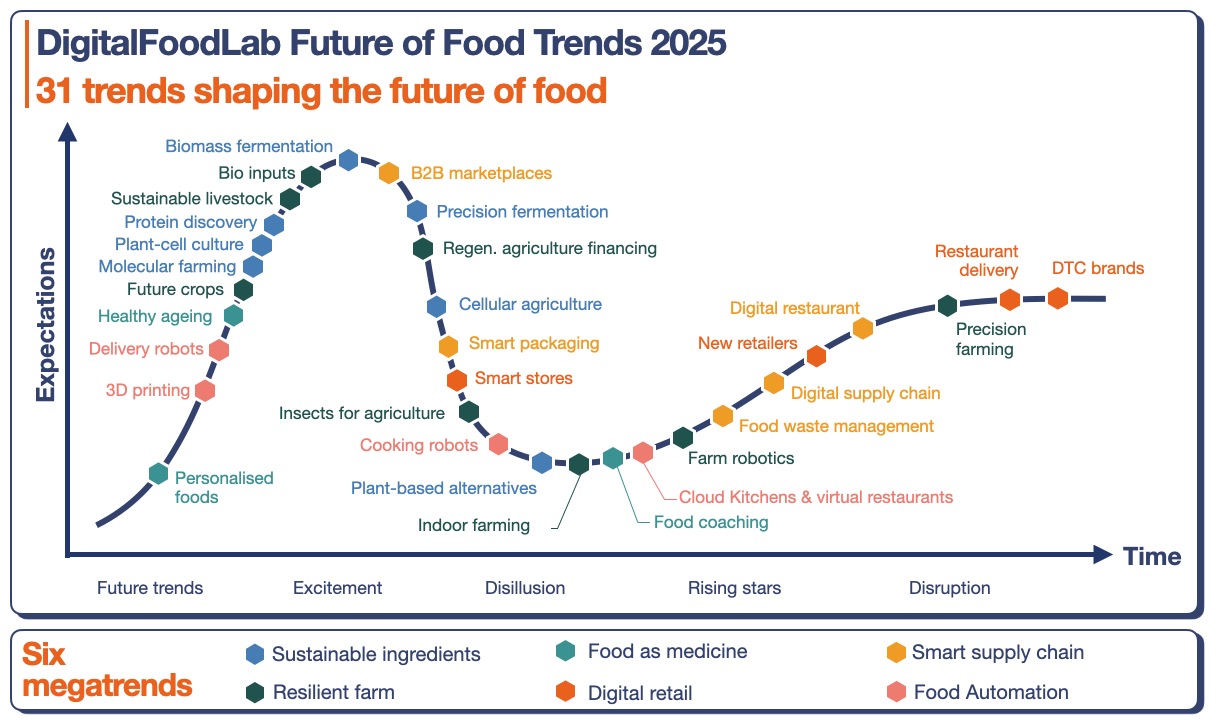
How things have evolved in a year?

Compared to last year’s edition, there are a few points to underline:

  1. The evolution is less dramatic than it previously. This is a visible consequence of investors’ current lack of appetite (and somewhat of large companies) to invest in long-term and unproven trends.
  2. We added some trends such as plant-cell culture (here is an insight on the topic), sustainable livestock, and regenerative agriculture financing. This is a really positive sign, showing that even in a complicated funding environment, new hypes emerging.
  3. We also removed some trends, such as reusable packaging (removed as the innovation ecosystem has all but vanished), and updated others to better reflect their evolution.

Beyond these technical points, I’d like to point out two reasons for hope. First, a significant number of trends are emerging (on the right of the curve). Second, there is a growing pipeline of “future trends” that are gathering steam and showing a strong push for disruptive innovation.

How do we evaluate and position trends?

A trend is the combination of an ecosystem of startups, a set of technologies or new business models, and B2B or B2C needs. It generally follows the pattern below from discovery (1), excitement (2), reality check (3) when the technology or the business model associated reveals its limitation, emergence (4), and disruption (5) when it becomes mature.
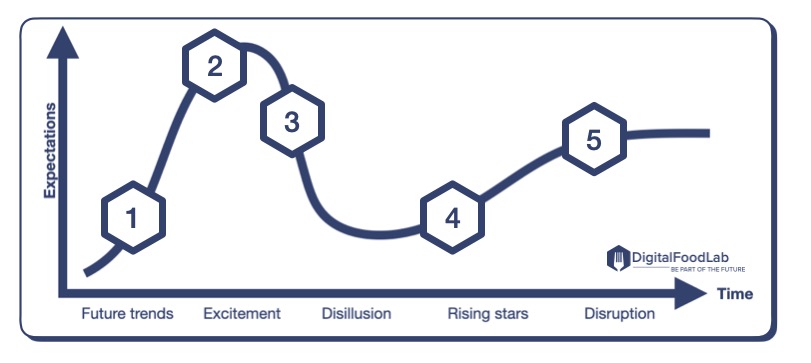
To position trends, beyond DigitalFoodLab’s team expertise, and our discussions with entrepreneurs, investors, and large companies, we rank trends on four criteria:

  • Strength of the ecosystem and its evolution: how much money is going into how many startups, and how is it evolving?
  • Corporate involvement through partnerships, internal development, product launches…
  • Tech maturity
  • Market & regulatory readiness, including the « market pull » (is there an actual demand?)

When will it be on your plate?

The position on the curve is not really predictive of if and when a trend will mature. Below are our estimations (to be read as an average between the minimum and the maximum time each trend could take to reach maturity). This report provides a global outlook; in different geographies, many trends wouldn’t be in the same position.
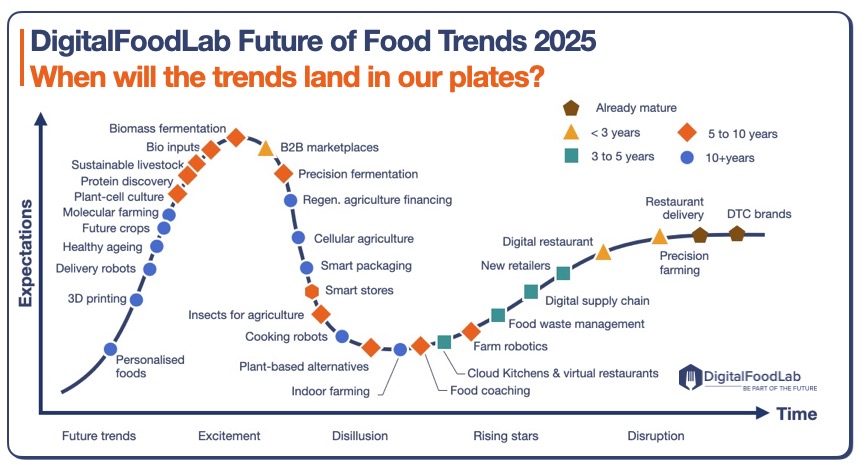
I want to point out that it is still an estimation based on current market trends and technologies that evolve pretty fast. The aim here is to provide an insight into what to expect for the future of food and how to plan for it.

Get your own trend curve

The report provides a general overview of the main trends shaping the future of the agrifood value chain at a global level. However, a single technology can have multiple applications with various maturity levels (such as precision fermentation for sweeteners vs. dairy alternatives), and some trends are more advanced in specific geographies than others.

If you want to use this information to map your company’s innovation ecosystem and then make strategic decisions on where to focus your innovation efforts, we highly recommend that you take the time to create an industry and geographic-specific view (and give us a call to do it!).

You're in a good company

Join the 60+ clients of Digital FoodLab: leading agrifood companies, retailers, banks, investors, startups, and public organisations.

Use case: project for a global F&B company looking to map its AgTech innovation ecosystem and the best startups to partner with

What we did:

  • Mapping of the AgTech ecosystem: startups, research regulators, and other leading companies.
  • Discussion to select areas to focus on.
  • Analysis of the information to reveal the trends and a model to analyse eventual partners.
  • A workshop to validate the opportunities based on our recommendations.
  • Scouting of relevant partners followed by introductions.

Results:

  • Mapping the different categories of innovations in AgTech that should be considered now to create long-term benefits for the business.
  • Identification of key partners (an incubator and a couple of startups).

Use case: project for a CPG company on the healthy ageing ecosystem

What we did:

  • Education of the board through a couple of workshops to define the perimeter
  • Identification of key opportunities and threats created by long-term evolutions (technologies, business models, behavioural changes).
  • Deep dives on each of the priority categories.
  • Co-construction of a vision on how the company should address these challenges.
  • Identification of partners (startups, incubators, funds) to move forward.

Results:

  • Creating a consensus on which categories to prioritise and how to address them.
  • Implementation of an open innovation strategy through the development of partnerships.

Use case: project for a global CPG company to develop a strategy on the healthy ageing ecosystem

What we do (ongoing mission on a subscription model):

  • Kick-off where we present an overview of the AgriFoodTech ecosystem to select with the client the categories to cover and for each, the level of information required.
  • Monthly newsletter: each month we send a newsletter with the articles that we have gathered ranked by relevance, their summaries, and a layer of analysis.
  • Database: we set up a personalised database that will be filled month after month with the information gathered on the companies identified for the watch.
  • Workshops: twice a year with the client’s innovation team and other “innovation curious” team members, we present an overview of the evolutions, key trends and a dashboard of the topics followed by the watch.

Results:

  • A clear, regular and evolutive tool to follow what is happening in terms of innovation on key topics.
  • A forum (through the workshops) to discuss innovation trends and new opportunities.

Use case: opportunity screening for an ingredient company

What we did:

  • Kick-off to define the perimeter of the ecosystem studied.
  • Mapping of the different trends shaping the innovation ecosystem of the client.
  • Analysis of the trends on DigitalFoodLab’s trend curve and other relevant frameworks.
  • Workshop to discuss DigitalFoodLab’s recommendations on key trends to prioritise

Results:

  • Shared view of the innovation ecosystem for the client with a view of the trends to prioritize.
  • Clear document (personalised trend curve) that can be easily shared internaly to explain the company’s innovation choices and which can be then updated each year.

Use case: scouting for an agriculture coop

What we did:

  • Kick-off to define the perimeter of the client, the goals of the scouting (partnerships) and the criteria on which startups should be evaluated.
  • Set-up scouting: we selected the first batch of 20+ key startups following the criteria of the client.
  • On-going scouting: then we set up a quarterly scouting of about ten startups.
  • For each scouted startup, we created an ID card with key information such as the business and technological maturity, funding, and corporate partnerships. We also added an explanation of why we selected this startup.

Results:

  • An ongoing and evolutive scouting are matching the client's criteria and its capabilities in terms of deal flow.

Use case: working on an acquisition process for a CPG company

What we did:

  • Kick-off to define what the client is seeking, notably in terms of maturity.
  • Workshop with the client based on a mapping of the different innovation ecosystems adjacent to its activities to select some priorities and discuss inspiring examples of startup acquisition stories.
  • Identification of 20+ targets.
  • Workshop to select the most relevant to engage with.
  • DigitalFoodLab worked as a sparing partner during the acquisition process, notably to help design how the acquired startup could be integrated into the overall company’s strategy.

Results:

  • Different results from traditional M&A processes with a focus on the client’s innovation strategy.
  • Identification of a good match for an acquisition.

Use case: market due diligence on sugar alternatives

What we did:

  • Kick-off with the client to discuss its interest on this category, its expectations and existing level of information (notably on the target company).
  • Mapping of the ecosystem to analyse the different existing alternatives and technologies to compare them.
  • Interview (calls) with relevant startups made by our internal biotechnology expert.
  • Recommendation on whether to invest or not.

Results:

  • Clear view of the ecosystem and of the reasons to believe (or not) in each sub-category.
  • Enforceable recommendations based on facts and expertise.