🐄 ☁ Methane reduction, the new holy grail?

Published on October 9, 2024

When asked, “What is exciting in FoodTech right now?” I always have the same answer: Healthy ageing and emission reduction. As we have discussed the former topic recently, let’s focus on emissions. It can be separated into multiple issues, ranging from financing regenerative practices (notably through carbon credits) to bioinputs. However, today, I’d like to focus on something that may look niche but is growing fast: enteric methane emissions.

What is methane, and why should we care about it?

Methane was almost absent from the climate discussion until the last couple of COP summits, where it became central. Indeed, Methane (CH₄) is much more potent (25 times more over 100 years) than CO₂ regarding warming potential. The good news is that its effects decrease over time in only 12 years. The bad news is that methane is already responsible for about 20% of global warming emissions and is still rising.

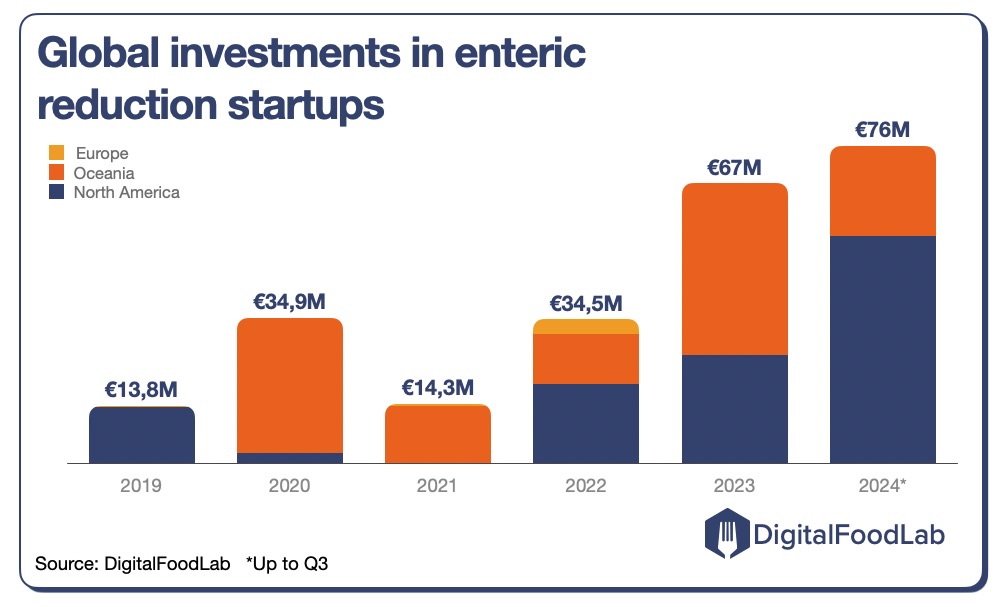
This short lifespan makes methane an obvious target for achieving climate goals, which has led to a flurry of innovation and investments.

How is methane linked to food?

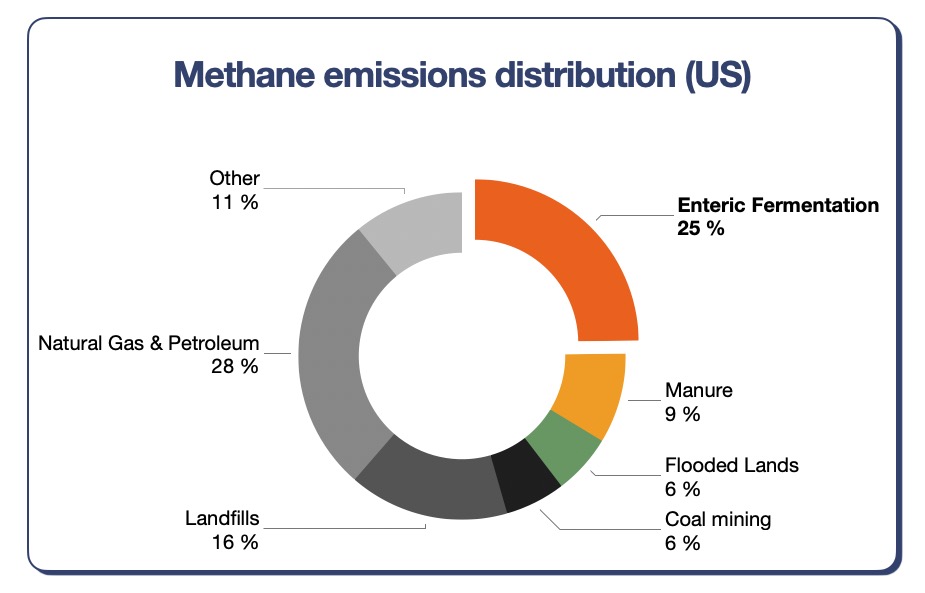
Food is directly responsible for about 40% of methane emissions. It can vary widely depending on each country’s agriculture, but there are about three sources:

  1. our focus, enteric fermentation, which is basically ruminant (cows, sheep, goats…) emissions through burping
  2. manure
  3. flooded lands: notably in rice cultivation (much higher in South East Asia), a source of methane that is actually relatively easy to solve.

And among ruminants, the main source is obviously cows (due to the sheer number of them). The process is quite simple: naturally-occuring microbes decompose and ferment food, creating methane as a by-product.

How to reduce enteric emissions from cows?
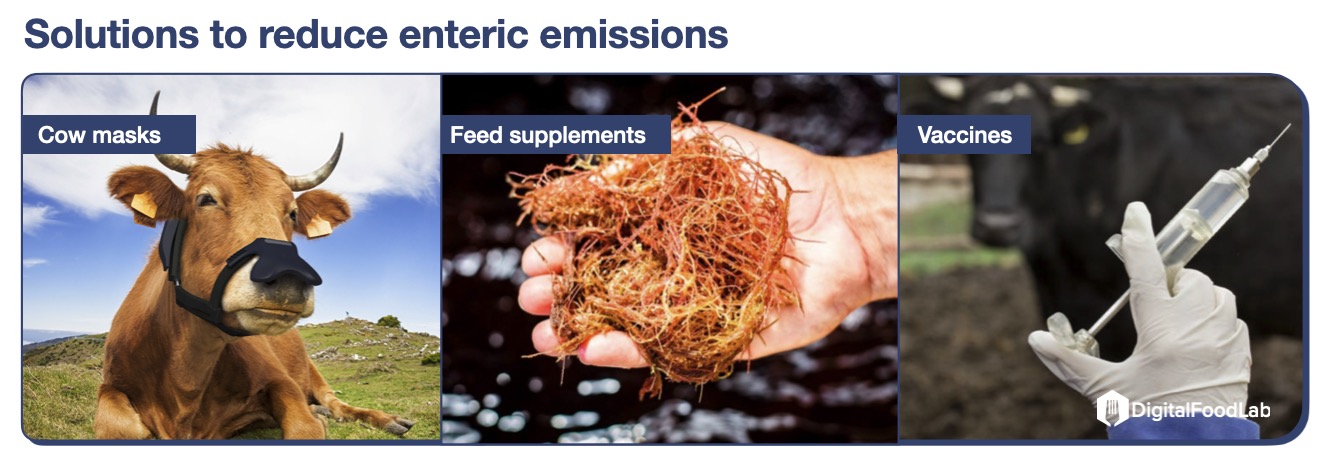
So, now that we better understand the challenge, what are the potential solutions? There are about three of them, with only two being at the core of this emerging ecosystem:

1 – Outlier solution: Putting masks to cows. This idea has been studied by a startup called Zelp (UK) with the help of Cargill, but is now mostly considered as too complicated, in terms of animal welfare, costs, and more efficiency. The idea was quite simple: capture methane from burping, and convert it into CO₂ through a chemical reaction.
2 – Feed supplements: this is where most of innovators are playing now.
Most of them are betting on red algae to create a supplement that acts on the cow’s microbiome and reduce entheric emissions. DSM has already a product on the market with a 30% reduction in methane. As these feed supplements are receiving regulatory approval in many countries, multiple startups  have raised significant funding to develop new, more potent solutions.

3 – Vaccines and cow gut microbiome modification: instead of feed supplements that have to be added to cows’ diets for all their lives, vaccines could be a one-off solution. The goal is to be able with a single shot to modify the cow’s microbiome and to cut enteric emissions. This space is also moving really fast, with some startups, such as Lucidome Bio ($13.5M raised in the past month) or ArkeaBio, which has raised $38.5M and says it plans to launch commercially by 2027.
 

What’s next for methane reduction?

What’s the most exciting about all these innovations, is how quick they have emerged from labs to experiments, and hopefully soon to commercial-scale products. However, they do come with some challenges, notably:

1 – regulation, which is part linked to the need of health impact studies (on the health of animals and humans). Basically, we need to have a good assesment of the benefits before rolling out these solutions.

2 – cost: who will pay? That’s always the question with emission reduction, but here it is a particularly touchy topic as dairy farmers margins are already tight (and consumers don’t seem particularly keep to pay a green premium). Public incentives, more or less linked to some sort of a carbon tax on cows could be required.

3 – the danger of inaction: as we wait for these solutions, there is a temptation to think that these technologies will enable us to “change nothing”. Most of them have not yet been proven at scale, so we should also pursue other solutions, such as alternatives to dairy & meet products.

Now, as explained in the introduction, this is only a part of a much larger picture for emission reduction. Taking all these new technologies and innovation ecosystems from enteric emission reduction to bioinputs into account is a necessity for any agrifood company serious on its climate goals and pledges.
This requires first an understanding of all the innovations in this space (what is happening and it is relevant for us?), a commitment to move forward (with the required means), and then a strategy on how to act on each of them (which to ignore, which to prioritise, and then with which tools, from investment to partnership).

You're in a good company

Join the 60+ clients of Digital FoodLab: leading agrifood companies, retailers, banks, investors, startups, and public organisations.

Use case: project for a global F&B company looking to map its AgTech innovation ecosystem and the best startups to partner with

What we did:

  • Mapping of the AgTech ecosystem: startups, research regulators, and other leading companies.
  • Discussion to select areas to focus on.
  • Analysis of the information to reveal the trends and a model to analyse eventual partners.
  • A workshop to validate the opportunities based on our recommendations.
  • Scouting of relevant partners followed by introductions.

Results:

  • Mapping the different categories of innovations in AgTech that should be considered now to create long-term benefits for the business.
  • Identification of key partners (an incubator and a couple of startups).

Use case: project for a CPG company on the healthy ageing ecosystem

What we did:

  • Education of the board through a couple of workshops to define the perimeter
  • Identification of key opportunities and threats created by long-term evolutions (technologies, business models, behavioural changes).
  • Deep dives on each of the priority categories.
  • Co-construction of a vision on how the company should address these challenges.
  • Identification of partners (startups, incubators, funds) to move forward.

Results:

  • Creating a consensus on which categories to prioritise and how to address them.
  • Implementation of an open innovation strategy through the development of partnerships.

Use case: project for a global CPG company to develop a strategy on the healthy ageing ecosystem

What we do (ongoing mission on a subscription model):

  • Kick-off where we present an overview of the AgriFoodTech ecosystem to select with the client the categories to cover and for each, the level of information required.
  • Monthly newsletter: each month we send a newsletter with the articles that we have gathered ranked by relevance, their summaries, and a layer of analysis.
  • Database: we set up a personalised database that will be filled month after month with the information gathered on the companies identified for the watch.
  • Workshops: twice a year with the client’s innovation team and other “innovation curious” team members, we present an overview of the evolutions, key trends and a dashboard of the topics followed by the watch.

Results:

  • A clear, regular and evolutive tool to follow what is happening in terms of innovation on key topics.
  • A forum (through the workshops) to discuss innovation trends and new opportunities.

Use case: opportunity screening for an ingredient company

What we did:

  • Kick-off to define the perimeter of the ecosystem studied.
  • Mapping of the different trends shaping the innovation ecosystem of the client.
  • Analysis of the trends on DigitalFoodLab’s trend curve and other relevant frameworks.
  • Workshop to discuss DigitalFoodLab’s recommendations on key trends to prioritise

Results:

  • Shared view of the innovation ecosystem for the client with a view of the trends to prioritize.
  • Clear document (personalised trend curve) that can be easily shared internaly to explain the company’s innovation choices and which can be then updated each year.

Use case: scouting for an agriculture coop

What we did:

  • Kick-off to define the perimeter of the client, the goals of the scouting (partnerships) and the criteria on which startups should be evaluated.
  • Set-up scouting: we selected the first batch of 20+ key startups following the criteria of the client.
  • On-going scouting: then we set up a quarterly scouting of about ten startups.
  • For each scouted startup, we created an ID card with key information such as the business and technological maturity, funding, and corporate partnerships. We also added an explanation of why we selected this startup.

Results:

  • An ongoing and evolutive scouting are matching the client's criteria and its capabilities in terms of deal flow.

Use case: working on an acquisition process for a CPG company

What we did:

  • Kick-off to define what the client is seeking, notably in terms of maturity.
  • Workshop with the client based on a mapping of the different innovation ecosystems adjacent to its activities to select some priorities and discuss inspiring examples of startup acquisition stories.
  • Identification of 20+ targets.
  • Workshop to select the most relevant to engage with.
  • DigitalFoodLab worked as a sparing partner during the acquisition process, notably to help design how the acquired startup could be integrated into the overall company’s strategy.

Results:

  • Different results from traditional M&A processes with a focus on the client’s innovation strategy.
  • Identification of a good match for an acquisition.

Use case: market due diligence on sugar alternatives

What we did:

  • Kick-off with the client to discuss its interest on this category, its expectations and existing level of information (notably on the target company).
  • Mapping of the ecosystem to analyse the different existing alternatives and technologies to compare them.
  • Interview (calls) with relevant startups made by our internal biotechnology expert.
  • Recommendation on whether to invest or not.

Results:

  • Clear view of the ecosystem and of the reasons to believe (or not) in each sub-category.
  • Enforceable recommendations based on facts and expertise.